
24 November 2026
Compare live raffles →
Golf gear competitions in the UK are online prize draws and skill competitions where you pay a small entry price, or use a free route, for a chance to win clubs, bags, trolleys, launch monitors or a golf trip. The best ones to enter are not the ones with the shiniest driver on the banner. They are the ones where the ticket price is low against the prize value, where the number of tickets is capped and fewer remain unsold, and where a free entry route is clearly shown. We built Raffle Genius to put those numbers side by side, with live odds updated every 10 minutes, so you can see which golf prize gives you the strongest chance for your money.
TL;DR
- Compare ticket price against prize value and the ticket cap, not the prize photo. A cheap ticket on a capped draw with many tickets still unsold usually means better odds.
- Every paid chance-based draw in the UK needs a genuine free entry route, or it needs to rely on a real skill test. Look for it before you pay.
- The Voluntary Code of Good Practice asks operators to cap credit card spending at £250 per month and to show maximum ticket numbers. Use both as a quick trust check.
- Set a monthly budget first. Treat a ticket as the price of a bit of fun, not an investment.
- Our UK raffle comparison lists live odds, ticket prices, prize values and closing times in one place.
Table of Contents
- What counts as a golf gear competition
- How to compare golf competitions on the numbers that matter
- A quick table to score a golf draw
- Free entry: how it works and how to find it
- Checking a golf competition is trustworthy
- Raffle, prize draw or skill competition: why the label matters
- Budgeting and playing responsibly
- What happens if you win
- Promo: compare golf prizes in one place
- Our view
- FAQ
- Sources
What counts as a golf gear competition
The phrase covers several formats, and knowing which one you are looking at tells you how to judge it.
- Prize draws and raffles. You buy a ticket or entry, and the winner is picked at random. A typical golf prize is a set of irons, a driver, a premium bag or a bundle of kit. Odds depend on how many tickets exist and how many have been sold.
- Instant wins. You find out straight away whether an entry has won. These are a different kind of product, and the Voluntary Code says operators should not accept credit cards for them. We list them on our instant win competitions page.
- Skill competitions. You answer a question or complete a task, and the best entry wins. The Gambling Commission says a genuine prize competition needs a skill, judgement or knowledge element that would put off a significant share of people or stop a significant share from winning. Easy multiple-choice questions rarely meet that test.
- Free giveaways. Brands, clubs and magazines sometimes give away a golf product for no payment at all. These cost nothing but are usually open to everyone, so the number of entrants can be very large.
If you want the legal background in plain English, our guides on the two legal tests for prize draws and on whether prize competitions count as gambling explain why the format matters.
How to compare golf competitions on the numbers that matter
Golf prizes range from a single wedge to a full bag and a trip. A bigger prize is not automatically a better deal, so we compare four numbers.
1. Ticket price against prize value
Divide the stated prize value by the ticket cap. That gives you the value each ticket is chasing. Then compare it with the ticket price.
Worked example, with made-up round numbers to show the method: a golf club set worth £1,500 with 1,000 tickets at £2 each. The operator could take £2,000 if every ticket sold, which is more than the prize is worth, so the ticket price is high against the prize. A second draw offers the same £1,500 set with 600 tickets at £1.50. Selling out brings in £900, and each ticket buys a share of the prize that is much larger. Your chance per ticket is also higher, at one in 600 against one in 1,000.

The real figures change from draw to draw, which is why we show them live rather than quoting them in an article.
2. The ticket cap
The cap is the maximum number of tickets the operator will sell. It sets the worst-case odds. The Voluntary Code says operators should give information about the likelihood of winning, such as maximum ticket numbers. A draw that hides its cap makes comparison impossible, so treat a missing cap as a reason to look elsewhere. Our guide to entry limits and the CAP Code explains why promoters are expected to disclose them.
3. How many tickets are still unsold
This is the part most people miss. If a draw has 1,000 tickets and only 300 have sold, a single ticket currently stands against far fewer rivals than the cap suggests. Fewer tickets sold means better odds for the people already in, and it means a new ticket buys a bigger share of the chance. Our undersold competitions page ranks draws by exactly this, so golf prizes with a lot of tickets left rise to the top.
Two cautions that help you use this well. Odds improve only if the draw happens with those tickets, so check the closing time and what the operator says happens if the draw does not sell out. And the figure changes as people buy, which is why a number that is 10 minutes old is more useful than one from this morning.
4. Closing time
Golf draws often cluster before the weekend or around major tournaments. A draw closing in an hour has less time to sell, which can mean thinner odds for you, but also less time to change. Note the closing time before you pay, and remember that a free postal entry needs time to arrive.
A quick table to score a golf draw
| What to check | Good sign | Warning sign |
|---|---|---|
| Ticket cap | Clearly stated before you pay | No maximum mentioned anywhere |
| Tickets sold | A low share sold with time still left | Nearly sold out, so your ticket gains little |
| Ticket price vs prize value | Cap multiplied by price is well below the prize value | Cap multiplied by price is far above it |
| Free entry route | Shown next to the paid route with equal prominence | Buried in terms or missing |
| Draw method | Independent person or auditable random process | Vague “we pick a winner” wording |
| Previous winners | Named or shown with proof | None shown after many draws |
Best odds, straight to your inbox
Once a week, Fridays at 10:00 UK time, with varied best-odds competitions ending within 48 hours. No spam, unsubscribe any time. 18+
Stay signed up for a chance to win £50 every month. One random winner drawn from all subscribers.
No purchase necessary. Free entry.
Free entry: how it works and how to find it
If you want to win golf gear without spending, this is the section that matters most.
A paid chance-based draw is a lottery in law unless it offers a free route or relies on skill. The Gambling Commission says the free route must be by ordinary first or second class post, or another method at the normal rate, no more expensive or less convenient than the paid route, promoted equally, and treated identically when prizes are allocated. The ASA adds that normal-rate options include ordinary post, a standard phone call or minimum-cost email or SMS, and that the free route should be advertised as prominently as the paid one.
In practice that means:
- Find the free entry wording on the competition page, usually in the terms.
- Follow it exactly: the postcard format, address, the competition name, your details and the closing date.
- Send it early. The Voluntary Code says operators should allow enough time for free postal entries to arrive, but a late postcard is still a lost one.
- Keep a note of what you sent and when.
A free entry has the same chance as a paid one, so a golf draw with few entries and a clear free route can be the best value of all. Our step-by-step guide to entering UK competitions free covers postcards and normal-rate email in detail, and Raffle Genius always highlights free-entry routes in its listings.
A Play to Earn feature is also on its way to Raffle Genius: you will play games to earn raffle tickets and enter for a chance at cash prizes. That gives students, mobile gamers and anyone on a tight budget another no-spend way in alongside the competition listings.
Checking a golf competition is trustworthy
Golf is an expensive hobby, and that makes a premium driver a popular lure. A few checks take two minutes.
Who is the operator? Look for a company name, a UK contact route and terms that name the promoter. Our listings verify operators and show trust ratings alongside user reviews, so you can see how other entrants rate the experience before you click through.
Is the prize real and specific? A good page names the brand, model, condition and value of the gear. “A set of golf clubs” without detail is not enough. If a prize is a golf holiday, check what is included and whether dates are fixed.
How is the winner picked? The Voluntary Code says operators should award prizes fairly using an independent person or a verifiably random and auditable computer process. Look for a statement that matches this, ideally with a live or recorded draw.
Is it for adults only? The same code asks operators to restrict prize draws to people aged 18 or over. If you are younger, our raffle age limit guide explains where the lines fall.
Is it genuinely UK-based? Our guide to spotting lawful UK-only competitions shows what to look for in the terms.
Are winners shown? After the closing date, a trustworthy operator publishes the result or contacts winners promptly. If a golf draw has run repeatedly and you never see a winner, treat that as information.

Raffle, prize draw or skill competition: why the label matters
Operators use the words loosely, and a golf draw might be called a raffle, a prize draw or a competition on the same page. What matters is how the entry works. If your result is down to chance, there should be a free route. If it is down to skill, the test should be hard enough to count. Our prize draw vs raffle checklist walks through five quick checks, and it takes less time than reading the terms in full.
Budgeting and playing responsibly
A golf competition ticket is cheap, and that is exactly why spending can drift. Decide a monthly amount before you open any listing and stick to it.
The Voluntary Code gives a useful benchmark for how seriously the sector is being asked to treat this. It says operators should limit credit card payments to £250 per month per player, offer monthly spend limits, allow account suspension for at least six months and show free entry options clearly before purchase. The code is voluntary, so an operator that offers these tools is signalling that it takes the issue seriously. Use them. Our guide to safe play, the £250 cap and live odds sets out the habits that work.
Some simple rules:
- Set a monthly limit and treat it as spent once it is gone.
- Pay with a debit card or another method you control, not credit.
- Do not chase a draw you missed by buying more tickets in the next one.
- If entering stops being fun, use the operator’s spend limit or suspension tools and speak to a support service such as GamCare.
What happens if you win
A golf set or a trip is a prize, not income in the usual sense, but money prizes and the way you came by them can raise questions. Our competition winnings tax guide for 2026 to 2027 has worked examples, and it is worth reading before you plan to sell a prize on.
Promo: compare golf prizes in one place
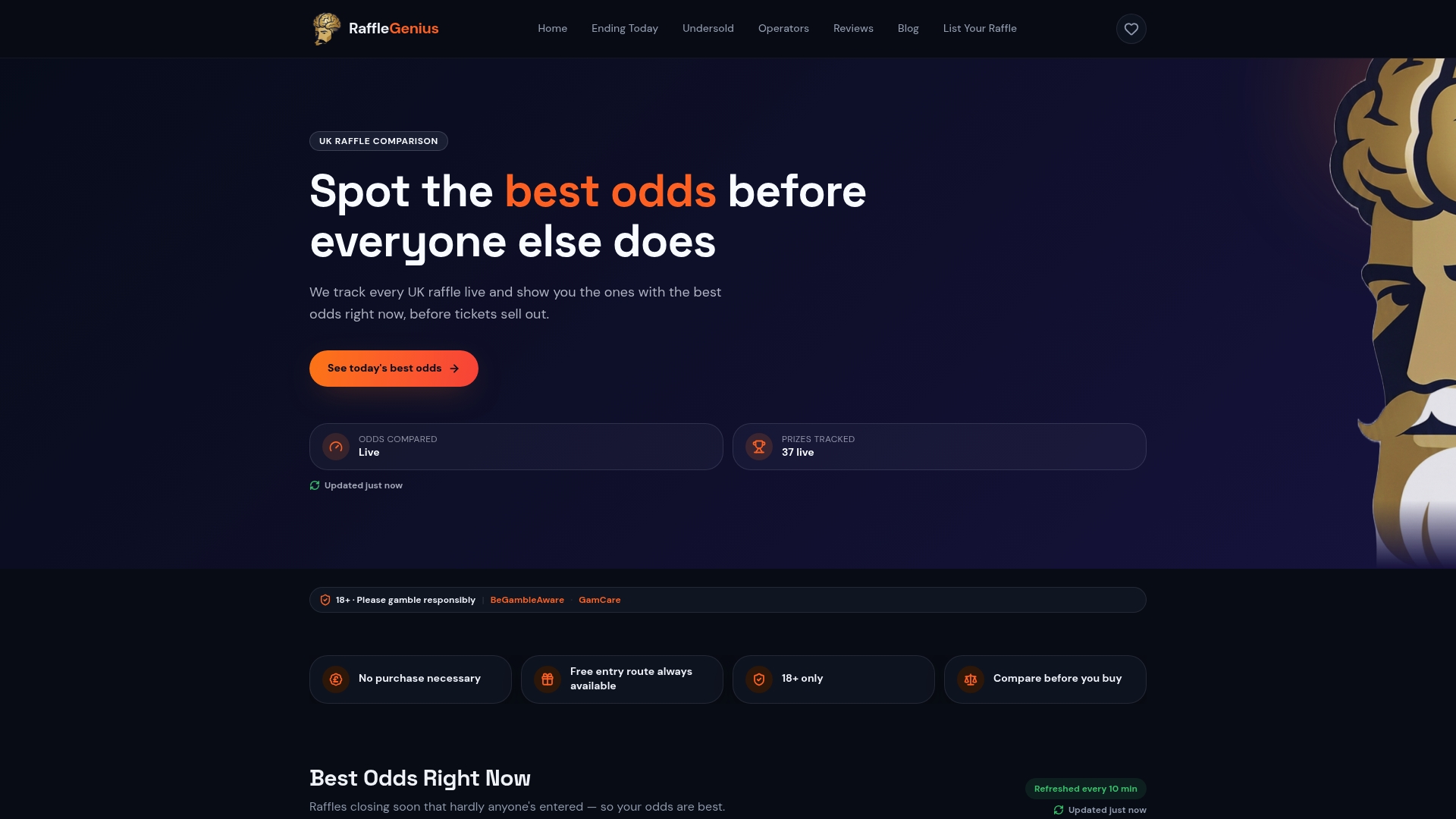
Browsing operator by operator is slow, and the numbers move. On Raffle Genius you can compare UK raffles and prize competitions by live odds, ticket price, prize value and closing time, with odds refreshed every 10 minutes. Operators are verified, free-entry routes are highlighted, and the weekly newsletter sends alerts so you do not have to keep checking. If you would rather browse without adverts, you can go ad-free for £4 per month.
If you run a competition yourself and want it in front of entrants who compare odds, you can get your raffle listed.
Our view
Most people choose a golf competition by the prize photo. We would rather you chose it by the arithmetic.
The prize value, the ticket price, the cap and the number of tickets left tell you far more than a glossy driver does. A draw with many tickets still unsold gives each ticket a better chance, and that is why we update odds every 10 minutes and surface undersold competitions.
We also think a free entry route should never be hard to find. We always highlight it, because it is part of what makes a competition fair and because it lets students and budget-conscious players take part too.
Pick the draw, set your limit, and enjoy the chance of walking off with a new set of clubs.
matt
FAQ
How do I enter golf competitions in the UK?
Find a live golf draw, check the prize, the ticket cap and the closing time, then either buy a ticket or use the free entry route described in the terms. You must be 18 or over for paid prize draws under the Voluntary Code. Our comparison page lists live golf and other prizes in one place.
How can I tell which golf competition has the best odds?
Look at the cap and at how many tickets remain unsold. A lower cap, a low share sold and a low ticket price compared with the prize value generally mean better odds. We show these figures live and refresh them every 10 minutes.
Is it free to win golf clubs?
It can be. Paid chance-based draws must offer a free route, usually by post at the normal rate, and it carries the same chance as a paid entry. Free giveaways from brands and clubs also exist, though they often attract many entrants.
How do I know a golf draw is genuine?
Check for a named operator, a stated cap, a clear free route and a fair draw method such as an independent person or an auditable random process. Operator verification, trust ratings and user reviews on Raffle Genius help you spot the draws worth entering.
Sources
- Voluntary Code of Good Practice for Prize Draw Operators, GOV.UK
- Free draws and prize competitions, Gambling Commission (licensees and businesses)
- Free draws and prize competitions, Gambling Commission (public and players)
- Promotional marketing: Free entry routes, ASA
Recommended
18+ · Please gamble responsibly. Raffle Genius is a comparison service and does not run competitions.
Best odds, straight to your inbox
Once a week, Fridays at 10:00 UK time, with varied best-odds competitions ending within 48 hours. No spam, unsubscribe any time. 18+
Stay signed up for a chance to win £50 every month. One random winner drawn from all subscribers.
No purchase necessary. Free entry.