
11 September 2026

Spot Lawful UK Only Competitions: Free Entry, Skill Tests, Live Odds
A UK-only competition is lawful for residents provided it offers a genuine free entry route or is genuinely skill-based. That single distinction, drawn from the Gambling Act 2005, separates legitimate prize draws from illegal lotteries. Before entering anything, check three things: the promoter’s company details, how visible the free entry route is, and whether ticket counts and odds are published.
TL;DR:
- Most UK competitions are legal if they offer a genuinely free entry route or are skill-based, but verifying the promoter’s company, free entry visibility, and published odds is essential.
- Operators must structure promotions correctly under the Gambling Act 2005, using either free draws with free entry options or skill-based contests, or they risk operating illegal lotteries.
- Screening for red flags on social media, such as vague terms or payment requests outside card processing, helps identify potentially unlawful or risky competitions.
- Comparing chances involves dividing the total tickets into one to estimate the win probability, then weighing that against the prize value and ticket cap to find better-value competitions.
- Always pay with a card to retain dispute rights, screenshot your entry details, and review terms thoroughly before participating in any competition.
Table of Contents
- What counts legally: free draws, skill-based competitions and lotteries
- Legal checklist to screen any UK-only competition quickly
- Red flags: spotting risky or illegal competitions on social media
- How to read odds and choose better-value UK-only competitions
- Step-by-step: entering a UK-only competition without exposing yourself to fraud or privacy risk
- How Rafflegenius uses live odds and transparency to help UK entrants
- Why most advice on this topic misses the point
- Where to find UK-only competitions worth entering
- Sources
- FAQ
What counts legally: free draws, skill-based competitions and lotteries
The Gambling Act 2005 gives operators two lawful routes to run a paid promotion without a lottery licence. A free draw relies on Schedule 2 and Section 339, which requires a genuinely free way to enter alongside the paid option. A prize competition relies on Section 14, which requires a task involving real skill, judgement, or knowledge. Get either wrong and the promotion becomes an unlicensed lottery.
That matters because the Gambling Commission does not license or approve individual prize competitions. There is no badge of official approval to look for. Operators either structure their promotion correctly under the free draw or skill test, or they are running something unlawful, whatever their marketing implies.
The practical tests look like this:
- Free draw route: a postal or free digital entry that costs nothing beyond a stamp, promoted as prominently as the paid option.
- Skill test route: a question genuinely capable of deterring a material proportion of entrants, not a tie breaker or trivial arithmetic.
- Neither present: the promotion is very likely operating as an illegal lottery, regardless of how professional the website looks.
Most reputable UK operators build free draws around the first route because a properly designed skill question is harder to defend if challenged.
Legal checklist to screen any UK-only competition quickly
Run through this before you type in a card number.
- Search Companies House for the promoter’s registration number. A verifiable UK company registration is the baseline signal of a real business behind the competition.
- Find the free entry route and check it sits as close to the paid entry as possible, not buried three pages deep.
- Read the full terms and conditions, specifically the draw date, how the winner is selected, and the exact prize specification.
- Look for published ticket information, which show the operator is comfortable with scrutiny.
- Check for an auditable draw method, such as a random number generator certificate or an independent adjudicator overseeing the pick.
Pro Tip: Screenshot the competition page and terms and conditions the moment you enter. If a dispute arises later, that timestamped record is worth more than your memory of what the site said.
Operators that clear all five points are rare enough that when you find one, it’s worth returning to. The DCMS voluntary code sets exactly this bar as best practice, even though following it isn’t mandatory.
Red flags: spotting risky or illegal competitions on social media
Gambling Commission research into online, individual-led raffles found many promoted through social media may be operating illegally, and that entrants generally have low awareness of what makes a draw lawful. People tend to trust visible winners and social proof rather than checking licensing or legal structure, which is exactly the gap bad actors exploit.
Watch for these patterns:
- Terms and conditions that are vague, missing, or only a few lines long.
- No company number anywhere on the page, or a number that doesn’t match the trading name.
- No public list of past winners, or winners announced without any verifiable detail.
- Artificial urgency: “last 10 tickets,” countdown timers that reset, or pressure to enter within minutes.
- Entry only through direct messages on Instagram or Facebook, with payment requested by bank transfer or cryptocurrency rather than a card processor.
If any of these appear, search the promoter on Companies House, check who processes payments, and see whether winners are published with real names or photos rather than initials. The Gambling Commission’s report is clear that the entrants themselves aren’t breaking the law; the risk sits with hosts running unlawful draws, but that’s little comfort if your money and data are already gone.
How to read odds and choose better-value UK-only competitions
Two competitions selling £2 tickets for a £30,000 car are not equal if one has sold 8,000 tickets and the other has sold 40,000. Divide the number of tickets into 1 to get your rough chance of winning, then weigh that against the prize value and entry cost. A 1-in-8,000 shot at £30,000 is meaningfully better value than a 1-in-40,000 shot at the same prize, even at identical ticket prices.
Practical steps for comparing value:
- Find the total ticket cap on the competition page before you buy.
- Divide prize value by total possible revenue (ticket price × cap) to estimate the operator’s margin.
- Watch for “undersold” competitions nearing their close date with tickets still unsold, which usually means genuinely better odds for late entrants.
- Cross-check the same prize type across two or three operators rather than assuming the first one you see is competitive.
Operators that publish ticket counts and use independent draw methods tend to attract fewer complaints, and disclosing odds isn’t a legal requirement, so its presence says something about how confident the operator is in its own numbers. This is precisely why a live-odds tracker earns its place in your routine: Rafflegenius refreshes odds data every 10 minutes across tracked competitions, which matters because ticket counts on undersold prizes can shift meaningfully within a single afternoon.
Step-by-step: entering a UK-only competition without exposing yourself to fraud or privacy risk
Follow this sequence every time, not just for competitions that feel risky; always use best betting sites for lucky numbers to ensure payment and processor safety.
- Pay by card, never by direct bank transfer or cryptocurrency, since card payments give you a dispute route your bank can act on.
- Screenshot the entry confirmation, the ticket numbers issued, and the terms and conditions as they appeared at the moment you entered.
- Review the marketing consent boxes before submitting and untick anything you don’t want, since some operators default to opt-in for third-party marketing.
- Limit the personal data you share to what the entry genuinely requires: name, contact details, and payment.
- Keep your proof of entry somewhere retrievable, such as a dedicated email folder, so you can act quickly if you’re contacted as a winner.
If a dispute over a prize ever reaches the Advertising Standards Authority or Action Fraud, that screenshot trail is what substantiates your claim.
How Rafflegenius uses live odds and transparency to help UK entrants
Rafflegenius exists because comparing dozens of UK competitions by hand is genuinely tedious, and stale odds data leads people to worse decisions than no data at all. The platform refreshes odds every 10 minutes and flags Undersold Competitions, where ticket sales are lagging relative to the closing date, often the best window for value.
The approach mirrors the checks this article recommends: it points readers toward operator transparency, published ticket counts, and visible winner histories rather than asking anyone to take a promoter’s word for it. Odds transparency isn’t a nice extra here; it’s the mechanism that lets an entrant actually compare like with like across dozens of live competitions in the time it takes to check one page manually.
Why most advice on this topic misses the point
Most guidance on UK-only competitions focuses entirely on legality, and that’s necessary but insufficient. Knowing a competition satisfies Section 339 or Section 14 tells you it won’t get shut down. It tells you nothing about whether it’s a sensible use of your money.
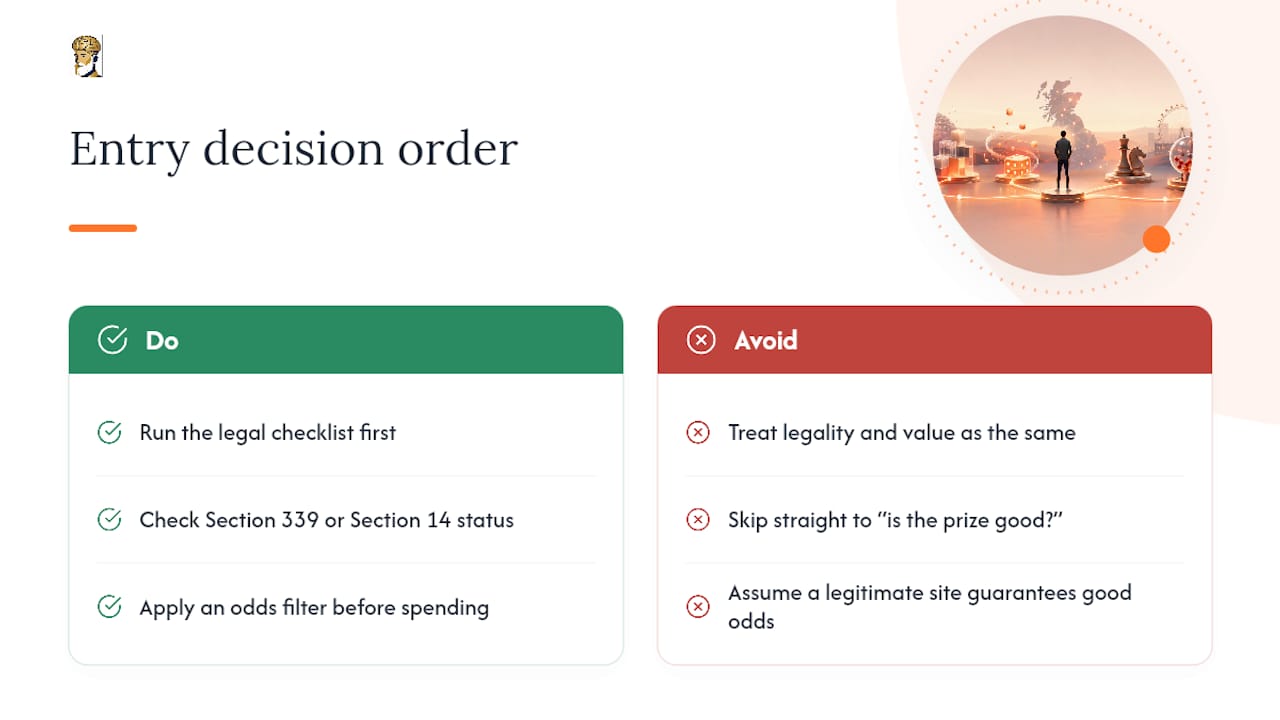
The gap in conventional advice is this: legality and value are treated as the same question, when they’re two separate filters that both need clearing. A perfectly lawful competition with 200,000 tickets sold against a £20,000 prize is legal and a poor bet. The Gambling Commission’s research on illegal individual-led raffles is valuable, but it addresses the wrong end of the decision for most entrants, who are far more likely to lose value to bad odds on a legitimate site than to fall for an outright scam.
My view: run the legal checklist first, always, because it filters out real risk to your money and data. Then, and only then, apply an odds filter before you spend anything. Skipping straight to “is the prize good?” is how people end up owning a tiny fraction of a chance in an oversold draw while believing they’ve done their homework.
— matt
Where to find UK-only competitions worth entering
Once you’ve run the legal checks and understand how odds work, the practical problem is speed: good value shifts hour by hour as tickets sell. This platform solves the comparison problem itself, tracking live odds, ticket prices, and closing times across UK-only competitions so you’re not refreshing a dozen operator pages by hand.

Start with Play to Win for currently live UK-only competitions, or head straight to the Undersold Competitions page if better odds matter more to you than any specific prize. If you’d rather build up entries gradually, Play to Earn lets you win free tickets through games instead of spending outright. For the legal checklist applied at scale, the Trusted Operators list shows which promoters meet the transparency criteria covered above.
This site earns commission when you click through to an operator and complete a purchase, which is disclosed here and doesn’t affect which competitions appear or how their odds are calculated.
Sources
For anything this article doesn’t fully resolve, go straight to the primary sources:
FAQ
Are UK-only competitions legal?
Yes, provided they offer a genuinely free entry route or require real skill to enter, satisfying Section 339 or Section 14 of the Gambling Act 2005.
How do I check if a competition operator is legitimate?
Search the promoter on Companies House, confirm published terms and conditions, and look for a public winners list with verifiable detail.
What’s the difference between a free draw and a skill-based prize competition?
A free draw needs a genuine free entry option alongside the paid one; a prize competition instead relies on a task requiring real skill or judgement, with no free route required.
How can I compare odds across different UK competitions?
Divide the total ticket cap into 1 for a rough chance of winning, then compare that against entry price and prize value; a tool like Rafflegenius tracks this across competitions automatically.
What should I do if a competition looks suspicious?
Check Companies House, review the payment method requested, and avoid any promotion asking for bank transfers or cryptocurrency, both common signs flagged in Gambling Commission research into illegal individual-led raffles.
Is disclosing ticket counts and odds a legal requirement?
No, publishing odds isn’t legally required, but operators who do it tend to attract fewer complaints and are generally easier to trust.
Recommended
18+ · Please gamble responsibly. Raffle Genius is a comparison service and does not run competitions.
Best odds, straight to your inbox
One email a week with the undersold UK competitions closing soon. No spam, unsubscribe any time. 18+