
2 September 2026

Enter UK competitions free, using a postcard or normal rate email
Yes, most UK prize competitions that charge for tickets must also offer a genuine free-entry route, and it has to carry the same odds as a paid entry. Check the operator’s Terms and Conditions for wording like “free entry” or “postal entry”, then follow those instructions exactly, including the reference number and any skill question. It costs no more than standard postage or a normal-rate email, and it must be treated identically to a paid ticket.
TL;DR:
- Operators must publish genuine free-entry routes with the same prominence and ease of access as paid tickets, including clear instructions and reference numbers.
- Valid free entries require submitting exact details via postcards, email, or SMS, at no cost beyond standard postage or normal network rates, and must arrive before the deadline.
- Common invalid entries include using premium-rate lines, paying for courier services, or submitting after the closing date, which invalidates the free route.
- A trustworthy operator provides identifiable company details, verifiable past winners, and consistent T&Cs that match advertised promises, avoiding vague or misleading information.
- A legitimate free entry guarantees the same odds as paid tickets, and keeping proof of postage and T&Cs is crucial to resolving disputes or reporting misconduct.
Table of Contents
- Where to find free-entry instructions on a competition page
- How to submit a valid free entry
- Costs, timelines and the legal principle behind free entries
- Verification checklist and red flags to spot
- How free entries affect your odds and building a smart strategy
- Why UK law requires a free-entry route at all
- Common no-purchase-necessary formats you’ll encounter
- How to check a competition is legitimate before you commit time to it
- Scams to watch for and how to sidestep them
- What rights you have as a free entrant
- What years of watching this market has taught me
- Compare UK raffles and spot free-entry routes faster
- Sources
Where to find free-entry instructions on a competition page
Free-entry instructions are almost never on the flashy prize page itself. Operators tuck them into the small print, which is deliberate but not sinister. It’s simply where the Gambling Commission’s guidance on free draws and prize competitions expects them to sit, as long as they’re genuinely accessible.
Look in three places, roughly in this order:
- The Terms and Conditions page, usually linked in the footer, often labelled “T&Cs”, “Rules” or “How to Enter”
- A dedicated free-entry or postal-entry page, sometimes separate from the general T&Cs on larger sites
- The competition footer itself, where some operators add a short “no purchase necessary” line with a link through to the full method
Once you find the clause, copy down the exact details it asks for. This typically includes the competition reference or slug (a short code identifying that specific draw), the operator’s registered postal address, your full name and contact details, and the answer to any qualifying question if the competition uses one. Miss the reference number and your entry may not be matched to the right draw at all.
Genuine operators must publish this route and give it comparable prominence to the paid entry option, not bury it three clicks deep. The ASA’s guidance on promotional marketing is clear that a free route hidden behind vague or misleading signposting fails the fairness test, regardless of whether the wording technically exists somewhere on the site.
How to submit a valid free entry
Once you’ve found the instructions, the process itself is simple. It just has to be followed to the letter.
- Write the required details clearly on a postcard or plain sheet of paper: your full name, address, date of birth if requested, the exact competition reference, and the answer to any skill question.
- Address it to the operator’s registered postal address, copied precisely from the T&Cs rather than a general contact address elsewhere on the site.
- Post it using standard first- or second-class stamps. This is the only cost you should incur, and it’s the correct cost under the Gambling Commission’s rules on free draws and prize competitions.
- Post it early enough that it can realistically arrive before the stated cut-off, allowing a few extra days for standard postal delivery.
- Check whether an electronic alternative exists. Many operators accept a “normal rate” email or SMS entry instead of, or alongside, the postal option, provided it costs no more than an ordinary message.
Pro Tip: Ask for a proof of postage certificate at the Post Office, it’s free for standard mail, and photograph your postcard before it leaves your hands. If the operator later claims it never arrived, you’ll have a timestamped record to challenge that.
Keep a simple log: the date posted, the competition name, and a screenshot of the T&Cs as they appeared that day. Operators do sometimes amend wording between draws, and a saved copy protects you if a dispute arises later.
Costs, timelines and the legal principle behind free entries
“Normal rate” has a specific meaning, and it’s worth knowing precisely where the line sits. Acceptable free-entry costs are: standard first- or second-class postage, a standard-rate email sent through your existing provider, or an SMS charged at your normal network rate. None of these should cost more than the equivalent action you’d take for any everyday letter or text.
What is not acceptable, according to the Gambling Commission, is any requirement to use Special Delivery, a courier, or a premium-rate phone line as the only free route. A free entry must be no more expensive and no less convenient than the paid ticket it stands alongside.
Processing windows vary by operator, but reputable competitions build in a buffer. The Gov states that operators should allow sufficient time for postal entries to be received before the draw closes, not just the advertised deadline.
Three things commonly invalidate a free entry:
- Missing or incorrect competition reference number
- Entry received after the stated closing date, even by a day
- Attempting to enter through a mechanism the T&Cs don’t actually list as valid, such as a premium-rate line
Verification checklist and red flags to spot
Before you spend a stamp, it’s worth thirty seconds checking whether the operator is one you can trust. A short checklist does most of the work:
- A Companies House number or clearly stated registered company name and postal address
- Full, specific T&Cs that spell out the free-entry method step by step, not a vague reference to “alternative entry available”
- A firm, published draw date, rather than “date to be confirmed” language that shifts repeatedly
- A list of past winners, ideally with some verifiable detail such as first name and county
Red flags tend to cluster together rather than appear alone. No postal option anywhere on the site, T&Cs that are missing entirely or read like a template with gaps, a draw date that keeps sliding, or no contact address at all are all signs to walk away. Our own checklist for spotting legitimate UK raffle sites covers this in more depth if you want a fuller reference before committing to any operator.
A promotion that requires consumers to use premium-rate channels to claim a prize, or that fails to promote its free route with the same prominence as the paid one, falls short of the standard promoters are expected to meet.
If something looks off and you’ve already lost money or time to it, both the Gambling Commission and the ASA accept public complaints, and both routes are free to use.
How free entries affect your odds and building a smart strategy
A properly submitted free entry goes into exactly the same draw, with exactly the same odds per entry, as someone who paid for a ticket. That’s the whole point of the rule; the Gambling Commission’s framework exists precisely so a free entrant isn’t quietly disadvantaged. One valid postal entry equals one paid ticket, no more and no less.
That equality opens a genuine strategy for cost-conscious entrants:
- Use the free-entry route wherever an operator offers one, especially for higher-value draws where a single entry still carries decent odds
- Keep your proof of postage and T&Cs screenshot every time, not just for the first competition you try
- Prioritise operators with transparent, specific T&Cs and a visible list of past winners over ones that are vague on both
- Track multiple competitions rather than fixating on one, since odds and closing times shift as ticket sales change
This is where a tracking tool earns its keep rather than being a nice extra. Comparing dozens of live competitions by hand, checking which ones actually publish free-entry instructions and which closing dates are approaching, isn’t a realistic use of anyone’s evening. Platforms exist to do that comparison continuously, refreshing odds regularly so the numbers you’re looking at reflect current ticket sales rather than a snapshot from three days ago.
Pro Tip: Set a personal rule to always check the T&Cs for a free-entry clause before buying a ticket, even for competitions you’ve entered before. Operators do revise their rules between draws, and last month’s method isn’t guaranteed to still apply.
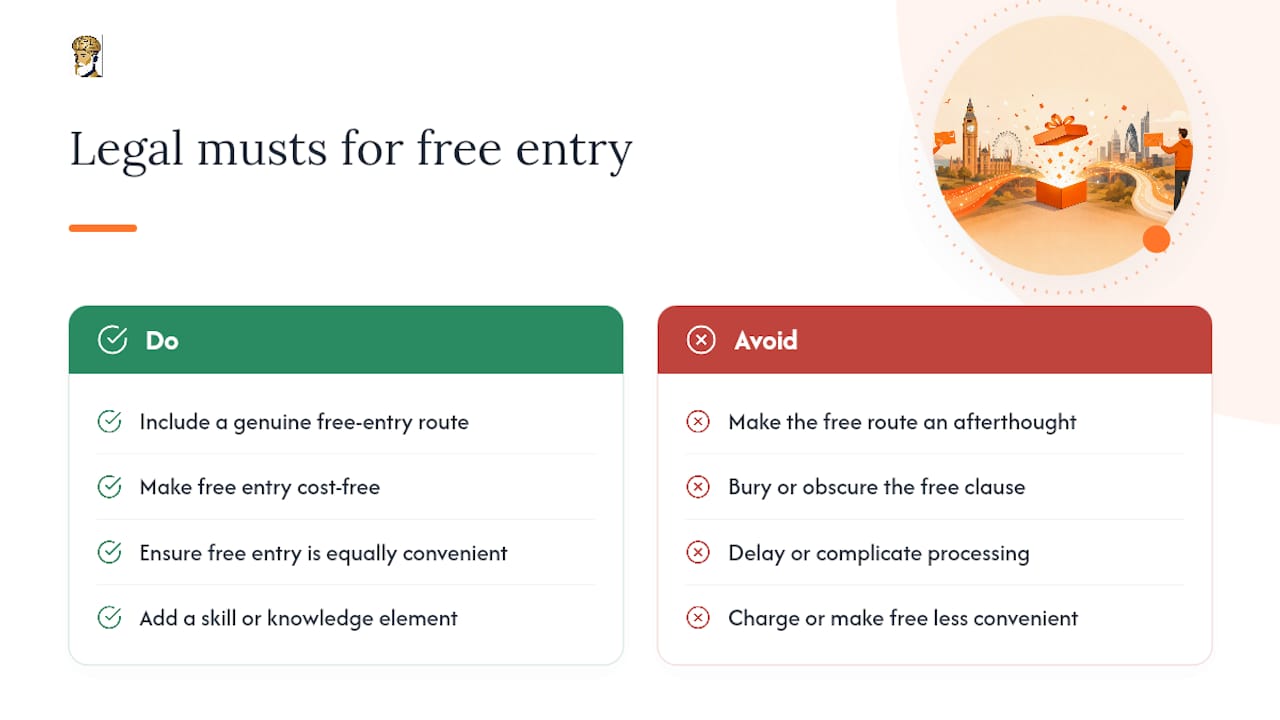
Why UK law requires a free-entry route at all
The rule exists because of where UK gambling law draws its line. A prize competition that requires payment to enter, with no genuine free alternative, and where winning depends purely on chance, risks being classified as an illegal lottery under the Gambling Commission’s rules. Unlicensed operators can’t legally run that kind of paid-only chance draw.
Two features typically keep a paid competition on the right side of the law: a skill or knowledge element in qualifying for entry, and a free-entry route that gives everyone a genuine, cost-free way to participate regardless of whether they buy a ticket. The free route isn’t a courtesy the operator is offering out of goodwill. It’s a structural requirement that determines whether the whole promotion is legally a prize competition rather than an illegal lottery.
This is also why the free route can’t be an afterthought. The ASA’s guidance is explicit that it must be promoted with comparable prominence to the paid route, and the Gambling Commission requires it to cost no more and be no less convenient than paying. An operator that technically includes a free-entry clause but buries it, delays processing it, or makes it needlessly awkward is undermining the legal basis the whole competition rests on. That’s precisely why the verification habits covered earlier matter as much as they do.
Common no-purchase-necessary formats you’ll encounter
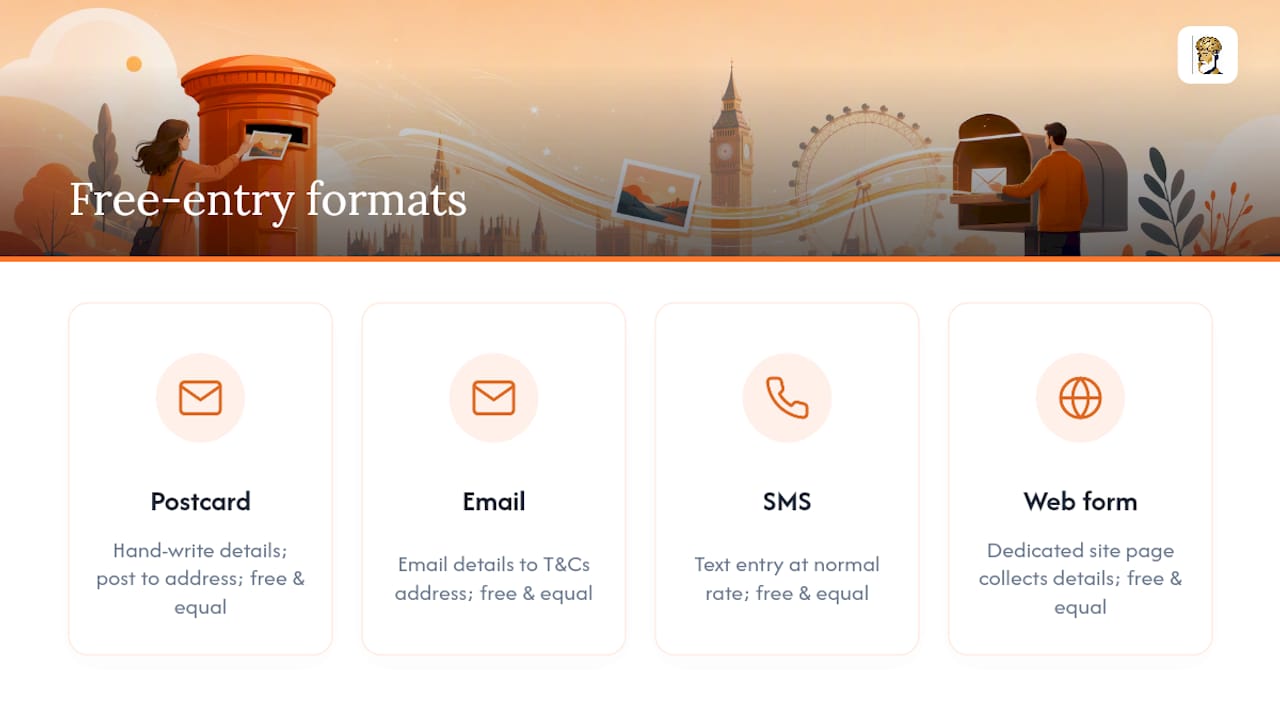
Free-entry mechanisms follow a handful of recognisable patterns across the UK market, and knowing them in advance saves time hunting through unfamiliar wording.
The postcard entry is the classic format: hand-write your details on a plain postcard or sheet of paper and post it to the operator’s registered address, following the reference-number rules covered earlier. It remains the most common route because it’s simple to administer and leaves a paper trail for both sides.
The normal-rate email entry has become just as widespread, particularly among operators running frequent, lower-value draws. You send an email containing the same core details a postcard would carry, to an address specified in the T&Cs, at no cost beyond your existing internet or mobile plan.
Some operators run an SMS-based free route, charged at your standard network rate rather than a premium number. Less commonly, you’ll see a web-form free entry, where a dedicated page on the operator’s site collects your details directly rather than asking for post or email. All four variants must meet the same underlying standard: genuinely free, genuinely equal odds, and genuinely as easy to find as the paid option.
How to check a competition is legitimate before you commit time to it
Verifying legitimacy is less about spotting one smoking gun and more about weighing several small signals together. Start with the operator’s company details. A registered company name, a Companies House number, and a real postal address (the same one the free-entry route asks you to write to) all suggest a business that’s prepared to be held accountable.
Cross-check the T&Cs against what the competition page actually promises. If the advertised prize, closing date, or entry method on the main page doesn’t match what’s written in the small print, treat that mismatch as a warning rather than a technicality. Genuine operators keep the two consistent because they have no reason not to.
Search for the operator’s past winners and, where possible, any independent mentions or reviews beyond their own site. A pattern of verifiable past winners, named with reasonable specificity, is a stronger signal than a vague “hundreds of happy winners” claim with no names attached. Our operator comparison guide walks through several established UK operators side by side if you want a reference point for what a transparent competition page typically looks like.
Scams to watch for and how to sidestep them
Most scams dressed up as prize competitions share a few tells once you know to look for them. The biggest is any requirement to pay to claim a prize you’ve supposedly already won, whether framed as a “processing fee”, “delivery charge” or “tax payment”. Legitimate UK competitions never ask winners to pay anything to receive a prize they’ve already secured.
A second common pattern is the premium-rate claim line, where the only way to confirm or collect a win is through an expensive phone number. The ASA’s guidance treats this as a breach in itself, regardless of how the rest of the promotion is dressed up.
Watch out too for competitions with no free-entry route mentioned anywhere, despite charging for tickets. As covered earlier, that absence alone puts the promotion’s legal footing in doubt. Similarly, be wary of sites with newly registered domains, no verifiable company details, and prize values that seem disproportionate to the ticket price and entry volume, since these often signal an operator with no intention of running a genuine draw at all.
If you’ve entered something that later feels off, don’t send further payments while you investigate. Report it through the Gambling Commission or ASA complaint routes covered earlier, and consider flagging it to your bank if you’ve already made a payment you now regret.
What rights you have as a free entrant
A valid free entry carries the same legal standing as a paid one, not a lesser version of it. Under the framework the Gambling Commission and GOV.UK’s voluntary code both set out, once your postal or electronic entry meets the stated requirements, the operator must place it into the same draw, at the same odds, as every paid ticket sold for that competition.
That means you’re entitled to expect your entry to be genuinely considered, not quietly excluded because it cost the operator nothing. You’re also entitled to clear, accessible T&Cs that spell out exactly how to enter for free, rather than deliberately confusing or incomplete instructions. If an operator’s free route is vague, hidden, or missing altogether, that’s a failure of their obligations, not a gap in your understanding.
If a dispute arises, whether over a missed entry, a disputed draw result, or an operator ignoring a valid postal entry, you have recourse. The Gambling Commission handles concerns about licensed activity, and the ASA takes complaints about misleading promotional practices, including free-entry routes that don’t meet the required standard. Keeping your proof of postage and dated T&Cs screenshots, as covered earlier, is what turns a vague grievance into a case someone can actually act on.
What years of watching this market has taught me
The gap between the rule and the reality is where most people trip up. UK law is genuinely robust here, but that legal protection only works if you follow the operator’s exact method, and plenty of entrants lose out simply by winging it rather than reading the actual clause.
The habit I’d push hardest is boring but effective: always get proof of postage, even for a competition you’ve entered a dozen times before. Operators revise their T&Cs more often than entrants assume, and a rule that worked in January doesn’t guarantee it still applies in June. I’d also treat a missing free-entry clause as a dealbreaker rather than a curiosity, since its absence tells you something concrete about how that operator is structured, not just how generous they feel.
For readers who want to keep tabs on which operators are getting this right, our weekly guides and operator breakdowns are worth bookmarking rather than relying on memory.
— matt
Compare UK raffles and spot free-entry routes faster
Reading every operator’s T&Cs by hand, competition by competition, isn’t a realistic habit to maintain, even for someone genuinely committed to entering for free. Platforms exist to remove that legwork: they track live odds, ticket prices and closing times across UK raffles and prize competitions, refreshing the numbers regularly so you’re never comparing stale data.

Some platforms flag which competitions have visibly published free-entry instructions, so you can filter for transparency before you commit any time to reading a full T&C page. If you’d rather not spend a stamp at all, the site’s Play to Win feature lets you earn raffle tickets through free games instead. For a quicker look at where the current best chances sit, browse the operators Rafflegenius tracks and start comparing before your next entry.
Sources
- Free draws and prize competitions — Gambling Commission
- Gov
- Promotional marketing: free-entry routes — ASA
Recommended
18+ · Please gamble responsibly. Raffle Genius is a comparison service and does not run competitions.
Best odds, straight to your inbox
One email a week with the undersold UK competitions closing soon. No spam, unsubscribe any time. 18+