
3 September 2026

Avoid Illegal Lottery: 5-Step UK Prize Draw vs Raffle Checklist
A raffle is legally a lottery: paid entry, a winner picked by chance, no skill involved. A prize draw or prize competition can only be run by a commercial business if it offers a genuine free-entry route or a real skill test. Miss that distinction and an organiser risks running an unlicensed lottery, with consequences that go well beyond an awkward email from a regulator.
TL;DR:
- A paid-entry competition that relies solely on chance is legally a lottery and requires a license for commercial operation.
- Genuine free-entry routes must be equally prominent, easily accessible, and provide the same odds of winning as paid routes to avoid illegal lottery classification.
- Skill-based competitions must have a meaningful challenge; simple or guessable questions do not meet legal standards for avoiding lottery status.
- Larger prizes attract stricter regulatory scrutiny, especially if the free route is weak or the odds are unclear or skewed.
- Transparency in terms, clear promotion of free routes, and proper record keeping are essential to avoid legal and regulatory issues.
Table of Contents
- Prize draw vs raffle: the main differences at a glance
- How UK law defines a lottery, prize competition and free draw
- What makes a free-entry route or skill test legally valid?
- A checklist for organising a lawful prize draw
- What happens when organisers get it wrong
- Prize types and value limits: how raffles and prize draws compare
- Advertising rules: what raffles and prize draws can and can’t say
- Tax rules for raffles and prize draws: organisers and winners
- What entering a raffle feels like versus a prize draw
- Common mistakes organisers make between raffles and prize draws
- Why the confusion around raffles and prize draws persists
- Compare live odds before you enter a prize draw
- Sources
Prize draw vs raffle: the main differences at a glance
Reading a competition’s terms and conditions gets much easier once you know what you’re looking for. The classification hinges on how someone enters, how a winner is picked, and who is legally allowed to run the promotion.
- Paid entry + pure chance = raffle/lottery. This usually needs a licence and is typically restricted to registered charities and societies.
- Paid entry + genuine free-entry route with equal chance = free draw/prize draw. This structure can be run commercially, provided the free route is real, not just theoretical.
- Skill-based entry where skill genuinely decides the winner = prize competition. This can also be run commercially, but only if the skill element is substantial enough to filter out a meaningful share of entrants.
When you’re checking a competition’s small print, look for a postal address for free entries, the exact tie-breaker wording, and whether a cash alternative is offered instead of the advertised prize. Those three details usually tell you within seconds whether you’re looking at a properly structured prize draw or a raffle dressed up to look like one.
How UK law defines a lottery, prize competition and free draw
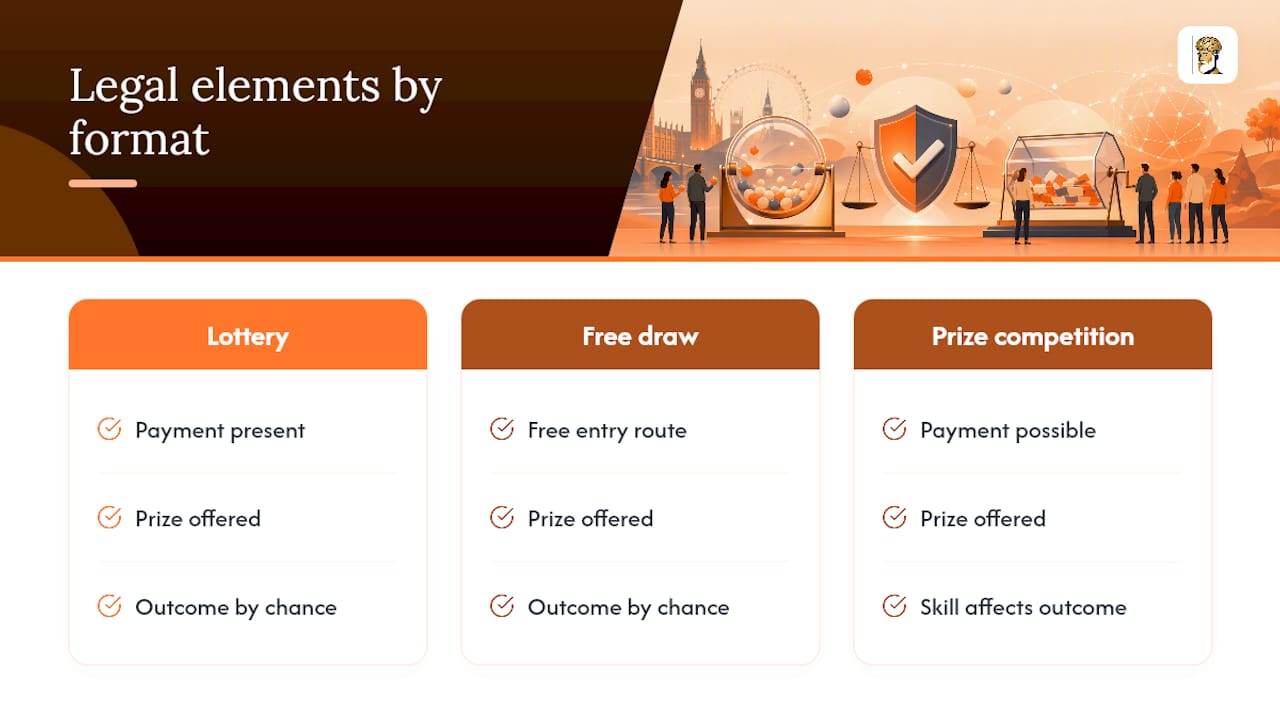
The Gambling Act 2005 treats something as a lottery when three elements are all present: a payment to enter, a prize on offer, and an outcome determined by chance. Tick all three boxes and, in law, it doesn’t matter what the promotion calls itself. A “raffle,” a “sweepstake,” or a “giveaway” that charges for entry and picks a winner at random is a lottery, and lotteries in the UK are generally restricted to licensed societies and charities.
That’s precisely why so many commercial competitions describe themselves as “prize draws” or “prize competitions” rather than raffles. Under Gambling Commission guidance, a free draw escapes lottery status because it offers a genuinely free way to enter alongside the paid one, removing the “payment” element for at least some entrants. A prize competition escapes it differently: by requiring a real skill or judgement that meaningfully affects who wins, removing the “pure chance” element instead.
Government research into online prize draws and competitions found that when these routes are weak or symbolic, the promotion behaves like gambling in practice, whatever it’s labelled.
What makes a free-entry route or skill test legally valid?
A free-entry route only counts if it’s genuinely usable. Gambling Commission guidance is explicit: the free route must sit at the ordinary rate (a standard first-class stamp, not a premium-rate call), it must give an equal chance of winning as the paid route, and it must be promoted with the same prominence as the paid option, not tucked away in a footnote.
- The free route can’t require a shorter window than the paid one, or ask entrants to jump through extra hoops.
- Postal entries need enough time to actually arrive before the closing date.
- The free route’s odds of winning must match the paid route’s odds, entry for entry.
Skill tests face a similarly strict standard. A genuine skill element has to be demanding enough to put off or defeat a real proportion of entrants. A multiple-choice question with an obvious answer, or a “try again until you get it right” mechanic, doesn’t meet that bar. The Voluntary Code of Good Practice for prize draw operators reinforces this, adding that operators should fulfil prizes promptly and be transparent about cash alternatives.
Pro Tip: If you can win a “skill-based” competition by guessing at random with a decent chance of success, the skill test almost certainly won’t hold up to regulatory scrutiny.
A checklist for organising a lawful prize draw
Anyone organising a prize draw or prize competition can work through this sequence before launch:
- Decide the core mechanic. Is the winner chosen by chance, by skill, or a mix of both?
- If it’s paid entry plus pure chance, don’t run it commercially. That’s a lottery, and you’ll need a licence or a partnership with a registered charity or society instead.
- If you want to run it commercially, build a genuine free-entry route or a robust skill test, promote the free route with equal prominence to the paid one, and give postal entries realistic time to land.
- Write clear terms and conditions, covering the cash alternative, closing date, tie-breaker method, and how and when prizes get fulfilled.
- Keep records. Log entries, retain proof of postal handling, and use independent supervision for the actual draw.
Getting this sequence right at the planning stage is far cheaper than untangling it after entrants start complaining.
What happens when organisers get it wrong
Regulators don’t pre-approve individual prize draws. The Gambling Commission places the responsibility squarely on the operator, stepping in only when a promotion looks like an unlawful lottery in practice.
The recurring failures are predictable: free-entry routes buried three pages deep in the terms, postal windows too short for a letter to realistically arrive, and skill tests that ask something like “what colour is the sky?” None of these survive scrutiny, and the Voluntary Code explicitly flags ineffective free routes as evidence that entrants are, in effect, being forced to pay.
Consequences range from mandatory refunds to criminal charges, and payment providers have shut down accounts tied to promotions found to be operating as illegal lotteries. Reputational damage tends to follow fast, since entrants who feel misled rarely stay quiet. If you’re ever challenged as an organiser, having your terms and conditions, postal proof and independent draw records ready to hand over is the difference between a quick resolution and a drawn-out dispute.
Prize types and value limits: how raffles and prize draws compare
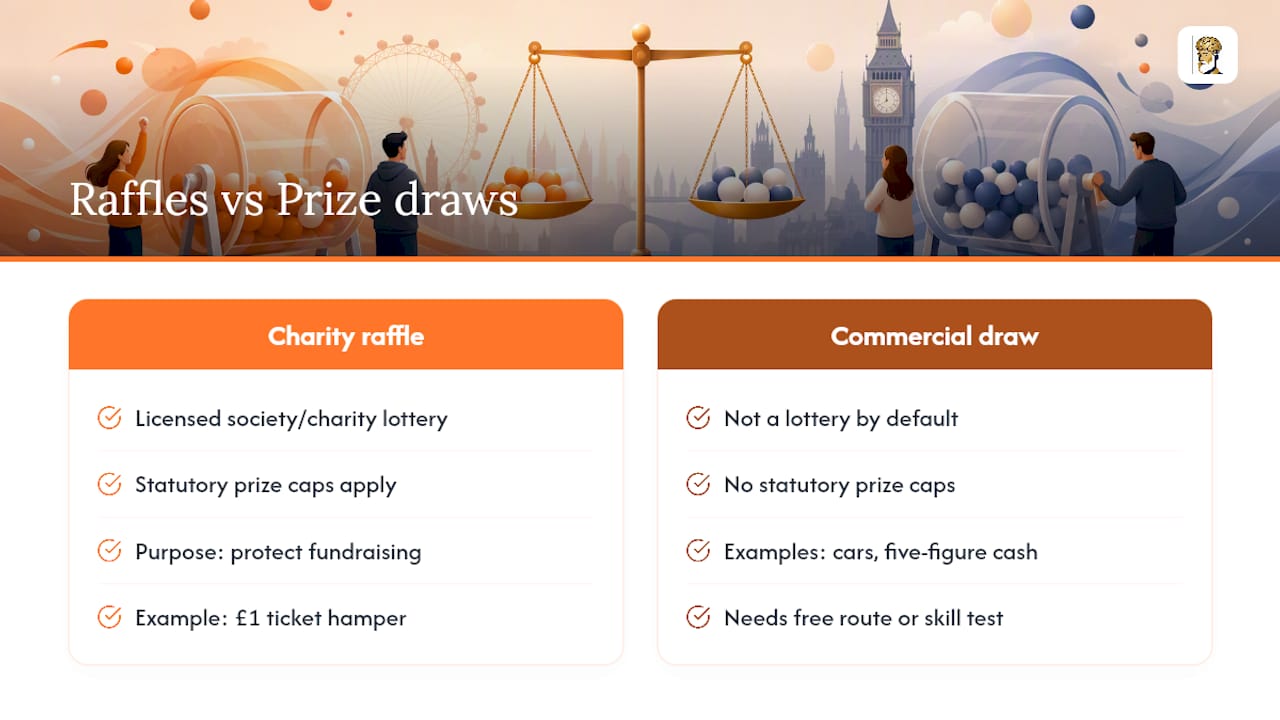
Licensed society and charity lotteries face specific structural limits tied to their registration type, covering things like ticket price caps and proceeds allocation, because the whole point of the licence is to protect charitable fundraising rather than generate private profit. A local hospice raffle selling £1 tickets for a hamper operates within that charitable framework by design.
Commercial prize draws and prize competitions work differently. Because they aren’t classified as lotteries, they don’t carry the same statutory prize caps that apply to licensed society lotteries. That’s part of why you see prize competitions offering luxury cars, five-figure cash sums, or high-end tech as headline prizes: the operator isn’t bound by charitable lottery limits, only by the underlying requirement that the free route or skill test genuinely takes the promotion outside lottery law.
That said, bigger prizes tend to invite more scrutiny, not less. A £50,000 cash prize competition with a token skill question attracts far more regulatory attention than a modest hamper raffle, simply because the incentive to cut corners on the free route rises with the prize value. Entrants comparing competitions should treat an unusually large prize as a reason to check the free-entry mechanics more carefully, not less.
Advertising rules: what raffles and prize draws can and can’t say
Charity raffles typically advertise through channels tied to the charitable cause itself: parish newsletters, local press, society membership lists, and fundraising events. Because the licence or registration underpins the whole activity, advertising tends to be modest in scale and closely tied to the charity’s own audience.
Commercial prize draws and prize competitions can advertise far more widely, including on social media, paid search, and affiliate sites, because they aren’t operating under a lottery licence’s constraints. That wider reach comes with its own obligation: advertising has to represent the free-entry route or skill requirement honestly, not bury it beneath the paid-entry call to action.
A prize draw advert that pushes “£2 entries, thousands of prizes” in large type while relegating the free-post address to a barely visible line in the terms is exactly the kind of imbalance the Voluntary Code was designed to discourage. Fair advertising means giving the free route equal billing, not just equal legal existence.
Tax rules for raffles and prize draws: organisers and winners
For charity raffles, gross proceeds generally support the charitable cause, with the specific tax and reporting treatment depending on the raffle’s registration and structure. Organisers running society lotteries need to keep accurate records to demonstrate proceeds are applied correctly, since that’s central to why the licence exists in the first place.
Commercial prize draw operators are trading businesses, so revenue from ticket or entry sales is taxed as ordinary business income, alongside standard obligations like VAT where applicable.
For entrants and winners, the position is simpler and applies whether the win comes from a raffle or a prize draw: prizes won through games of chance or genuine competitions are generally not treated as taxable income for the individual winner, because they aren’t earnings. Selling a won prize, letting a won property, or generating income from a won asset afterwards is a different matter and may trigger separate tax rules, but the win itself isn’t usually the taxable event.
What entering a raffle feels like versus a prize draw
Entering a charity raffle is a small, low-friction transaction. You buy a strip of tickets at a school fair or via a society mailing list, the numbers get read out at a fixed time, and you either win or you don’t. The prize pool tends to be modest, the odds are usually printed somewhere on the ticket, and the whole process feels community-rooted rather than commercial.
Entering a commercial prize draw is a different experience. You’re usually navigating a website with tiered ticket bundles, countdown timers, and prominent paid-entry buttons, while the free-entry route sits somewhere in the terms and conditions. The prizes are typically bigger: cars, cash sums, holidays, premium electronics. Odds vary enormously between competitions depending on how many tickets sell, which is exactly why comparing live odds across operators matters more here than it ever did for a village hall raffle.
Common mistakes organisers make between raffles and prize draws
The most frequent error is structural: running what is legally a raffle while calling it a “prize draw” and assuming the rename changes its legal status. It doesn’t. If entry is paid and the winner is picked purely by chance with no functioning free route, it’s a lottery regardless of the label on the landing page.
A close second is building a free-entry route that technically exists but fails in practice, a short entry window, a postal address that only appears after several clicks, or a free-entry deadline that’s earlier than the paid deadline. Regulators treat an ineffective free route as functionally equivalent to having none at all.
Weak skill tests round out the list. Organisers sometimes assume any question, however trivial, satisfies the skill requirement. It doesn’t; the question has to be hard enough that a meaningful share of entrants actually get it wrong. Finally, some organisers forget to promote the free route with the same visibility as the paid one, an imbalance the Voluntary Code specifically calls out as a red flag.
Why the confusion around raffles and prize draws persists
Most people assume “raffle” and “prize draw” are interchangeable marketing terms, and honestly, the industry hasn’t done much to correct that. Operators have every commercial incentive to blur the line, since “prize draw” sounds more legitimate to a wary buyer while functioning, in some cases, almost identically to an unlicensed lottery.
What’s underappreciated is how much the free-entry route acts as a genuine consumer protection mechanism rather than a legal technicality. When it works properly, it means nobody has to pay to have a real chance of winning, which is precisely the safeguard licensed lotteries provide through their charitable structure instead. The government’s own research into online prize draws found that weak free routes create harms similar to unregulated gambling, and that’s the strongest evidence yet that this isn’t a paperwork distinction. It’s a consumer protection question dressed up in legal terminology.
Entrants who take the time to check a competition’s free-route mechanics before paying are, in effect, doing the regulator’s job for themselves. That’s not a bad habit to build, given how unevenly the Voluntary Code gets applied across smaller operators.
— matt
Compare live odds before you enter a prize draw
Some platforms track live odds, ticket prices and closing times across UK raffles and prize competitions, updating frequently so users are not working from stale numbers. That matters most exactly where this article has been pointing: spotting whether a competition’s free-entry route is genuinely equal to its paid one, and whether a prize pool is undersold relative to tickets sold.

Browsing tracked competitions through Play to Win lets you see which draws currently offer the strongest odds without paying to enter. If you’re after competitions where ticket sales haven’t caught up with the prize value, the undersold competitions list is worth checking first. Whichever draw you choose, read the terms and conditions carefully and play within your means. Visit comparison platforms to check today’s odds before you commit to an entry.
This article is general information, not a substitute for advice from a qualified lawyer. Consult a qualified legal professional about your own circumstances before acting on anything here.
Sources
Recommended
18+ · Please gamble responsibly. Raffle Genius is a comparison service and does not run competitions.
Best odds, straight to your inbox
One email a week with the undersold UK competitions closing soon. No spam, unsubscribe any time. 18+