
12 September 2026

UK Raffle Age Limits: 16, 18 and When Under 16s Can Enter
Most UK lotteries and raffles require entrants to be 16 or over, under sections 45 and 56 of the Gambling Act 2005. Under-16s can take part only in narrow exceptions, such as incidental lotteries at fetes, while alcohol prizes carry a separate 18+ threshold. Free draws and prize competitions, by contrast, are not classed as lotteries at all, so the statutory age limit does not automatically apply to them.
TL;DR:
- Most UK lotteries and raffles require entrants to be at least 16 years old, with limited exceptions for incidental events and private or family-based lotteries.
- Genuine free draws and prize competitions do not fall under lottery law, so they are not bound by the 16+ age restriction, provided entry is unrestricted and free.
- Organisers must correctly classify their promotion as a lottery, free draw, or prize competition to comply with age and licensing rules and consult local authorities if unsure.
- Selling tickets to minors is illegal, and organizers should verify age restrictions, keep detailed records, and withhold age-restricted prizes from under-18 winners.
- Proper classification and pre-event registration or licensing, along with clear ticket wording and adherence to age and prize restrictions, are essential to run compliant raffles.
Table of Contents
- What the Gambling Act 2005 requires: minimum ages by raffle type
- Why free draws and prize competitions are different
- Organiser responsibilities: registration, sellers and age checks
- If a child enters or wins: immediate steps and likely outcomes
- Quick checklist: lottery, free draw or prize competition?
- Raffle Genius and checking eligibility before you enter
- The gap between what organisers assume and what the law says
- Check the raffle before you check the age rule
- Sources
- FAQ
What the Gambling Act 2005 requires: minimum ages by raffle type
The Gambling Act 2005 draws a clear legal line, and it starts with a definition. Section 45 defines a child as anyone under 16, and section 56 makes it an offence to invite, cause or permit a child to take part in a lottery, subject to a handful of statutory exceptions detailed in the legislation itself. That single rule underpins almost everything else in this article.
The 16+ threshold applies broadly across the raffle world, not just to headline events like charity car draws. It covers:
- Small society lotteries run by clubs, charities and community groups
- Larger lotteries operating under a Gambling Commission licence
- Private lotteries restricted to members of a society, workplace or residential premises
- Customer lotteries run by a business for its own patrons
There are lawful gaps in that coverage. Incidental lotteries, those run as a minor sideshow at an event whose main purpose is something else entirely (a village fete, a school fair), can lawfully include under-16 participants, because the lottery itself is not the point of the gathering. Private lotteries among family or a small closed group sit outside the general public-facing rules too, though the practical scope for these is narrow.
None of this is guesswork territory. If you are organising a raffle and unsure whether it counts as incidental, private, or a standard public lottery, the safest move is to read the statutory wording directly rather than rely on secondhand summaries, and to raise the specific scenario with your local authority’s licensing team before selling a single ticket. Getting the classification wrong at the planning stage is far easier to fix than after tickets have gone out.
Why free draws and prize competitions are different
Not everything that looks like a raffle is legally a lottery, and that distinction changes the age rules entirely. The Gambling Commission draws three separate categories, each with different obligations.
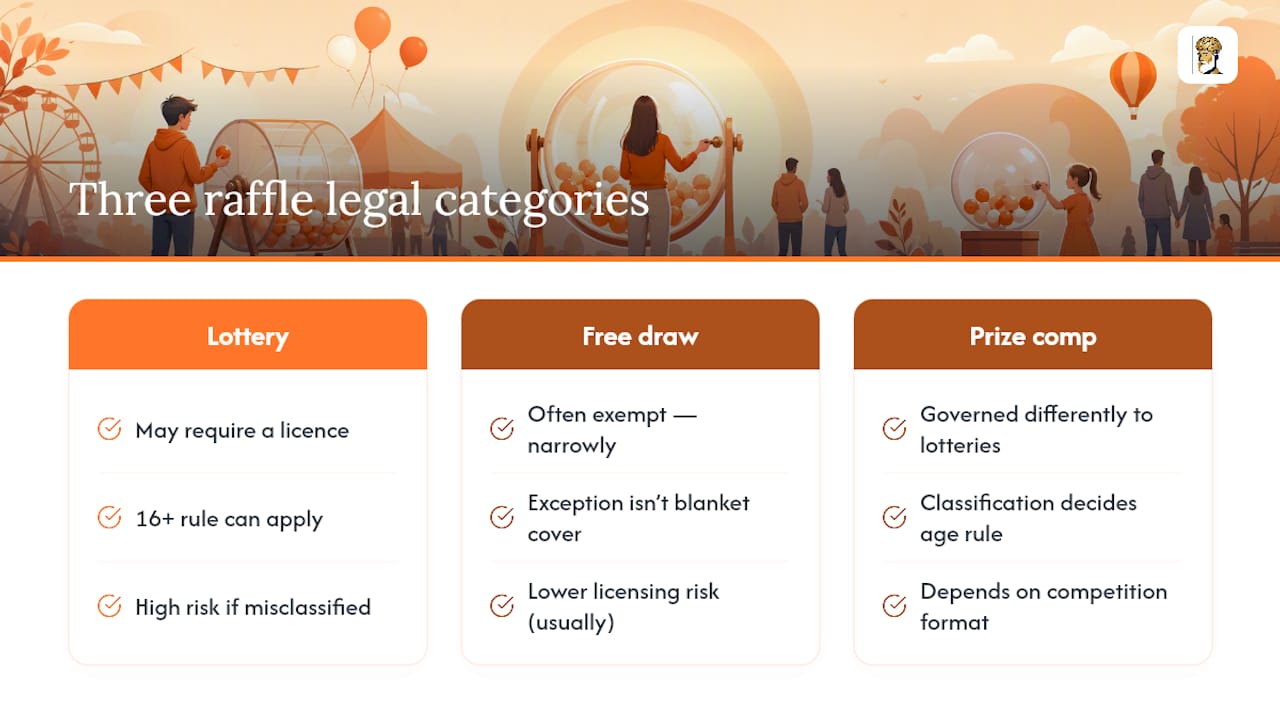
- A lottery requires payment to enter and awards prizes purely by chance. This is what triggers the 16+ rule and, above certain thresholds, a licensing requirement.
- A free draw offers a genuine, unrestricted route to enter without paying, alongside any paid entry option. Because nobody is compelled to pay to take part, the Gambling Commission does not regulate genuine free draws as lotteries in England, Wales and Scotland, and the statutory age limit does not automatically apply.
- A prize competition requires entrants to exercise a genuine skill, knowledge or judgement element that a reasonable proportion of people could fail. Because outcome is not decided by chance alone, it falls outside lottery law too.
Red flags that a promotion is actually a disguised lottery include: a “free entry” route that is buried, slow, or costs more in postage than it saves; a competition “question” so easy that it screens out almost nobody; or terms that make the free route materially harder to use than paying. Genuine free draws still carry consumer protection duties around clear, honest entry terms, even without lottery licensing attached.
Organiser responsibilities: registration, sellers and age checks
Running a compliant raffle means matching your event to the right regulatory tier before you sell a ticket. Small society lotteries can register with the local authority rather than obtain a full Gambling Commission licence, provided proceeds from a single draw and annual proceeds across all draws stay below specified thresholds. Cross either threshold and you need a Gambling Commission operating licence instead, which brings additional reporting and compliance duties.
Selling tickets carries its own restrictions, separate from entering. Employing someone under 16 to sell tickets or otherwise provide gambling facilities is an offence under the Act, and customer lotteries (where a business sells to its own clientele) face further constraints that local licensing teams can clarify for your specific venue; for an international perspective on responsible practices, see Responsible Gambling guidelines.
On the day, a handful of practical controls make the difference between a smooth draw and a dispute:
- Print clear ticket wording stating any age restriction on entry or on specific prizes
- Keep records of ticket sales, proceeds and the draw itself
- Withhold alcohol prizes from anyone who cannot show they are 18 or over
- Check with your local council’s licensing team if any element of the event feels borderline
Pro Tip: Confirm your event’s classification with the local authority before printing tickets, not after. A five-minute phone call to licensing is far cheaper than reprinting five hundred raffle books.
If a child enters or wins: immediate steps and likely outcomes
Discovering that an under-16 has entered, or worse, won, is not a crisis if you handle it methodically. Start by establishing the facts: was this genuinely a lottery (payment required, chance-based) or a free draw where the age rule may not even apply? Was payment actually taken from the child, or from a parent on their behalf? Is the prize itself age-restricted, such as alcohol?
From there, the response is usually straightforward:
- Withhold any age-restricted prize until the winner (or a verified adult) can claim it appropriately
- Offer a refund of the entry fee where the promotion was genuinely a regulated lottery and the entrant should not have been eligible
- Re-draw the prize if the original win cannot lawfully stand
- Log what happened, when, and what action you took, in case questions arise later
Most incidents resolve at organiser level with common sense and a written record. Escalate to the Gambling Commission, your local authority’s licensing team, or the Fundraising Regulator only where the classification is genuinely disputed or a complaint has been raised.
Quick checklist: lottery, free draw or prize competition?
Working through four questions in order will classify almost any raffle-style promotion correctly.
- Does entry require payment? If no, and a free route is genuinely open to everyone, you are likely running a free draw, not a lottery.
- Is the outcome decided by chance alone? If entrants must answer a question or show a skill that filters out a real proportion of people, it may be a prize competition instead.
- Is the lottery incidental to a bigger event? A raffle at a fete where the fete, not the raffle, is the main draw can fall under the incidental lottery exception.
- Is there a genuine free entry route, clearly and equally available? If yes, the Gambling Commission’s own guidance confirms this keeps the promotion outside lottery regulation.
Answer those four honestly and the correct action follows: register with the local authority, apply for a full Gambling Commission licence, or simply ensure your free-entry route and terms are transparent. Where the answer stays unclear, the Commission, your council’s licensing desk and the Fundraising Regulator all offer direct routes to a definitive answer, rather than guesswork based on how a competitor runs theirs.
Raffle Genius and checking eligibility before you enter
We track live UK raffles and prize competitions, refreshing odds regularly so entrants can see ticket prices, prize values and closing times side by side. That real-time view is useful for a different but related question to age eligibility: whether a promotion you are looking at is worth your money.
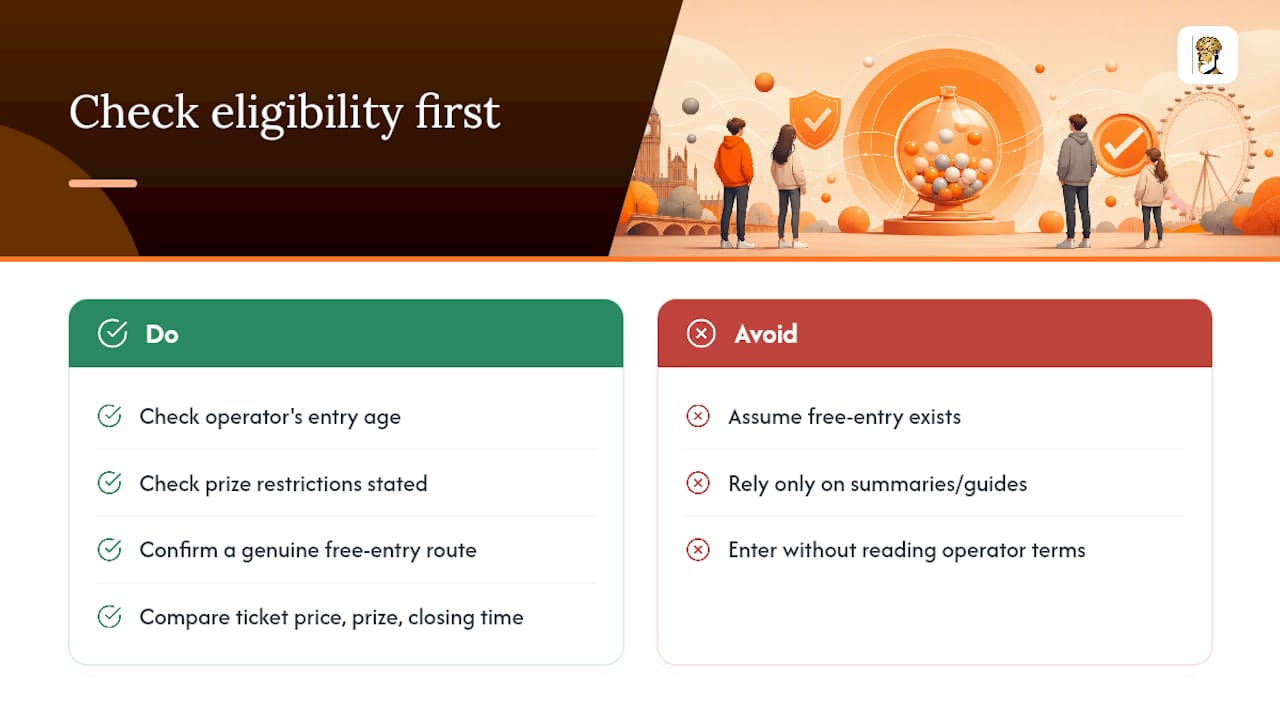
Before entering anything, check the operator’s own terms for entry age, prize restrictions and whether a free-entry route genuinely exists, since operators vary in how clearly they state this. Our operator guides walk through exactly what to look for in those terms, and the broader raffle blog covers how free draws differ from paid lotteries in practice. None of this replaces reading the operator’s own terms or, where genuinely uncertain, seeking legal advice.
The gap between what organisers assume and what the law says
Most confusion about raffle age limits comes from treating “raffle” as one legal category when it is really three: lotteries, free draws and prize competitions, each governed differently. Organisers who assume a fete raffle is automatically exempt from the 16+ rule are relying on an exception that regulatory guidance treats narrowly, not as a blanket cover for anything held at a community event.
The conventional advice, “just check if under-16s can play”, also skips the more useful question: what type of promotion is this in the first place? Get that classification right and the age rule mostly answers itself. Get it wrong and you risk running an unlicensed lottery while believing you are running a compliant free draw.
My take is that the 16+ threshold matters less in isolation than most guides suggest, and the classification question matters more. Prioritise working out whether you are running a lottery, a free draw or a prize competition before worrying about ticket wording or prize withholding. Everything downstream, registration, age checks, who can sell tickets, depends on getting that first call right.
— matt
Check the raffle before you check the age rule
Our platform exists for the moment after you have confirmed a promotion is lawful and open to you: deciding which one is actually worth entering. Rather than trawling dozens of operator sites individually, our platform tracks ticket prices, prize values, odds and closing times across UK operators in one place, refreshed regularly.

If you want to compare which operators currently offer the strongest odds relative to ticket price, the operators page lists the operators currently tracked. Prefer a free-entry route while you get familiar with how these promotions work? The Play to Win feature offers free entry options. Either way, check the operator’s own terms on age and prize restrictions before entering, since Raffle Genius provides tracking and comparison, not legal advice.
Sources
- Legislation
- Free draws and prize competitions (Gambling Commission)
- Lotteries and raffles (Fundraising Regulator)
FAQ
What is the minimum age to enter a raffle in the UK?
Most UK lotteries and raffles require entrants to be 16 or over under sections 45 and 56 of the Gambling Act 2005, though incidental lotteries at events like fetes are a narrow exception.
Can under-16s take part in any raffles at all?
Yes, in limited cases. Incidental lotteries run as a minor part of a larger event, and genuine free draws that are not classed as lotteries, can lawfully include under-16 participants.
Are free draws and prize competitions covered by the same age limit as raffles?
No. The Gambling Commission does not regulate genuine free draws and prize competitions as lotteries in England, Wales and Scotland, so the statutory 16+ lottery limit does not automatically apply to them.
Do I need a licence to run a raffle in the UK?
It depends on proceeds. Small society lotteries can register with the local authority if proceeds stay below specified thresholds; anything above that needs a full Gambling Commission licence.
What happens if a child wins an age-restricted prize like alcohol?
Organisers should withhold the prize until the winner can verify they are 18 or over, offer an alternative or deferred collection where possible, and keep a record of the incident.
Can Raffle Genius tell me if a specific raffle is legal?
No. Raffle Genius tracks odds, prices and prize types across UK operators to help you compare where to spend your money, but confirming an operator’s legal classification means checking their own terms or contacting the Gambling Commission directly.
Recommended
18+ · Please gamble responsibly. Raffle Genius is a comparison service and does not run competitions.
Best odds, straight to your inbox
One email a week with the undersold UK competitions closing soon. No spam, unsubscribe any time. 18+