
18 September 2026

Catch Undersold UK Experience Competition Odds With 10 Minute Updates
Odds on any UK experience competition come down to one calculation: your tickets divided by total tickets sold, or the advertised “1 in N” figure. The single most useful habit is to check that ratio before every entry and prioritise transparent, ticketed draws over vaguely worded ones. Undersold competitions, where ticket sales lag behind the deadline, often offer far better value than heavily promoted ones.
TL;DR:
- The true likelihood of winning a UK experience competition depends on the number of tickets bought relative to the total available, which fluctuates as sales progress.
- Undersold competitions, where ticket sales lag behind the cap, significantly improve your odds, especially if checked close to the deadline.
- Calculating the cost-per-chance and value ratio helps determine whether the competition offers genuine value compared to the advertised odds or prizes.
- Verifying the operator’s legitimacy involves checking registration details, transparent terms, winner history, and free postal entry routes to avoid illegal or poorly run draws.
- Using live odds tracking tools can help identify undervalued or undersold competitions but always confirm details before purchasing tickets.
Table of Contents
- What counts as an experience competition in the UK?
- How do you read competition odds and work out your true chance?
- How do you judge whether a competition is actually good value?
- How do you check if a UK competition operator is legitimate?
- Using live-odds tracking to spot undersold experience draws
- Are experience competitions legal in the UK, and are any prize types restricted?
- How do experience competitions differ from lotteries and other prize draws?
- How do you use past winner data to judge true odds?
- A practical balance between fun and value
- Find better odds without checking a dozen sites
- Sources
- FAQ
What counts as an experience competition in the UK?
UK prize competitions typically offer two entry routes: a paid ticket purchase and a free postal entry, a structure that keeps many of these draws outside the licensing rules that govern lotteries under the Gambling Act 2005. That paid-plus-free format is what you’ll see on almost every experience competition site operating legally in Britain.
“Experience” prizes cover a broad category, and their value is far more subjective than cash:
- Spa days and wellness breaks — typically worth £100 to £400, though quality varies enormously between venues.
- Driving experiences (supercars, track days) — often priced by the operator at £150 to £600.
- Concert and event tickets, including VIP packages, which can swing wildly in resale value depending on the artist.
- Short breaks and holidays, usually the highest-value experience prizes, sometimes bundled with spending money.
Entry costs on these draws usually range from £0.49 to £5 per ticket, with draws running anywhere from a few days to several weeks depending on how quickly the operator wants tickets sold.
How do you read competition odds and work out your true chance?
Odds appear in two main formats on UK competition sites: fractional (like 4/1) and decimal (like 5.0). Converting either to implied probability is straightforward. For decimal odds, divide 1 by the decimal figure; for fractional odds, divide the second number by the sum of both numbers, then convert to a percentage. A guide to odds formats commonly used across British betting and competition markets confirms this is the standard conversion method, even outside sports betting.
For ticket-based competitions, though, you don’t need fractions at all. You calculate odds directly from ticket counts.
Statistic callout: if a competition sells 5,000 tickets and you buy 10, your maximum possible odds are 10 in 5,000, which simplifies to 1 in 500. That’s your real chance, not the marketing headline.
Here’s how to turn that into a repeatable check:
- Find the total ticket cap and current tickets sold, usually listed on the entry page.
- Divide the number of tickets you plan to buy by the total ticket cap.
- Compare that fraction against the advertised “1 in N” odds. They should match.
- Recheck close to the deadline. Undersold draws improve your odds as the clock runs down.
An “undersold” competition is simply one where ticket sales are running behind the cap. If a 5,000 ticket draw has only sold 2,000 with two days left, your odds on 10 tickets jump from 1 in 500 to 1 in 200, assuming no late surge. Watch for listings that say “limited tickets remaining” without giving a number. That vagueness is a red flag, not a marketing quirk.
How do you judge whether a competition is actually good value?
Two figures do most of the work here: cost-per-chance (ticket price divided by your odds) and value ratio (the prize’s cash equivalent divided by the ticket price). Neither is complicated, but together they cut through the noise of headline prize values.
Take two hypothetical draws. Draw A offers a £2,000 driving experience, 4,000 tickets at £2 each. Draw B offers a £1,500 spa retreat, 1,000 tickets at £3 each.
- Draw A’s value ratio: £2,000 ÷ £2 = 1,000.
- Draw B’s value ratio: £1,500 ÷ £3 = 500.
On raw value ratio, Draw A win, despite the smaller headline prize. Your odds are also better on Draw A: 1 in 4,000 per ticket versus 1 in 1,000 on Draw B, so the smaller prize pool matters less than it first appears.
Cash alternatives change this further. Many experience competitions let winners take a cash sum instead of the prize itself, usually at a discount to the stated retail value. If resale or cash-out value is meaningfully lower than the advertised prize, factor that into your value ratio rather than taking the marketing figure at face value.
- Casual players chasing fun: cap spend and enter for enjoyment, treating the prize value as a bonus.
- Value-seeking players: only enter when the value ratio beats your personal threshold, and revisit undersold listings, as ratios shift daily.
Pro Tip: Recalculate the value ratio the day before a draw closes, not when you first spot it. Ticket counts move, and a mediocre ratio on Monday can turn into a genuinely good one by Friday.
How do you check if a UK competition operator is legitimate?
Before entering any experience draw, run a handful of checks that take less than five minutes combined.
- Search the operator’s company number on Companies House, the UK’s official register, to confirm it’s a registered, active business.
- Look for clearly published terms and conditions, including the ticket cap, closing date, and how the cash-alternative option is calculated.
- Check for named past winners with dates and prize details. An operator with no visible winner history for months is worth avoiding.
- Confirm a free postal entry route exists, as its absence may signal the operator isn’t structuring the competition correctly under UK rules.
If any of these are missing, treat that as grounds to skip the draw entirely rather than assume it’s an oversight. For anyone whose competition entries are starting to feel less like fun and more like compulsion, BeGambleAware offers UK-specific harm-minimisation support and budgeting advice. Tax treatment of prize winnings can also vary depending on prize type and value, so check official HMRC guidance rather than relying on operator claims about tax-free status.
Using live-odds tracking to spot undersold experience draws
An undersold competition is one where ticket sales are trailing the cap as the closing date approaches, meaning your odds improve the longer you wait, provided sales don’t surge at the last minute. Static listings go stale fast; a competition that looked fully subscribed yesterday might have sold another thousand tickets overnight. That’s why live odds tracking matters more for experience draws than almost any other category, since prize appeal (a helicopter ride, a festival weekend) tends to attract bursts of last-minute buying that shift odds quickly.
A practical workflow looks like this:
- Filter listings by the “experience” category to narrow the field to holidays, days out, and similar prizes.
- Sort by value ratio or displayed odds rather than headline prize value.
- Build a short watchlist of draws closing within the next 24 to 48 hours, when undersold gaps are most visible.
- Verify the operator’s terms and conditions before buying, even when the odds look excellent.
Live odds data updating every 10 minutes matter because ticket sales on popular experience draws can move sharply within a single afternoon; tools like Smarter Picks and Odds from ParlayGeeks can help you track these changes efficiently. That refresh rate is what separates a genuinely current value ratio from one that was accurate three hours ago but isn’t now.
Pro Tip: Never treat good odds as a substitute for reading the terms. A competition can look mathematically brilliant and still have a cash-alternative clause that undercuts the prize value by half.
Are experience competitions legal in the UK, and are any prize types restricted?
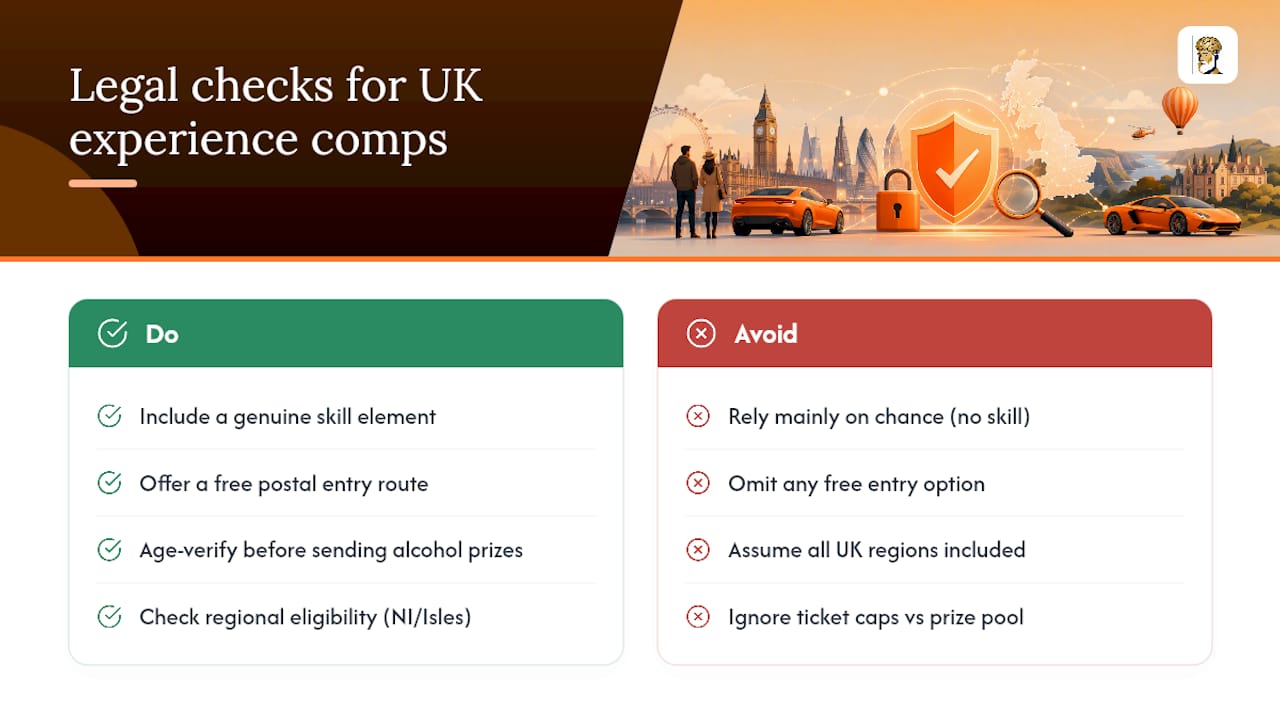
Experience competitions operating with a genuine skill element (a question, tiebreaker, or similar) plus a free postal entry route generally sit outside the Gambling Act 2005’s licensing requirements, which is why they proliferate legally across the UK market. That said, restrictions do apply in specific circumstances.
Prizes involving alcohol are subject to age verification requirements, and operators must confirm entrants are 18 or over before dispatching anything containing alcohol. Firearms, certain vehicles requiring specific licences, and prizes with export restrictions can also complicate fulfilment, occasionally leading operators to substitute a cash alternative rather than the advertised prize. Draws advertised as open to “UK residents” sometimes exclude Northern Ireland or the Channel Islands due to differing local regulations, so always check the eligibility section rather than assuming national coverage.
Competitions that lean too heavily on chance without a genuine skill element, or that fail to offer a free entry route, risk falling foul of gambling regulation and being classified as an illegal lottery. This is one of the clearest signals of a poorly run operator: if there’s no free postal route listed anywhere, question why. Operators occasionally cap the number of tickets a single person can buy, both for fairness and to manage regulatory exposure on very high-value prizes like homes or cars. That ticket cap, when present, is worth checking against the total pool, since it affects the realistic best-case odds any one entrant can achieve.
How do experience competitions differ from lotteries and other prize draws?
The National Lottery and other licensed lotteries operate under strict Gambling Commission oversight, with fixed odds structures published in advance and no free entry route required, since they’re regulated as gambling products rather than skill-based competitions. Experience competitions work differently: the free postal entry requirement exists precisely because they’re not licensed lotteries, and that structural difference carries real consumer benefits.
Because ticket counts are visible and capped, your odds on an experience competition are often calculable in a way that jackpot lotteries aren’t. A National Lottery Set For Life ticket carries odds published by the operator based on the full number combination pool, fixed regardless of how many tickets are sold. An experience competition’s odds shift with sales volume, meaning a canny entrant who buys late in an undersold window can secure meaningfully better odds than an early entrant on the same draw.
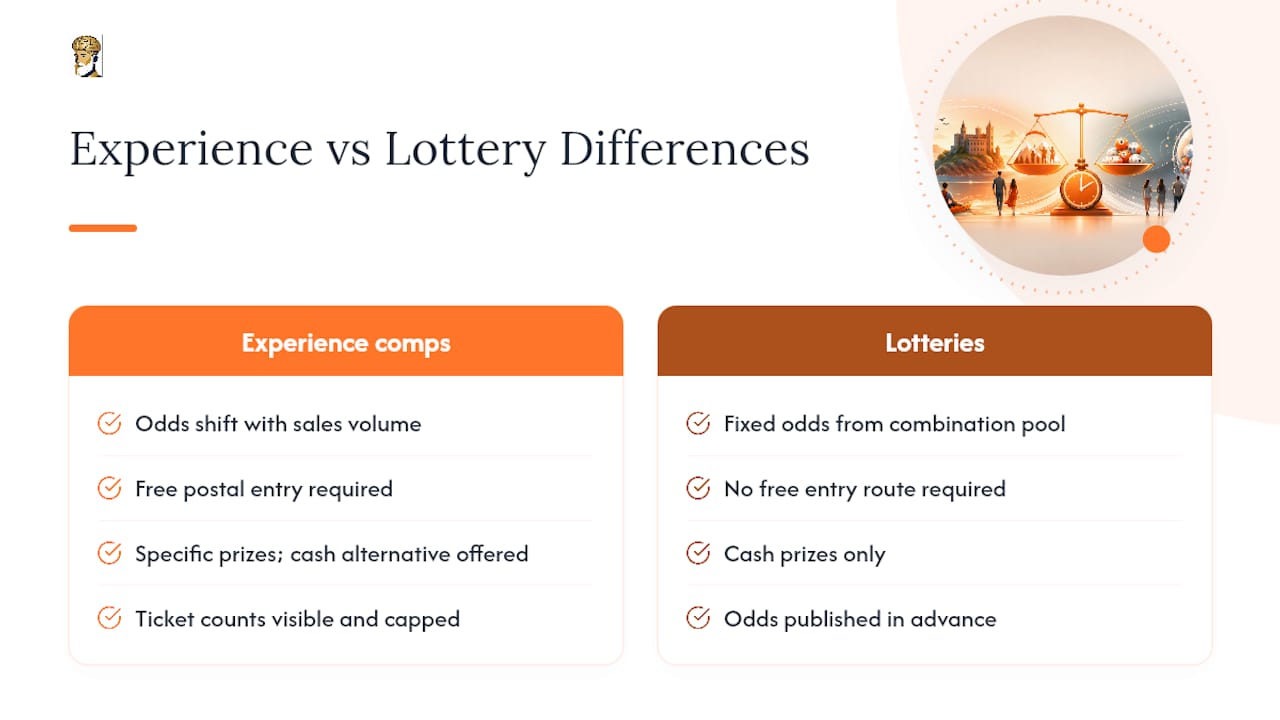
The other consumer benefit is prize specificity. Lotteries pay cash, full stop. Experience competitions let you choose (within reason) which prize categories suit you, whether that’s a holiday, a driving day, or event tickets, and many offer a cash-alternative option if the prize itself doesn’t appeal. That flexibility, combined with lower entry costs per ticket, is why experience competitions have grown into a genuine alternative to traditional lottery play for UK entrants who want more control over what they’re chasing.
How do you use past winner data to judge true odds?
Published winner histories are one of the most underused tools for judging whether a competition’s advertised odds hold up in practice. Most legitimate operators list past winners with names, prize details, and dates, usually on a dedicated winners page.
Cross-reference that list against the operator’s typical ticket caps. If a competition consistently sells out its full ticket allocation before drawing, and winners are drawn promptly with visible evidence, that’s a strong signal the stated odds are genuine. If winner listings are sparse, outdated, or missing prize values, treat the advertised odds with more scepticism, regardless of how attractive the ratio looks on paper.
It’s also worth tracking how often the same prize categories recur. An operator that regularly runs “undersold” driving experience draws, for example, gives you a rough historical base rate for how often that category tends to under-sell, which is more useful than any single snapshot. Comparison sites that rank UK competitions by live value ratio often archive past rankings, letting you spot patterns in which prize types and operators consistently offer better odds over time.
None of this replaces checking the current ticket count before you buy, but a pattern of transparent, promptly resolved draws with published winners gives you far more confidence than a single well-worded listing ever will.
A practical balance between fun and value
Treat every experience competition as entertainment with a mathematical filter attached, not the reverse. The value ratio and undersold window matter, but they should narrow your choices, not justify spending beyond what you’d happily lose. Verify the operator, check the free entry route exists, and let the numbers, not the prize photo, make the final call.
— matt
Find better odds without checking a dozen sites
Rafflegenius exists because comparing value ratios across dozens of operators by hand is exactly the kind of repetitive checking most entrants give up on after a few draws. Instead of manually recalculating cost-per-chance on every listing, Rafflegenius tracks live odds, ticket counts, and prize values across UK raffles and updates them every 10 minutes, with a dedicated view for undersold competitions where your odds are quietly improving as the deadline approaches.
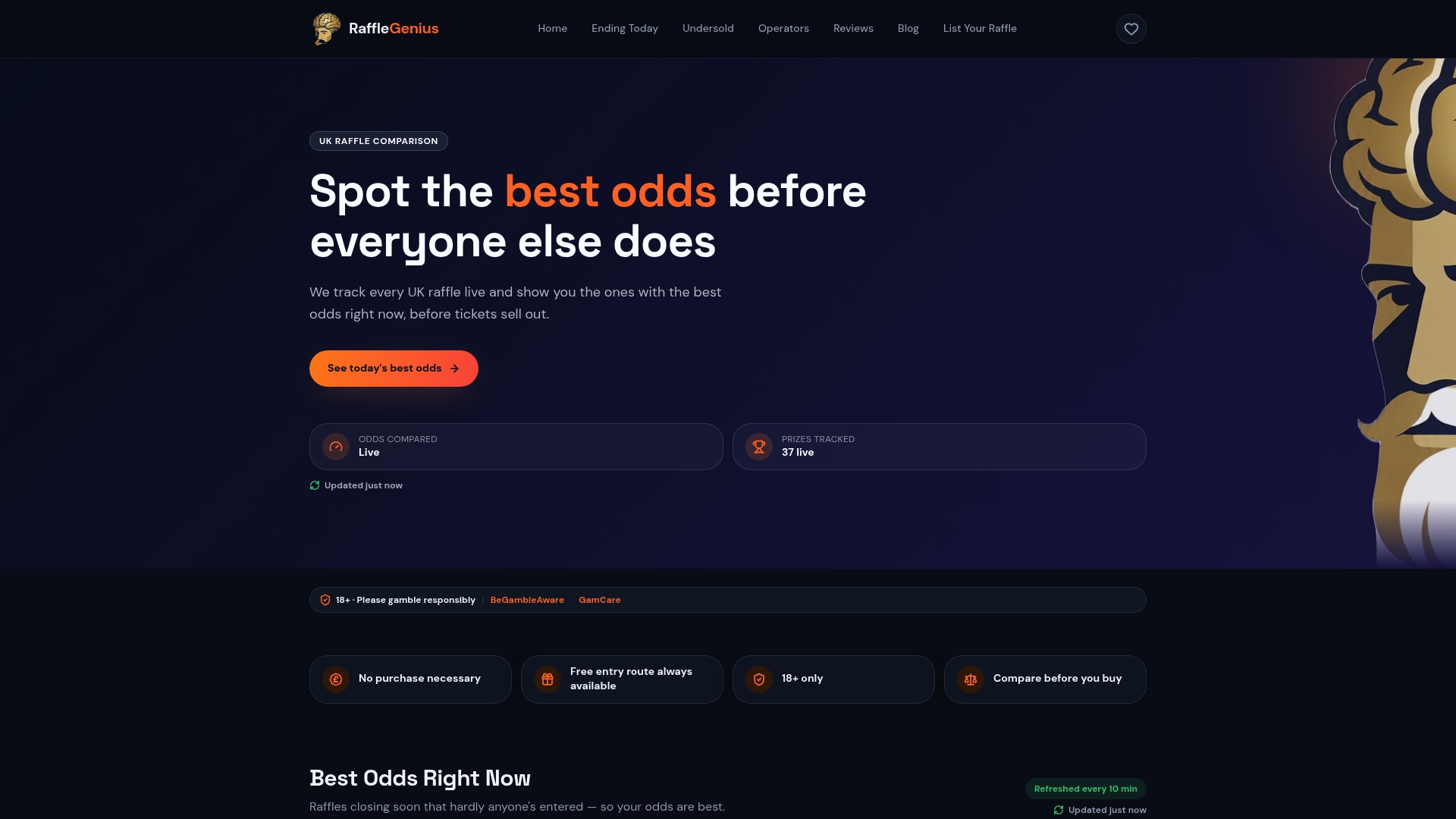
That said, live odds are only half the picture. Always verify an operator’s terms and conditions directly before entering, since Rafflegenius helps you find strong value ratios but doesn’t replace checking the small print yourself. If you’d rather browse without adverts interrupting your comparisons, the Go ad-free option costs £4 per month. Start by filtering the experience category on the main comparison page and see which draws are currently undersold before you commit your next ticket budget.
Sources
- Prize Competitions UK: Complete Guide (2026)
- BeGambleAware
- Companies House search
- Bet-UK guide to odds formats
FAQ
What are the best competition sites in the UK?
The strongest UK competition sites publish clear ticket caps, named past winners, and a genuine free postal entry route, rather than relying on headline prize photos. Rafflegenius helps you compare live odds and value ratios across multiple operators so you can judge which listings meet those standards before entering.
What are the odds of winning the Set For Life lottery in the UK?
Set For Life odds are fixed by the National Lottery based on the full number combination pool and don’t change with ticket sales volume, unlike experience competition odds. Experience competitions instead offer odds that shift as tickets sell, meaning an undersold draw can offer better relative odds than a popular lottery format.
What are the best car competitions in the UK?
The best car competitions combine a transparent ticket cap with a value ratio that reflects the car’s realistic resale value, not just its showroom price. Checking the operator on Companies House and confirming a free entry route exist are the two fastest legitimacy checks before entering any high-value car draw.
Are online competitions worth it?
Online competitions can offer genuine value when the odds are transparent and the value ratio is favourable, particularly on undersold draws close to their deadline. They’re best treated as entertainment with a mathematical filter, budgeted deliberately rather than chased for a specific outcome, and resources like BeGambleAware are worth consulting if entering starts to feel compulsive rather than enjoyable.
Recommended
18+ · Please gamble responsibly. Raffle Genius is a comparison service and does not run competitions.
Best odds, straight to your inbox
One email a week with the undersold UK competitions closing soon. No spam, unsubscribe any time. 18+