
14 September 2026

10-minute live odds: compare UK prize competitions and vet operators
Favour competitions with a low value ratio, transparent cash alternatives, and verifiable trust signals over glossy prize photography. Live-odds tracking tools like Raffle Genius exist precisely to surface undersold opportunities before everyone else spots them. Scan the ranked comparison below to shortlist an option, then run it through the vetting checklist before you spend a penny.
TL;DR:
- Competitions with smaller, undersold pools and clearly disclosed cash alternatives generally offer better value ratios and higher individual winning odds.
- Using live-odds tracking tools like Raffle Genius and verifying operator trust signals can significantly improve the safety and value of entries.
- Avoid competitions lacking clear registration, cash alternatives, winners’ history, or with shifting draw dates, as these are likely red flags.
- Matching your goals with the right type of competition—cash, tech, or smaller pools—maximizes the chance of winning without unnecessary risk.
- Entering via free or postal routes in multiple undersold draws can boost odds legally without breaching the rules.
Table of Contents
- How to compare prize competitions by odds and value
- How are odds and value actually calculated?
- What trust checks should you run before entering?
- Which prize competition fits your goals?
- How do you enter, track, and manage risk?
- Are prize competitions based on skill or luck?
- What do common prize competition terms actually mean?
- What prize categories offer the best relative value?
- How can you maximise entries without breaking the rules?
- Editorial take: when comparison actually pays off
- Try Raffle Genius before you enter your next competition
- Where to check before you enter
- Sources
- FAQ
How to compare prize competitions by odds and value
Comparing prize competitions properly means looking past the headline prize and into the maths behind it. A £3,000 watch giveaway with 50,000 tickets sold is a far weaker proposition than a £500 cash draw with 2,000 tickets, even though the second prize looks smaller on paper. Value ratio, the relationship between ticket price, total tickets, and declared prize value, helps to separate a genuinely good draw from a marketing exercise.
Raffle Genius sits first on this list because it updates odds every 10 minutes across tracked competitions, which matters when ticket sales can shift a draw’s value ratio within an hour. Beyond that platform, the UK market includes several distinct approaches worth understanding before you commit any spend:
- A raffle comparison platform: aggregates live odds and flags undersold competitions across multiple operators, useful as a first checkpoint before buying anywhere.
- Large-scale luxury draws (the Omaze UK model): high production value, big-ticket prizes like houses or supercars, but typically enormous ticket pools that dilute individual odds.
- Skill-based instant-win platforms (the BOTB model): entrants answer a qualifying question, then compete for instant-win slots, which changes the legal and probability structure entirely.
- Mid-tier multi-prize operators (models similar to Rev Comps, Elite Competitions, and Click Competitions): frequent draws, tiered ticket pricing, and rolling prize categories from tech to cash.
- Niche and regional operators (models similar to High Peak Comps, McKinney Competitions, and Storm Competitions): smaller ticket pools can mean better odds, but disclosure standards vary more widely.
- Community and club-style draws (models similar to Trinity Club Competitions and Bounty Competitions): often built around loyal follower bases, with odds that depend heavily on how quickly a competition sells out.
| Approach | Best for | Ticket price range | Typical odds/total tickets | Value ratio/cash alternative | Free-entry option | Trust signal | Draw frequency |
|---|---|---|---|---|---|---|---|
| Raffle Genius (tracking layer) | Finding undersold draws across operators | N/A (comparison tool) | Varies by tracked competition | Highlights cash alternative presence | Links to operator free-entry routes | Aggregates Trustpilot/Companies House data | Updates every 10 minutes |
| Large luxury draws | Big-ticket dream prizes | £10 | Often large ticket pools | Cash alternative usually disclosed | Postal entry typically available | Established Trustpilot footprint | Weekly to monthly |
| Skill-based instant-win | Entertainment with instant results | £1 to £3 | Instant-win pool, not a single draw | Structured differently, less like a value ratio | Free postal entry route required by law | Long trading history, public accounts | Continuous |
| Mid-tier multi-prize operators | Regular players wanting variety | £1 to £10 | 1,000 tickets | Cash alternative disclosure varies | Usually available, check terms | Check Companies House and Trustpilot individually | Daily to weekly |
| Niche/regional operators | Better odds on smaller pools | £1 to £3 | Often under 5,000 tickets | Less consistently disclosed | Sometimes limited or unclear | Verify before entering | Weekly |
| Community/club draws | Loyal follower engagement | £1 to £5 | Depends on sellout speed | Rarely a fixed value ratio published | Often available on request | Newer footprint, verify carefully | Variable |
Watch for a few immediate red flags before you enter anywhere: no visible company registration number, no published cash alternative figure, a “winners” page with no names or dates, and draw dates that shift repeatedly without explanation. Any one of these should push a competition to the bottom of your shortlist, not just a mental note.
How are odds and value actually calculated?
Odds are simple: tickets sold divided into one gives your individual chance. Value ratio takes it further by dividing the prize’s declared cash value by the total revenue if every ticket sells. A £2,000 prize with 1,000 tickets at £3 each generates £3,000 in potential revenue, giving a value ratio of roughly 0.67, meaning the operator is offering back about two thirds of maximum revenue as prize value.
- Odds come from ticket price, total ticket cap, and confirmed sales figures where operators disclose them.
- Value ratio compares declared prize value against maximum possible revenue from ticket sales.
- Cash alternative amounts, where offered, act as a useful sanity check on whether the advertised prize value is realistic.
This data is pulled from operator disclosures, public ticket counters, and cash alternative statements, refreshing roughly every 10 minutes rather than relying on a static snapshot. The limitation worth knowing: some operators under-disclose ticket sales or run promotional instant-wins that sit outside the standard value ratio model entirely, which lowers confidence in any single ranking.
What trust checks should you run before entering?
A legitimate operator leaves a paper trail, and checking it takes minutes. Search the company name on Companies House to confirm it is an active, registered UK entity, not a dormant shell or a trading name with no filing history. Then check Trustpilot for review volume and pattern, a handful of five-star reviews posted the same week is a weaker signal than hundreds spread over months.
Look for a published winners history with names, locations, and dates, not just prize photos. Genuine operators also disclose their cash alternative clearly, since the Gambling Commission’s guidance on free draws and prize competitions sets out how free-entry routes must work alongside paid ones for a competition to stay outside lottery regulation. If a competition relies purely on chance with no genuine free route and no skill element, it risks crossing into what the Gambling Commission defines as a regulated lottery, which UK operators must licence properly.
Red flags worth memorising:
- No Companies House listing or a company registered only weeks before launch.
- Vague or missing free-entry instructions.
- No stated cash alternative for a “must be won” prize.
- Contact details limited to a social media inbox with no address or phone number.
Pro Tip: Search the operator’s name alongside “Companies House” and “Trustpilot” in two separate tabs before you ever enter card details. It takes under two minutes and eliminates most of the obviously risky operators immediately.
Which prize competition fits your goals?
Matching a competition to your own goals comes down to three decisions, and skipping any one of them tends to lead to disappointing spend.
- Set a budget ceiling first. Decide your weekly or monthly entry spend before browsing prizes, not after seeing a car you like.
- Choose prize type deliberately. Cash prizes carry a clean, comparable value; physical items depend on resale value and personal use, so a £30,000 car prize is only worth what you would genuinely pay for it.
- Decide your odds tolerance. Entertainment-minded entrants can accept large ticket pools for a dream prize; value-focused entrants should favour smaller, undersold draws with disclosed value ratios.
Before buying, ask any operator directly: is there a ticket cap, is a cash alternative available and at what amount, and how is the draw verified? A hesitant or unclear answer to any of those three questions is itself useful information.
How do you enter, track, and manage risk?
Verify the operator using Companies House and Trustpilot first, then calculate your actual chance using ticket price against total tickets sold, not the cap. Enter, screenshot your confirmation email as a receipt, and follow the draw live where operators stream it rather than relying solely on a results page.
- Set a weekly spend limit before you start, and treat it as fixed, not a starting point.
- Cap entries per competition rather than spreading thin across dozens of draws with no real chance in any of them.
- Use a live-tracking tool to catch competitions that are undersold close to their closing time, when value ratios often improve sharply.
Pro Tip: Competitions frequently sell fastest in their final 24 hours. Checking undersold listings the evening before a draw closes can reveal a value ratio noticeably better than the one advertised at launch.
Are prize competitions based on skill or luck?
UK prize competitions split broadly into two legal categories, and the difference genuinely changes your odds. Skill-based competitions require entrants to answer a qualifying question correctly, a genuine test of knowledge or judgement, before being entered into the prize draw. This structure is what allows many paid-entry competitions to operate legally outside lottery licensing.
Pure luck-based draws, where entry alone with no skill element determines eligibility, must offer an equally weighted free-entry route to stay compliant, since chance alone cannot legally be sold as a lottery ticket outside a licensed National Lottery structure. In practice, most commercial competitions blend the two: a simple qualifying question sits in front of what is functionally a random draw.
The practical effect on your odds is limited, since qualifying questions are rarely difficult enough to filter out many entrants. What matters more is whether the operator publishes how many people answered correctly, because that number, not the total ticket count, sometimes represents your real competing pool. Some competitions also run instant-win elements alongside the main draw, giving entrants two separate chances from a single ticket, which changes the value calculation again.
What do common prize competition terms actually mean?
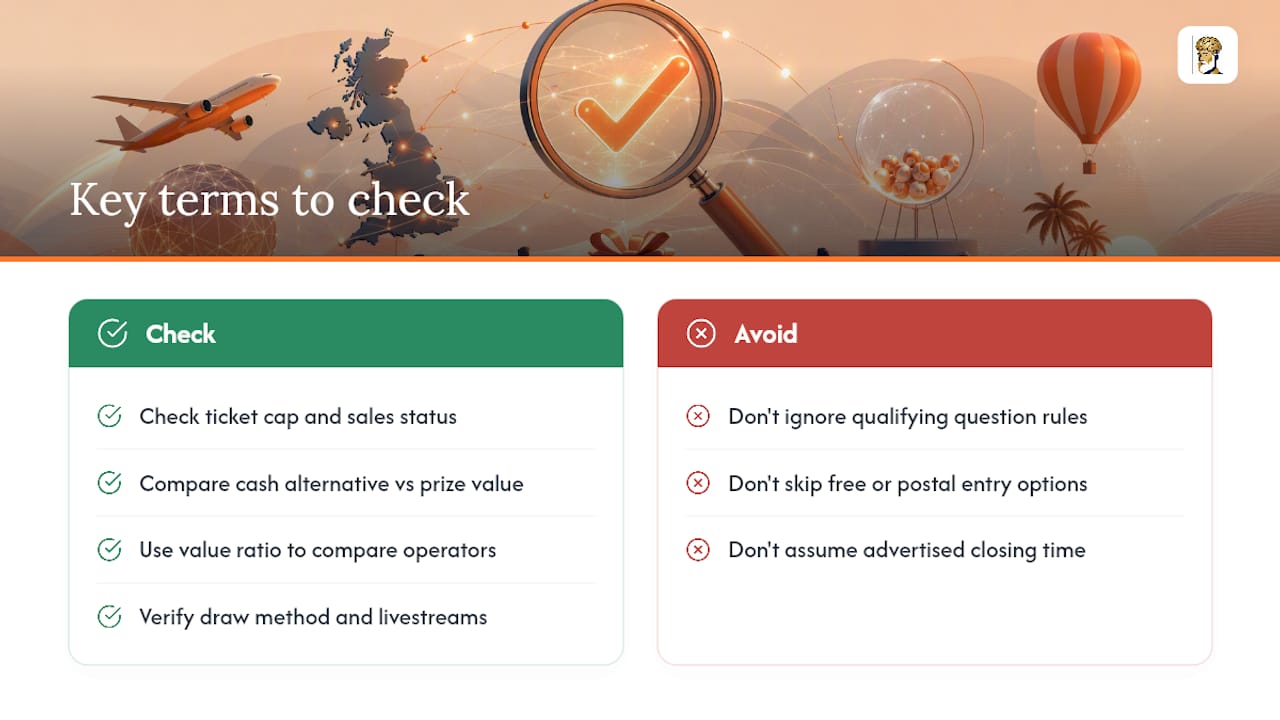
Understanding the vocabulary helps you read terms and conditions quickly instead of skimming past the details that matter. A ticket cap is the maximum number of entries an operator will sell, and competitions that sell out before the cap is reached, closing early, generally offer better real odds than the advertised maximum suggests.
The cash alternative is the amount an operator will pay instead of handing over the physical prize, and its size relative to the advertised prize value tells you how realistic that headline figure actually is. Value ratio, covered earlier, is your single best comparison metric across different operators and prize types.
Draw method refers to how the winner is selected, commonly a random number generator, and transparent operators will name the specific tool or process used and often livestream the draw itself. The qualifying question is the skill element mentioned above, while free entry or postal entry describes the no-purchase-necessary route that UK operators running as prize competitions rather than lotteries must provide clearly in their terms.
Finally, closing time matters more than most entrants realise, since a competition can close early once its ticket cap sells out, regardless of the advertised end date. Always check terms for whether the operator extends deadlines when sales are slow, since this practice can quietly worsen your odds if ticket numbers keep climbing.
What prize categories offer the best relative value?
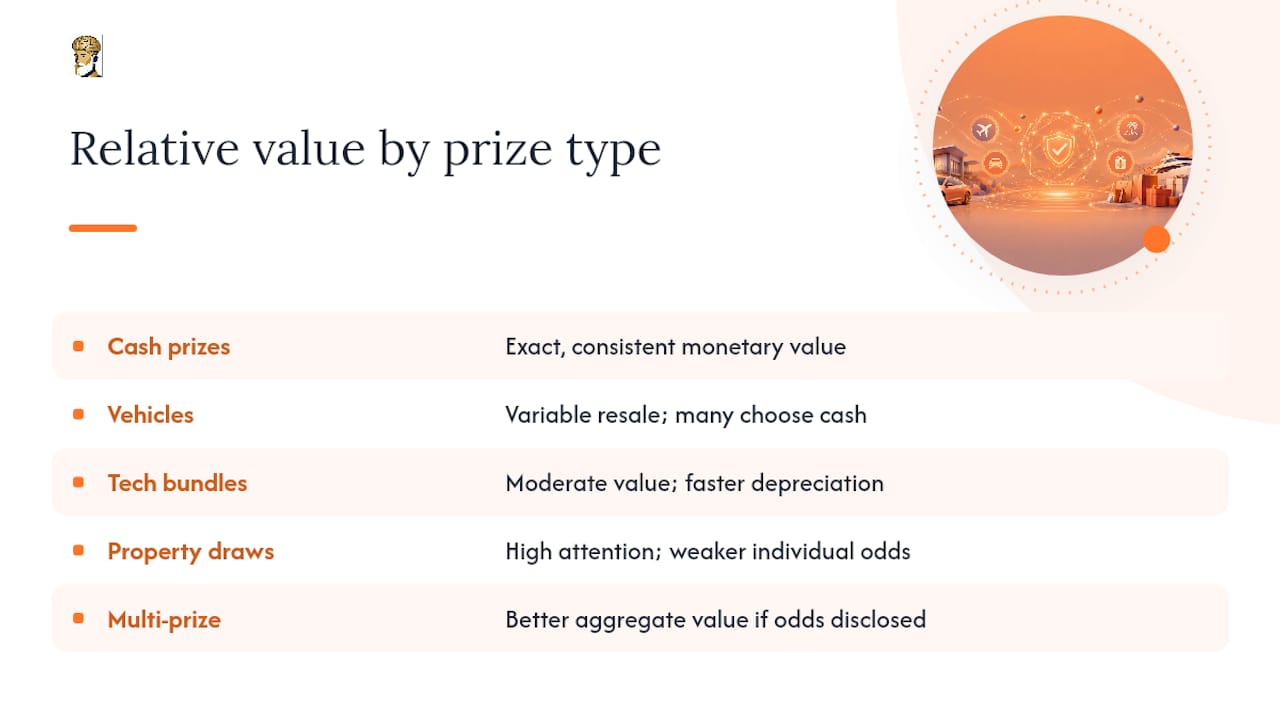
Cash prizes offer the cleanest comparison because their value never depends on your personal taste or resale ability. A £5,000 cash prize is worth exactly £5,000 to every single entrant, which makes value ratio calculations straightforward and reliable.
Vehicles, particularly the luxury cars and supercars that dominate marketing for larger operators, carry more variable real-world value. A supercar’s advertised retail price rarely matches its resale value, and many winners opt for the cash alternative instead, which is itself a useful clue: check what percentage of past winners in an operator’s published history chose cash over the physical prize.
Tech bundles and high-end electronics sit in the middle, holding value reasonably well but depreciating faster than cash retains its worth. Property draws, house giveaways in particular, generate huge attention but typically carry enormous ticket pools, meaning individual odds are often dramatically weaker than smaller cash or tech competitions running at the same time. Multi-prize competitions, where a single ticket qualifies for several draws or instant-win tiers, can offer better aggregate value than a single-prize draw of similar ticket price, provided the operator discloses odds for each tier separately rather than bundling them into one vague total.
How can you maximise entries without breaking the rules?
Every legitimate paid-entry prize competition running in the UK must offer a free, no-purchase-necessary route, and using it properly is the single most rule-compliant way to increase your entries. Read the specific instructions for each operator, since postal entry formats, required information, and submission limits vary, and ignoring the stated format is the most common reason free entries get rejected.
Spreading a fixed budget across several undersold competitions, rather than concentrating it in one high-profile draw, tends to improve your aggregate odds more than repeated entries into a single popular competition. Watch published terms for any stated limit on entries per household or per person, since exceeding it can void your entries entirely rather than simply capping them.
Timing matters too. Entering close to a competition’s closing time, once you have checked it is genuinely undersold, avoids the risk of the ticket pool growing significantly between your entry and the draw. Combining free postal entries with a small number of paid entries, where your budget allows, is a legitimate way to increase overall entries without paying for every single one, and it is explicitly the structure the free-draw rules are designed to permit.
Editorial take: when comparison actually pays off
Comparison genuinely moves the needle on undersold draws with disclosed cash alternatives, where the numbers are checkable and real. It does far less for headline luxury draws with huge ticket pools, where the appeal is entertainment, not expected value. Watch for gambler’s fallacy creeping in, chasing tiny probability gains with escalating spend rarely ends well. Use a realtime tool to keep comparisons disciplined rather than emotional.
— matt
Try Raffle Genius before you enter your next competition
Raffle Genius gives you something most comparison sites cannot: odds that update every 10 minutes rather than a static snapshot from launch day. Start with the undersold competitions feed to see which draws currently offer stronger value ratios than their advertised headline suggests, then cross-check the operator against the trusted operators list before spending anything.

Some platforms earn commission when users click through to an operator and enter a paid competition, and transparency about this is important as much as the odds data itself. The platform does not promise you will win, no comparison tool honestly can, but it does promise you will see the real numbers before you decide. Browse the full list of tracked operators and shortlist your next entry with current data rather than last week’s.
Where to check before you enter
- Gambling Commission: free draws and prize competitions
- Gambling Commission: when a lottery needs a licence
- BeGambleAware harm-minimisation support
Sources
- Gambling Commission – Free draws and prize competitions
- Gambling Commission – When is a lottery not a lottery?
- BeGambleAware
FAQ
What is a value ratio in a prize competition?
Value ratio compares an operator’s declared prize value against the maximum revenue possible if every ticket sells, giving you a single number to compare across different competitions.
Is Raffle Genius free to use?
Yes, Raffle Genius tracks and compares operator odds without charging users, earning commission only when you click through and enter a competition.
How often should I check odds before entering?
Check as close to your entry time as possible, since ticket sales shift value ratios continuously and a competition can look far better an hour before closing than it did at launch.
What makes a prize competition legal in the UK?
A prize competition stays outside lottery licensing when it includes a genuine skill element or offers an equally weighted free-entry route, as set out in Gambling Commission guidance.
Should I always choose the competition with the biggest prize?
No, a large advertised prize with a huge ticket pool often carries worse individual odds than a smaller, undersold competition with a disclosed cash alternative.
Recommended
18+ · Please gamble responsibly. Raffle Genius is a comparison service and does not run competitions.
Best odds, straight to your inbox
One email a week with the undersold UK competitions closing soon. No spam, unsubscribe any time. 18+