
3 October 2026

Promoters Must Disclose Entry Limits: CAP Code 8.28.1 and UK Free Entry Rules
Organisers may impose a limit on the number of entries a person can submit, but any restriction significant enough to affect someone’s decision to enter must be disclosed before or at the time of entry under CAP Code rule 8.28.1. Whether a free-entry route is also compulsory depends on whether the promotion is chance-based or skill-based. For the definitive position, the Gambling Commission and the Advertising Standards Authority remain the primary regulators to consult.
TL;DR:
- Entry limits must be disclosed before or at the time of entry; hidden or late-enforced restrictions can lead to legal and reputational issues.
- To qualify as a free draw and avoid lottery classification, the free route must cost no more than standard postage and be equally convenient as paid options.
- Promoters must clearly specify conditions such as entry limits, closing dates, and eligibility, ensuring information is easy to find and not buried in fine print.
- A genuine skill-based competition does not require a free entry route if the skill test is sufficiently difficult to deter most entrants.
- Recognizing common entry limit patterns helps entrants assess fairness, especially when limits are not transparently disclosed or are bypassed using automated tools.
Table of Contents
- How UK law classifies promotions: lottery, free draw and prize competition
- What promoters must disclose about entry limits and other significant terms
- Free-entry route rules: what “no less convenient” and “normal rate” mean in practice
- Common entry-limit patterns and real examples from UK competitions
- Practical checklist for entrants: what to check about entry limits before entering
- Publisher perspective: how Raffle Genius interprets and flags entry limits
- Our take: disclosure matters more than the limit itself
- How Raffle Genius helps you spot entry limits and find raffles with clear rules
- FAQ
- Sources
How UK law classifies promotions: lottery, free draw and prize competition
UK gambling law sorts prize promotions into three distinct categories, and the category a promotion falls into decides whether it needs a licence or a free way in.

A lottery exists where entrants pay to take part, prizes are allocated wholly or partly by chance, and no genuine skill offsets that chance. Running one without a licence breaches the Gambling Act 2005, which is why most commercial promotions are deliberately structured to avoid the definition.
A free draw sidesteps that problem by remaining chance-based while offering an accessible route that costs nothing beyond normal communication charges. Because entry is genuinely free for anyone who wants it, the promotion escapes classification as a lottery even though winners are still picked at random.
A prize competition takes the other route: it introduces a genuine test of skill, knowledge or judgement. Under Gambling Commission guidance, a prize competition that requires skill does not have to offer a free entry route, because the skill element, not the payment, is what determines the outcome. The test for “genuine skill” matters here: a question must be hard enough to deter a significant proportion of entrants or prevent a material number from winning. A trivial multiple-choice question that nearly everyone answers correctly rarely clears that bar, which risks the promotion being reclassified as a chance-based draw requiring a free route after all.
Northern Ireland operates under its own gambling legislation, so promoters running UK-wide competitions should check whether any regional variation affects their specific promotion before launch.
What promoters must disclose about entry limits and other significant terms
Disclosure obligations sit separately from the gambling classification question, and they apply regardless of whether a promotion is a free draw or a skill-based competition. CAP Code rule 8.28.1 explicitly lists “any restriction on the number of entries” as information that must be stated before or at the time of entry, alongside closing dates, prize details and any geographic or age restrictions.
This information does not need to sit in the headline advert itself, but it must be easy to find at the point a person decides to enter, not buried deep inside a separate terms document discovered only after payment. ASA guidance on promotional marketing for competitions reinforces that terms should not be unnecessarily complex, and that changing rules part-way through a promotion can attract enforcement action. Where a promoter alters an entry limit or closing date after the competition has launched, the ASA/CAP guidance treats that as a transparency failure likely to generate upheld complaints.
The consequences of getting this wrong are reputational as well as regulatory. A misleading omission around entry limits can trigger an ASA ruling, forcing the promoter to amend future material, and it tends to erode consumer trust in the brand running the promotion long after the complaint is resolved.
Free-entry route rules: what “no less convenient” and “normal rate” mean in practice
For a free draw to stay exempt from lottery classification, its free route has to meet two linked tests. Guidance on Schedule 2 of the Gambling Act explains that the free route must cost no more than the “normal rate” of ordinary communication, such as a standard first- or second-class stamp, and it must be “no less convenient” than any paid route offered alongside it.
Common pitfalls include directing the free route through a premium-rate phone line, a postal address that requires special or recorded delivery, or a digital form that consumes paid mobile data while the paid entry route sits one tap away on an app. Any of these can tip the free route into being a disguised payment, which undermines the exemption entirely. The Gambling Commission’s definitions guidance also flags that a web-only free route can exclude entrants with limited internet access, so promoters are advised to offer an alternative where that risk is realistic.
Where a promoter runs both a paid and a free route, the two need equal prominence in advertising and equal treatment once entries are received: the same prize pool, the same odds, and the same shuffling or draw process. A promoter who buries the free route in small print while headlining the paid one is likely to fall foul of both gambling law and CAP disclosure rules at once.

Common entry-limit patterns and real examples from UK competitions
Entry limits in UK competitions tend to follow a handful of recognisable patterns, and recognising them helps entrants judge whether a rule is ordinary housekeeping or something that skews their odds unfairly.
- Per-person caps: many promoters, including supermarket competitions, restrict entry to one submission per person to keep the field fair.
- Per-household limits: some competitions extend the cap to a household, which stops multiple family members from gaming the odds with separate accounts.
- Per-category or per-image caps: photography and creative competitions sometimes allow several submissions, with the Wildlife Photographer competition’s per-image structure a commonly cited example in public terms.
- Per-email or per-device limits: digital promotions often track entries by email address or device identifier rather than relying on an honour system.
These patterns from public competition rules show real variation: some specify a strict “one entry per person”, while others knowingly permit up to 25 submissions within a single promotion. Limits become genuinely unfair when they are not disclosed until after entry, when they are enforced inconsistently, or when automated bulk-entry tools let some entrants bypass the stated cap entirely, a red flag worth watching for in any competition with a large prize.
Practical checklist for entrants: what to check about entry limits before entering
Before entering any UK competition, a short review of the published terms can save disappointment later and confirm the promotion is being run fairly.
- Locate the entry-limit rule. Check whether it appears in the main promotional material or only inside the full terms and conditions, since CAP rule 8.28.1 requires it to be visible before you commit.
- Find the free-entry route if one exists. Confirm exactly how to use it and what, if anything, it costs you to send.
- Check eligibility restrictions. Age, UK residency and any excluded groups (such as employees of the promoter) should be stated clearly.
- Confirm how winners are chosen and published. Look for a stated draw date, a prize-number breakdown and a commitment to publish or make available winner details.
- For skill-based competitions, check judging independence. The rules should name who judges entries and on what basis.
- If anything is unclear, contact the promoter directly and keep a record of your correspondence.
Pro Tip: Screenshot the entry-limit and free-route terms at the moment you enter, since promoters occasionally amend pages later and a saved copy gives you evidence if a dispute arises.
If a promoter will not clarify ambiguous terms, entrants can escalate unresolved concerns to the ASA for advertising breaches or to the Gambling Commission where licensing or classification is in question.
Publisher perspective: how Raffle Genius interprets and flags entry limits
When we list a UK raffle or competition, we include entry limits where available and note whether a free-entry route exists. We refresh these listings regularly because a limit that changes mid-promotion changes a buyer’s real odds, not just the small print. A one-entry cap on a heavily promoted draw produces very different odds from an uncapped one with the same ticket pool, and we think that distinction belongs on the listing page itself, not three clicks into a terms document. Readers comparing raffles can check our listing pages directly for the specific entry rules attached to each competition before deciding where to spend.
Our take: disclosure matters more than the limit itself
The number attached to an entry limit gets most of the attention, but it is the wrong thing to fixate on. A tight one-entry-per-person cap run with transparent, stable rules is fairer to entrants than a generous-looking unlimited entry policy that hides a premium-rate free route or buries its terms until after payment. The research behind this piece points to one consistent pattern: regulatory trouble clusters around disclosure failures, not around limits that are simply strict.
Conventional advice tends to tell entrants to “read the terms”, which is true but incomplete. The more useful habit is checking where the terms live: a limit disclosed in the headline advert signals a promoter confident in its own rules, while one buried deep in a linked document is a reason for caution regardless of how generous the headline prize looks.
If we had to prioritise one check above all others, it would be the free-route test. A chance-based draw that makes its free route genuinely inconvenient is quietly behaving like a lottery while advertising itself as something else.
— matt
How Raffle Genius helps you spot entry limits and find raffles with clear rules
We built our comparison tool because checking entry limits and free routes across dozens of UK raffles, one terms page at a time, is tedious work that most entrants reasonably skip. The platform updates odds frequently and indicates entry rules next to each listing, so the limit that affects your odds is visible alongside the ticket price, not hidden behind a separate click.
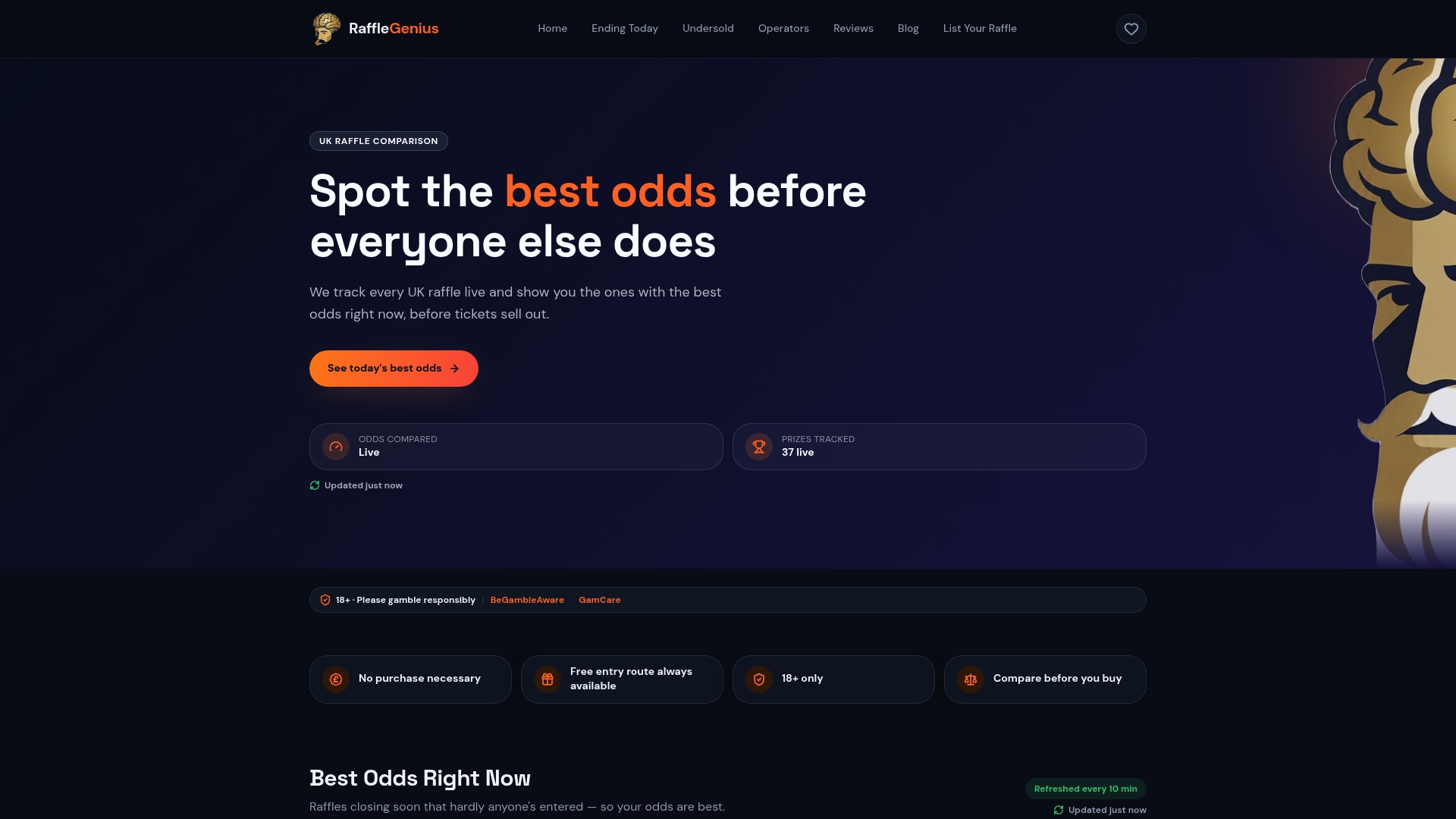
- Compare live UK raffles with odds, ticket prices and closing times in one place on our main comparison page.
- Browse undersold competitions where entry limits often leave better odds available.
- Check our list of trusted operators before you commit any money to a draw.
- Go ad-free on our listings for £4 per month through our Go ad-free plan.
If you run a competition and want your entry rules presented clearly to entrants searching for their next draw, you can get your raffle listed with us.
This article is general information, not a substitute for advice from a qualified lawyer. Consult a qualified legal professional about your own circumstances before acting on anything here.
FAQ
What competitions can I enter?
You can enter any UK-based free draw or prize competition open to your age group and location, provided you meet the eligibility terms the promoter has published. Our operator comparison guide lists active competitions across categories including cars, cash and tech prizes.
What are the legal requirements for prize competitions in the UK?
A prize competition must include a genuine test of skill, knowledge or judgement difficult enough to deter a meaningful proportion of entrants, otherwise it risks being treated as a chance-based draw under the Gambling Act 2005. Promoters must also disclose entry limits, closing dates and prize details before or at the point of entry, under CAP Code rule 8.28.1.
Is it worth entering free competitions?
Free draws can be worth entering since the free route must cost no more than the normal rate of post and be no less convenient than any paid alternative, so you lose nothing but a little time. Checking a site that tracks live odds and entry limits, such as our operator comparisons, helps you judge whether a particular free draw offers reasonable odds against the field.
Can I enter a car competition for free?
Yes, if the car competition is structured as a free draw or dual-route promotion, it must offer a free entry route that is genuinely accessible and no less convenient than the paid option. Always check the promoter’s published terms for the exact free-entry method and any stated entry limit before taking part, and see our guidance on checking raffle legitimacy for further verification steps.
Sources
- The CAP Code (promotional marketing: competitions and prize promotions)
- Free draws and prize competitions (Gambling Commission)
- Prize competitions and free draws (Schedule 2 guidance excerpt)
Recommended
18+ · Please gamble responsibly. Raffle Genius is a comparison service and does not run competitions.
Best odds, straight to your inbox
One email a week with the undersold UK competitions closing soon. No spam, unsubscribe any time. 18+