
8 October 2026

Uncapped UK Competitions: 5 Checks, Then Track Live Odds
“Uncapped” rarely means limitless in practice: it usually signals that a promoter has not set a published maximum, but legal rules on free entry and the promoter’s own terms still shape how many times you can realistically enter. Before chasing volume, check the free entry rules that apply and verify the small print. The sections below walk through the legal backdrop, a verification checklist and tactics for tracking genuinely favourable draws.
TL;DR:
- For promotions based on chance that charge an entry fee, the free route must cost no more and be no less convenient than paid entry.
- Search the full terms for per person, per household, or maximum entry limits, then confirm closing date, judging method, prize allocation, and contact details.
- Use only listed entry methods, keep receipts or confirmations, and avoid bots, aliases, or IP masking, which can invalidate entries and disqualify winners.
- Compare ticket cost with prize value and monitor odds near closing, because undersold draws may offer better chances; set a fixed budget before entering.
Table of Contents
- What ‘uncapped’ means in UK competitions and how the law treats entry limits
- Checklist: how to verify a competition really allows unlimited entries
- Lawful tactics to increase legally allowed entries and avoid disqualification
- Where UK entrants commonly find uncapped or high‑entry competitions
- How live odds and tracking improve your entry strategy
- Responsible, evidence-based play for frequent entrants
- Raffle Genius: track odds and spot genuinely uncapped opportunities
- FAQ
- Sources
What ‘uncapped’ means in UK competitions and how the law treats entry limits
UK promotions fall into a few distinct legal categories, and the differences matter more than the marketing language used to describe them. A prize competition that includes a genuine element of skill does not need a lottery licence, whereas a draw based wholly on chance that charges an entry fee must offer a free route that is no less convenient and no more expensive than the paid one, according to the Gambling Commission. This free-route requirement exists precisely so a chance-based promotion does not become an unlicensed lottery.
“Normal rate” has a specific meaning under this guidance:
- Ordinary first or second class post counts, provided it is not a premium or guaranteed-delivery service.
- A standard-rate telephone call, charged at the caller’s usual rate, qualifies as a free route.
- Basic-rate email or SMS entry is acceptable, but premium-rate numbers or paid-for text services do not meet the requirement.
Even where no entry limit is advertised, most promoters write per-person or per-household caps into their full terms. This is the core reason “uncapped” headlines can mislead: the promotional copy emphasises no stated maximum, while a clause several paragraphs into the terms restricts how many entries count towards the prize draw.
Our own guides go further into these distinctions, including how prize competitions differ from lotteries under UK law and the two legal tests that decide whether a promotion needs a licence at all.
Checklist: how to verify a competition really allows unlimited entries
Confirming an “uncapped” claim takes a few minutes of reading, and it is time well spent before you commit postage, purchases or personal details to a promoter.
- Read the full terms and conditions, not just the promotional page, and search specifically for “per person”, “per household” or “maximum entries” language.
- Compare the free-entry method against the paid route. It should cost no more than standard post, a standard-rate call or basic email, and it should be presented with similar prominence to the paid option, as the ASA’s guidance on free entry routes sets out.
- Check the closing date, judging process and prize allocation mechanism. Promoters must publish these clearly under CAP rules on promotions with prizes, and judging should be independent wherever selection involves subjective criteria.
- Look for a complaints or query route, such as a named contact or customer service address, and use it if any clause is unclear.
- Keep proof of entry, whether that is a certificate of posting, an email confirmation or a purchase receipt, in case a dispute over validation arises later.
Our piece on disclosing entry limits under CAP Code 8.28.1 walks through real examples of restrictive terms worth watching for.
Pro Tip: Screenshot the terms and conditions page on the day you enter, since promoters sometimes amend wording after a draw opens.

Lawful tactics to increase legally allowed entries and avoid disqualification
Where a promoter genuinely allows multiple entries, the safest way to use that allowance is to follow the stated method exactly, whether that means one postal entry and one paid entry per draw, or a set number of paid tickets alongside a single free route. Our guide on entering free using a postcard or normal-rate email covers how to use the no-purchase-necessary option correctly.
- Submit paid entries up to any stated limit, and pair them with the free route if the terms allow both.
- Never use scripts, bots, multiple aliases or IP masking to submit extra entries, since these methods breach almost every promoter’s terms and typically lead to disqualification.
- Keep a simple log of purchases, confirmation emails and dates entered, so you have evidence if a promoter asks you to validate a win.
- Ask the promoter directly when a clause is genuinely ambiguous rather than guessing and risking invalidation.
Pro Tip: If a promotion’s terms are silent on a method you are considering, such as entering once per email address, treat that silence as a reason to ask rather than a loophole to exploit.
Where UK entrants commonly find uncapped or high‑entry competitions
Several sources consistently carry promotions that either advertise no entry cap or allow a high volume of lawful entries, and each comes with its own pattern of terms worth knowing before you dive in.
- Magazine competitions and broadcaster “win” pages typically publish detailed terms and usually include a free-entry route, since many operate as prize competitions rather than paid draws. Broadcaster pages such as ITV’s free competitions section list numerous weekly draws alongside help pages explaining how to enter without paying.
- Charity raffles and operator sites often permit a high number of paid entries, but they still publish per-person limits and validation rules, so the absence of a visible cap does not mean the absence of any limit.
- Aggregators and newsletters serve as discovery tools rather than entry routes themselves, helping you spot undersold draws or competitions nearing their closing date before ticket volume rises.
How live odds and tracking improve your entry strategy
Timing affects value more than most entrants realise: an undersold draw close to its closing date, or one with a smaller ticket pool than usual, can offer noticeably better odds for the same entry cost than a heavily promoted draw earlier in its cycle. Our breakdown of high-value competitions in the UK explains how undersold draws arise and why they matter to frequent entrants.
Tracking a handful of fields consistently helps you compare opportunities on their merits rather than on marketing noise:
- Current odds, which shift as ticket sales change.
- Ticket price relative to prize value.
- Closing time, since late entries into undersold draws often carry better odds.
- How prominently the free-entry route is displayed, which signals how seriously a promoter treats its legal obligations.
A platform that refreshes odds every 10 minutes gives you a live view of which draws are genuinely undersold, according to our raffle comparison tool, rather than relying on a promoter’s own snapshot at launch.
Responsible, evidence-based play for frequent entrants
Chasing every “uncapped” promotion without a plan tends to cost more than it returns. We think the sounder approach is to set a fixed budget before entering anywhere, favour operators with a track record of transparent terms, and keep records of every entry so validation never becomes a dispute. Shortcuts that promise more entries, such as scripted submissions or fake accounts, carry a real risk of disqualification and rarely pay off against that risk.
— matt
Raffle Genius: track odds and spot genuinely uncapped opportunities
We built our UK raffle comparison page to solve exactly the problem this guide describes: spotting which “uncapped” or undersold draws are worth your time before the odds shift against you. Our odds update every 10 minutes, we flag free-entry routes clearly, and we verify operators so you are not left decoding terms and conditions alone.
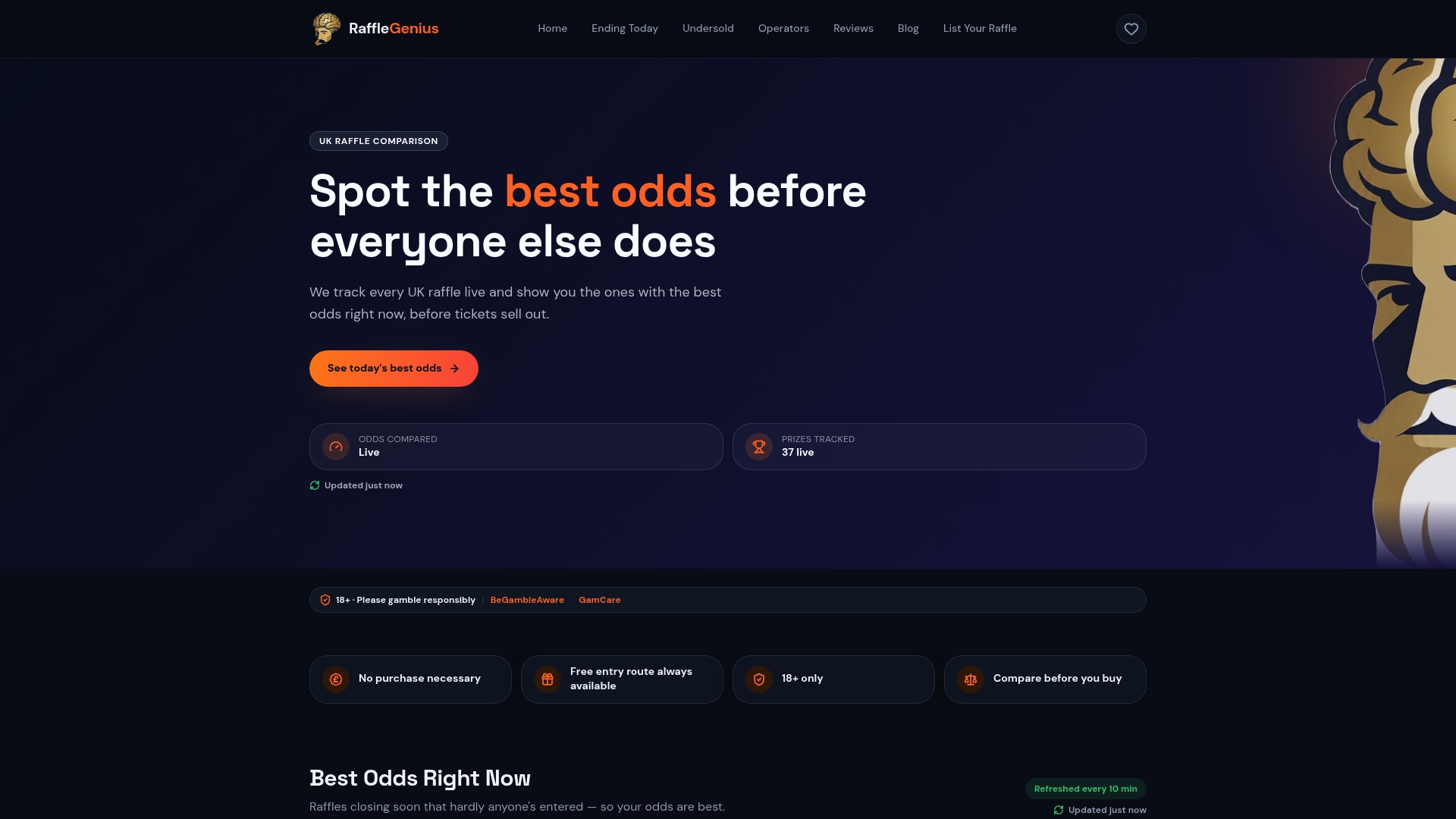
- Browse live odds across Cars, Cash, Homes, Watches & Jewellery, Tech, Holidays and Motorbikes in one place.
- Check how we vet listings on our trusted operators page before you commit to any draw.
- Go ad-free for £4 per month if you want a cleaner browsing experience while you compare draws.
| What you get | Where to find it |
|---|---|
| Live odds refreshed every 10 minutes | UK raffle comparison |
| Operator verification and trust ratings | Trusted operators |
| Ad-free browsing | Go ad-free, £4/month |
Start on our comparison page, filter by category, and prioritise the draws where odds and closing times genuinely favour you.
FAQ
What are the best free online competitions to enter in the UK?
The best free routes are usually found on broadcaster pages and magazine competition sites, which commonly publish both a paid and a standard-rate free entry method side by side. Always confirm the free route meets the Gambling Commission’s normal-rate standard before relying on it, since premium-rate alternatives do not qualify.
What are some current magazine competitions in the UK?
Magazine competitions change frequently, so the most reliable approach is to check each title’s own competitions page or digital edition for live listings and their published terms. Look for a clearly stated free-entry method and a closing date, both of which CAP guidance requires promoters to disclose.
Can a promoter still limit entries if a competition says “uncapped”?
Yes, “uncapped” typically means no advertised maximum rather than a legal guarantee of unlimited entries, and most promoters include per-person or per-household limits in their full terms. Reading the complete terms and conditions, not just the headline claim, is the only reliable way to confirm the real limit.
Is it legal to enter a UK competition without paying?
Yes, where a promotion is a chance-based draw that charges to enter, the law requires a free entry route that is no less convenient and no more expensive than the paid one, as set out by the Gambling Commission. Skill-based prize competitions work differently and do not always need to offer a free route in the same way.
What should I avoid when trying to maximise competition entries?
Avoid scripts, multiple fake accounts or any method designed to bypass a stated entry limit, since these breach almost every promoter’s terms and typically result in disqualification. Stick to the entry methods explicitly listed in the terms, and contact the promoter if any rule is unclear.
Sources
- Free draws and prize competitions - Gambling Commission
- Promotional marketing: Free entry routes - ASA
- Promotions with prizes (CAP guidance)
Recommended
18+ · Please gamble responsibly. Raffle Genius is a comparison service and does not run competitions.
Best odds, straight to your inbox
One email a week with the undersold UK competitions closing soon. No spam, unsubscribe any time. 18+