
10 September 2026

Before you pay: 5 checks to verify UK odds transparency
Odds transparency in UK prize draws means an operator publishes enough information for you to calculate your actual chance of winning before you pay. A draw is genuinely knowable only when it discloses a ticket cap or live entry count and a working free-entry route. The Gambling Commission expects licensed operators to publish this before purchase, and tools like Raffle Genius track it in real time so you can compare draws in seconds rather than digging through terms and conditions.
TL;DR:
- Most UK prize draws are only knowable if they disclose a ticket cap or current entry count, which allows accurate calculation of actual odds.
- A legitimate competition must offer a visible free-entry route, a fixed closing date, and publish a verifiable draw method with audit evidence.
- Without a published cap or estimate, odds remain unknowable until the draw closes, making it risky to rely on vague or shifting figures.
- Social media-led draws often lack proper licensing, visible operator information, or transparent odds, increasing the risk of illegal activity.
- Using real-time tracking tools like Raffle Genius helps compare current odds and identify undervalued competitions before purchasing tickets.
Table of Contents
- Quick checklist: five things to check before you pay
- What UK rules and Gambling Commission guidance say about disclosure
- How to calculate or estimate your odds from published figures
- Red flags and illegal activity to avoid, especially on social media
- How Raffle Genius helps you check odds and compare value in real time
- Use transparency to play responsibly
- Check this week’s best odds on Raffle Genius
- Official guidance and explainers to read next
- Sources
- FAQ
Quick checklist: five things to check before you pay
Before entering any UK prize competition, run through five checks on the competition page itself, not buried three clicks deep in the terms.
- Published ticket cap or live entry count. This is what lets you calculate a worst-case “1 in N” figure. No cap means no knowable odds.
- A clear free-entry route. Legitimate prize competitions must offer one to stay outside lottery licensing rules, and it should be visible on the page itself, not just referenced in small print.
- A fixed closing date. Draws that quietly extend their deadline are usually stalling because ticket sales are lower than hoped, which changes your actual odds without telling you.
- A published draw method with audit evidence. Look for a CSPRNG seed you can verify, or a preserved live recording of the draw.
- Operator identity. A Companies House number, a registered postal address, and accessible terms and conditions.
Pro Tip: Screenshot the ticket cap and closing date when you enter. Operators occasionally edit these fields after launch, and a screenshot gives you a record of what you were promised.
Marketing language is not proof of anything. A competition branded a “raffle” is often legally a prize competition using a skill question or free postal route, and that label tells you nothing about whether the operator is honest about entry numbers. Judge the page on the five checks above, not the branding.
What UK rules and Gambling Commission guidance say about disclosure
The Gambling Commission’s guidance on information to lottery players, proceeds and prizes requires licence holders to make clear, accessible information available before purchase. That includes how winners are determined and, crucially, the likelihood of winning. Remote lottery licensees with significant annual proceeds face specific requirements to give players usable information on prizes and chances rather than vague reassurance.
Where an exact figure isn’t possible because final ticket numbers depend on how many people buy in before closing, the Commission’s own guidance says operators should still publish a reasonable estimate and label it clearly as an estimate. An unlabelled guess dressed up as a fact is itself a transparency failure.
It helps to understand the legal categories underneath the marketing:
- Lotteries require a licence from the Commission or registration with a local authority, and prizes are allocated purely by chance against a payment.
- Society lotteries run for charitable or non-commercial purposes under specific licensing conditions.
- Prize competitions avoid lottery licensing by including a genuine skill element or, more commonly, a free postal or online entry route that carries equal weight to a paid entry.
That free-entry route is not a footnote. It is the legal mechanism that keeps most UK online raffles classified as prize competitions rather than unlicensed lotteries, so it needs to be real, working, and easy to find, not hidden behind a support ticket or a slow-loading page.
How to calculate or estimate your odds from published figures
The formula is simple: your tickets divided by total tickets equals your probability, and you flip that into a “1 in N” figure by dividing total tickets by your own ticket count.
Worked example: a competition capped at 5,000 tickets, and you buy one. Your odds are 1 in 5,000. Buy five tickets in the same draw and your odds improve to 1 in 1,000, because your chance rises in direct proportion to how many entries you hold, up to whatever per-person limit the operator sets.
Follow this in under a minute on any competition page:
- Find the published ticket cap or current entry count.
- Divide the cap by the number of tickets you’re considering buying.
- That result is your “1 in N” figure. Compare it against the prize value to judge whether the cost per chance is reasonable.
- If no cap is published, check whether the operator gives a labelled estimate or an average from previous draws, and treat that number as provisional rather than fixed.
Odds transparency in numbers: a capped draw of 5,000 tickets gives a single entrant fixed worst-case odds of 1 in 5,000, a figure that cannot get worse even if the operator undersells the draw. Without a published cap, that same competition’s true odds stay unknowable until the moment it closes, which is exactly why the cap matters more than almost any other detail on the page.
Red flags and illegal activity to avoid, especially on social media
Some warning signs are easy to spot once you know to look for them, and most cluster around the same missing disclosures covered above.
- No free-entry route, or one that only exists as vague postal instructions buried in the terms.
- No Companies House number, no registered address, and no archive of named past winners with dates.
- No published ticket cap, a closing date that keeps moving, or a “rollover” explanation that never states how many entries carried over.
- The competition is run by an individual account on social media rather than a registered business.
That last point deserves particular attention. The Gambling Commission has warned that paid draws promoted on social media frequently lack the society lottery licence or registration they need, even when the organiser claims the proceeds go to charity. The Commission’s own 2026 research into individual-led online lotteries found a rise in reports about these draws, and external coverage of that research points to the same compliance gaps: no visible licence, no verifiable draw method, no accountable operator. If you spot a suspected illegal draw, the Commission accepts reports directly through its public guidance pages.
How Raffle Genius helps you check odds and compare value in real time
A web platform tracks live UK raffles and updates odds periodically, showing ticket counts, ticket price, prize value, and closing time on one page. Instead of opening ten operator sites to compare five entries against a car worth £30,000 or a cash prize, you see the numbers side by side and updated as tickets sell.
That live update matters because odds move. A competition sitting at 40% sold on Monday might be 85% sold by Thursday, and your “1 in N” figure shifts with it. Checking a raffle comparison platform before buying lets you spot undersold competitions where your odds are still favourable, and cross-check an operator’s own published cap or winners list against what the platform is tracking independently.
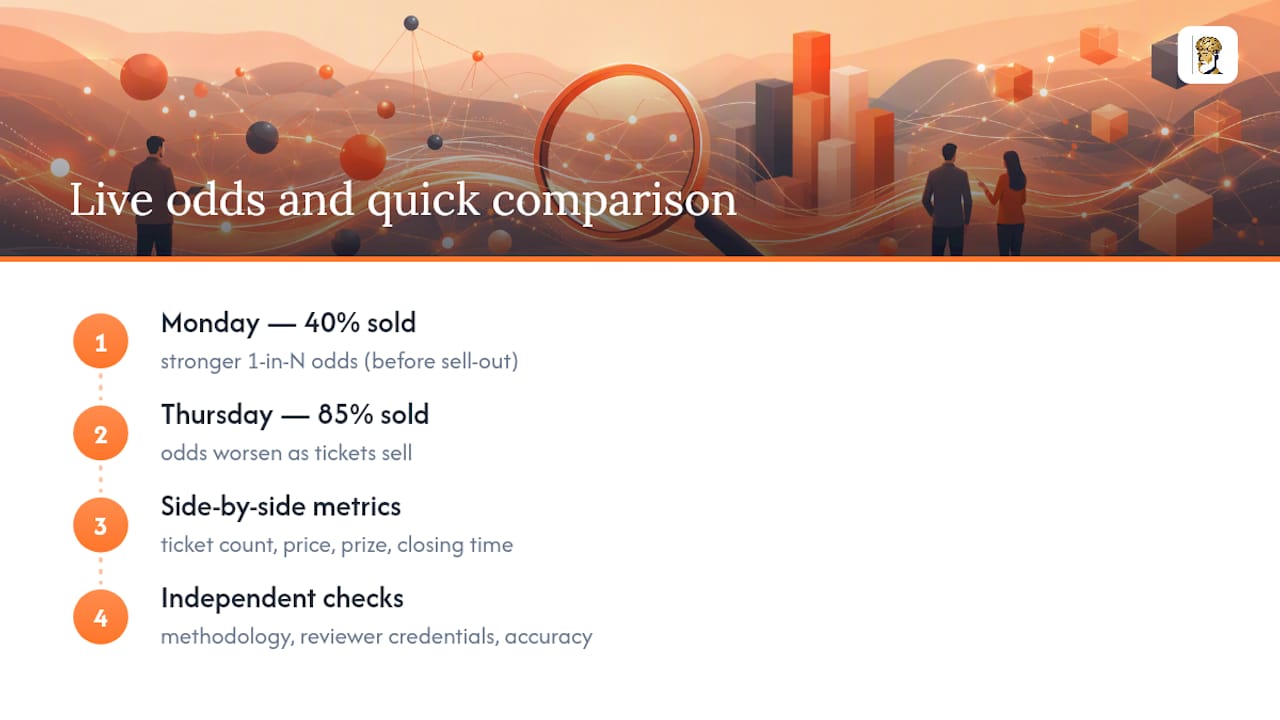
Details on the platform’s methodology, verified reviewer credentials, and accuracy benchmarks are maintained separately and updated as new data becomes available.
Use transparency to play responsibly
Transparency only protects you if you actually use it before you pay, not after. Treat published odds the same way you’d treat a price tag: read it first, decide second.
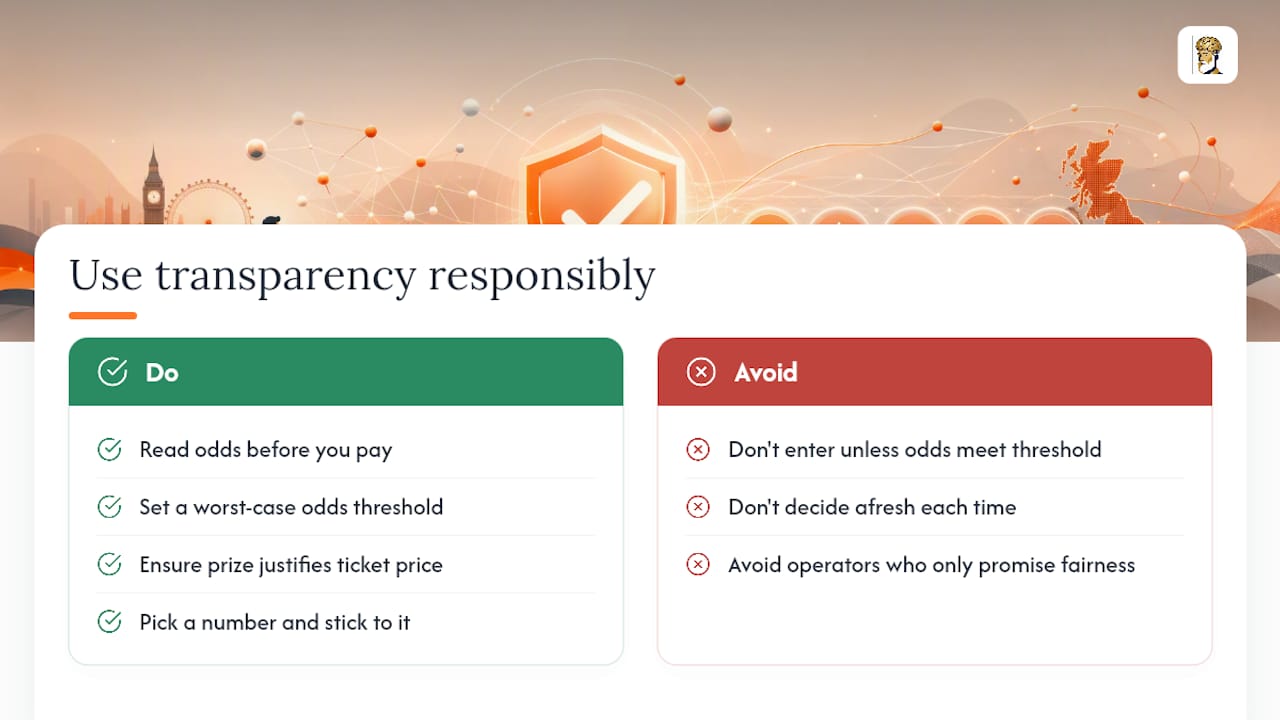
A rule worth adopting: don’t enter unless the worst-case odds are better than a threshold you’ve set for yourself, and the prize value genuinely justifies the ticket price at that threshold. Mine is roughly 1 in 2,000 for anything under £10 a ticket. Adjust yours to your own budget, but pick a number and stick to it rather than deciding fresh each time a competition looks exciting.
Favour operators who publish audit evidence and a dated winners archive over those who simply promise fairness. A seed you can verify or a preserved recording tells you far more than a testimonial ever will.
— matt
Check this week’s best odds on Raffle Genius
This platform exists to remove the guesswork this article just walked you through, tracking ticket counts, prices, and closing times across UK raffles and refreshing the picture frequently so you’re never comparing yesterday’s odds. Rather than manually applying the checklist above to multiple operator pages, you get the numbers already laid out.
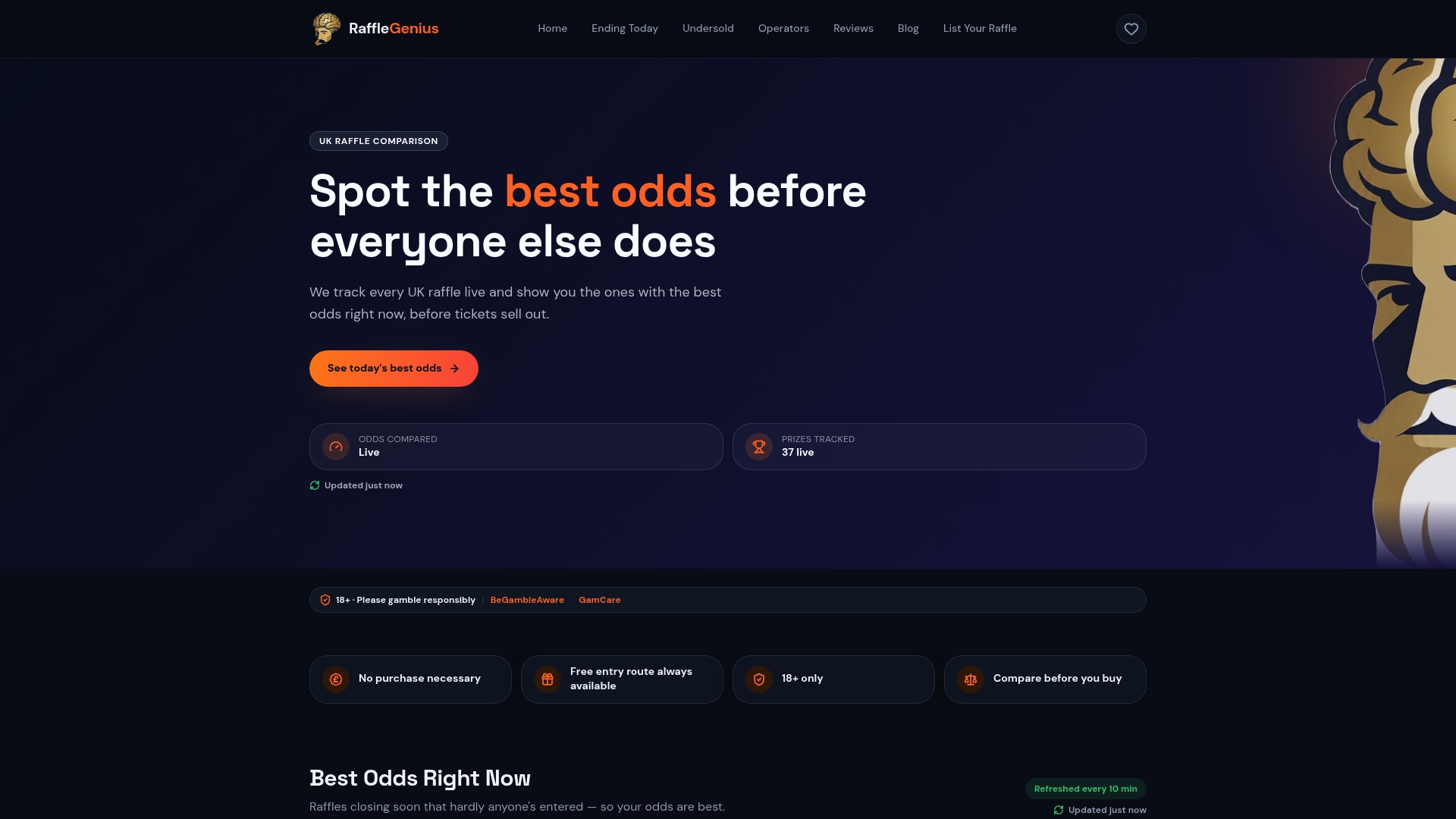
A sensible next move is to visit the best odds this week page and see which current competitions are undersold relative to their prize value. If you’d rather build a chance without spending, the Play to Win feature lets you earn entries through free games instead of a ticket purchase.
Official guidance and explainers to read next
- Information to lottery players, proceeds and prizes — Gambling Commission
- Fundraising and lotteries on social media — Gambling Commission
- Are UK raffle sites legit? — Raffle Genius
- How to find the best UK prize raffles — Raffle Genius
Sources
- Information to lottery players, proceeds and prizes – Gambling Commission
- Fundraising and lotteries on social media – Gambling Commission
FAQ
What does odds transparency mean for a UK raffle?
It means the operator publishes a ticket cap or live entry count, a working free-entry route, and a verifiable draw method, so you can calculate your actual chance before paying.
How do I calculate my odds on a capped competition?
Divide the total ticket cap by the number of tickets you hold; a single ticket in a 5,000 ticket draw gives you 1 in 5,000 worst-case odds.
Is every online raffle in the UK licensed?
No. Many are legally prize competitions relying on a free-entry route rather than a lottery licence, and some draws promoted on social media lack any licence or registration at all.
What should I do if I suspect an illegal draw?
Report it through the Gambling Commission’s guidance pages, and avoid entering competitions with no Companies House number or published ticket cap.
Can Raffle Genius show me which competitions have the best odds right now?
Yes. Raffle Genius updates odds every 10 minutes across tracked UK competitions, letting you compare ticket price, prize value, and entry counts on the best odds this week page.
Recommended
18+ · Please gamble responsibly. Raffle Genius is a comparison service and does not run competitions.
Best odds, straight to your inbox
One email a week with the undersold UK competitions closing soon. No spam, unsubscribe any time. 18+