
20 November 2026
Compare live raffles →
Comping is the hobby of regularly entering competitions, prize draws and raffles in the hope of winning prizes, and someone who does it is a comper. The Cambridge Dictionary lists it as UK informal and describes it as entering competitions, for example in magazines or online, to win prizes. Today most comping happens online, which means the skill is no longer just finding competitions but comparing them: ticket price against prize value, how many tickets are left, when the draw closes and whether there is a genuine free route in. That is the job we built Raffle Genius to do, with odds refreshed every 10 minutes.
TL;DR
- Comping is the informal UK word for regularly entering competitions, draws and raffles to win prizes. A comper is the person doing it.
- No system guarantees a win. What you can control is which competitions you enter: the ticket price, the prize value and the number of tickets sold all change your odds.
- Fewer tickets sold generally means better odds for the same prize, so undersold competitions are where careful compers look first.
- Legitimate UK draws that charge to enter must offer a free entry route, usually a postal entry at the ordinary rate, with the same chance of winning as a paid ticket.
- Promo codes and offers come with terms. Read the entry limits, closing date and free route before you pay.
Table of Contents
- What comping means in the UK
- How comping works step by step
- Draws, raffles and prize competitions: why the label matters
- Free entry: the comper’s route
- Understanding odds: the part that separates compers
- Competition promo codes explained
- How to tell a genuine competition from a bad one
- Comping with Raffle Genius
- Our view on comping
- FAQ
- Sources
What comping means in the UK
The word comes from “competition”, shortened in the way British English likes to shorten things. The Cambridge entry also calls it a potentially profitable hobby but not a sure-fire way to make money, which is a fair summary: some people do win regularly, but nobody can promise you a result.
If you searched “comping meaning” and landed on pages about jazz, you were not wrong to be confused. In music, comping is short for accompanying: a pianist or guitarist playing chords behind a soloist. The two meanings share a root in the word “accompany” or “compliment” depending on the context, and nothing else. In hospitality, to “comp” something means to give it away free, as in a comped meal. Here we are talking about the third meaning: entering competitions for prizes.
What counts as a competition for a comper? Almost anything with a prize and an entry route:
- Prize draws and raffles, where winners are picked by chance from valid entries.
- Prize competitions, where you answer a question or complete a task that takes some skill, knowledge or judgement.
- Instant wins, where you find out immediately whether an entry has won.
- Social media giveaways and magazine, supermarket or brand promotions.
Prizes range from small cash sums and gadgets to cars, holidays, watches and even houses, and that spread is exactly why comping has become a serious pastime for people who treat it like a numbers game.
How comping works step by step
The details differ between operators, but the journey is similar almost everywhere:
- Find a competition. You choose a prize, then look at the ticket price, the maximum number of tickets and the closing date.
- Register. Most online operators ask you to create an account and confirm you are 18 or over and live in the UK or in the areas the rules list.
- Choose your entries. You pick how many tickets to buy, often up to a per-person limit, or you use the free entry route.
- Wait for the close. Entries close at a stated time. In a draw, the winner is chosen from the valid entries by the method the rules describe.
- Winner verification. The winner is contacted and the result should be published.
The GOV.UK Voluntary Code of Good Practice for Prize Draw Operators says prizes should be awarded fairly by an independent person or under independent supervision, unless the winner is chosen by a computer process that is verifiably random and auditable or by a certified physical drawing machine. It also says paid and free entries should have an equal chance of winning each prize, and that the draw mechanism should be published on the operator’s website. Those are useful things to look for before you enter anywhere.
Draws, raffles and prize competitions: why the label matters
UK law treats these differently, and knowing the difference protects you as a comper.
A prize draw or raffle is decided by chance. Under the Gambling Act 2005, an operator in Great Britain that charges to enter a chance-based draw must also offer a free entry route, otherwise it risks being an illegal lottery. The Gambling Commission says that route must be clearly promoted, no less convenient than the paid route, available at no more than the standard communication rate, and treated equally when prizes are allocated.
A prize competition relies on skill, knowledge or judgement and needs no free route, but the skill has to be real. The same Gambling Commission page says simple multiple-choice questions typically do not meet the skill threshold. The ASA adds in its free entry routes guidance that a skill question must be hard enough to stop a significant proportion of people from participating or winning.

In practice: a competition that charges for entry, asks an obvious question and offers no free route is worth a closer look. We cover the legal tests in more depth in our guides on prize draw rules in the UK and whether prize competitions count as gambling, and the prize draw versus raffle checklist is a quick way to sort what you are looking at.
Free entry: the comper’s route
For budget-conscious compers, students and anyone who wants to enter without spending, free entry is the heart of the hobby. The ASA explains that a free route means a method charged at the normal rate: ordinary post, a standard phone call, or the minimum cost of an email or standard text. Extras such as special delivery or premium-rate numbers are likely to be unacceptable. The GOV.UK code adds that free entry may be first- or second-class post, or any method neither more expensive nor less convenient than the paid route, and it must be publicised before the point of purchase.
The ASA’s CAP Code (rule 8.17.2) goes further: the free route must be explained clearly and prominently in the initial advertising and promoted at the same level as the paid route. If a site buries it, or demands recorded delivery, that is a warning sign rather than a technicality.
A few practical habits help:
- Check the free route is stated on the competition page before you reach the checkout.
- Keep a record of what you posted and when, since postal entries must arrive before the close.
- Remember that a free entry has the same chance of winning as a paid one in a properly run draw, but each postal entry usually counts as one ticket, so it will not match someone buying fifty.
Our step-by-step guide to entering UK competitions free by postcard or normal-rate email walks through the wording and timing. On Raffle Genius, free-entry routes are highlighted alongside the paid ones so you do not have to hunt for them.
Best odds, straight to your inbox
Once a week, Fridays at 10:00 UK time, with varied best-odds competitions ending within 48 hours. No spam, unsubscribe any time. 18+
Stay signed up for a chance to win £50 every month. One random winner drawn from all subscribers.
No purchase necessary. Free entry.
Understanding odds: the part that separates compers
The arithmetic is simple. If a draw has 5,000 tickets and you hold one, your chance is 1 in 5,000. Hold 10 and it is 1 in 500. Odds depend on how many tickets are sold, and in a competition with a ticket cap, the cap sets the worst case for your odds.
That gives you three levers:
- Tickets sold so far. The fewer tickets sold relative to the cap, the better your odds are at the moment you buy, because there are fewer rival entries. An undersold competition that closes with spare tickets gives each remaining ticket a better chance.
- Ticket price against prize value. Divide the prize value by the cap and compare it with the ticket price. A cheap ticket on a large prize can look attractive, but only if the numbers add up.
- Number of winners. Draws with several prizes give you more chances, which changes the maths. Our guide to multi-winner odds shows how.
A worked example
Imagine two cash draws, both illustrative figures, not real listings.
| Draw A | Draw B | |
|---|---|---|
| Prize | £5,000 | £5,000 |
| Ticket price | £2 | £1 |
| Ticket cap | 5,000 | 10,000 |
| Tickets sold | 1,500 | 9,000 |
| Your odds with one ticket now | 1 in 1,501 | 1 in 9,001 |
| Cost of one ticket as a share of prize | 0.04% | 0.02% |
Draw B looks cheaper, but unless many tickets stay unsold, your odds are far worse. Draw A costs twice as much per ticket and gives you roughly six times the chance if it closes where it stands. This is why we show ticket price, prize value, tickets sold and closing time side by side, and why undersold competitions are a good starting point for anyone chasing better odds. Note that odds on a live competition move as tickets sell, so the figure you see is a snapshot until the close.
If you want a closer look at how modest prizes behave, our piece on small prize competition odds compares 1 in 50 with 1 in 500 draws. If you prefer to catch last-chance deals, the ending today list shows raffles closing in the next 24 hours, and instant wins collects competitions where you find out at once.
No method guarantees a win. In a prize draw, every valid entry has an equal chance of being picked, so what you are optimising is value, not luck.
Competition promo codes explained
A promo code is a short code entered at checkout, usually for a discount on tickets or extra entries. They are a normal part of how competitions are marketed, and the rules for them are the same as for the rest of the promotion.
The ASA’s guidance on terms and conditions says the CAP Code (rule 8.17) requires significant conditions to be stated before or at the point of entry. That includes how to take part, any free entry route, start and closing dates, any proof-of-purchase requirement, the nature and number of prizes, and restrictions such as age or location. Under rule 8.28 the full terms must be clearly accessible at that stage too.
When you use a code, check these four things:
- Does it change your entry limit? Some offers add entries on top of the per-person cap, others sit inside it.
- Does it have an expiry or minimum spend? Conditions should be stated up front.
- Does it affect the price per entry? Work out the new cost against the prize value using the method above.
- Is the free route unchanged? A code should never be the only sensible way in.
A discount is only a bargain if the competition itself is good value. A 20% saving on a draw with poor odds is still a poor draw.
How to tell a genuine competition from a bad one
Comping is worth doing only when the operator is trustworthy. Before you enter, check the following:
- Terms are visible before payment, including closing date, ticket cap, entry limit and free route.
- The operator is named. A registered company, a contact address and a clear way to reach it.
- The draw method is published, in line with the GOV.UK code described earlier.
- The numbers add up. Multiply ticket price by the cap. If a £1 ticket with a 2,000-ticket cap funds a £20,000 prize, ask where the remaining £18,000 comes from. Honest operators with a good answer exist, such as a prize bought in or sponsored, but you should know the answer.
- Pay by card where you can, since card payments carry protections that bank transfers and gift cards do not.
The ASA upheld complaints against one advertiser whose ads did not say that terms and conditions applied or explain how to find them, which shows the regulator treats hidden conditions as a real problem. Our guides to whether UK raffle sites are legit, spotting fake competitions and verifying and reporting competition scams give fuller checklists. Raffle Genius verifies the operators it lists and shows trust ratings next to value so the comparison is not only about price.
If gambling-style entry ever stops being fun, or you find yourself spending more than you planned, set a monthly limit before you start and take a break. Free routes exist so that you never have to pay to take part.
Comping with Raffle Genius
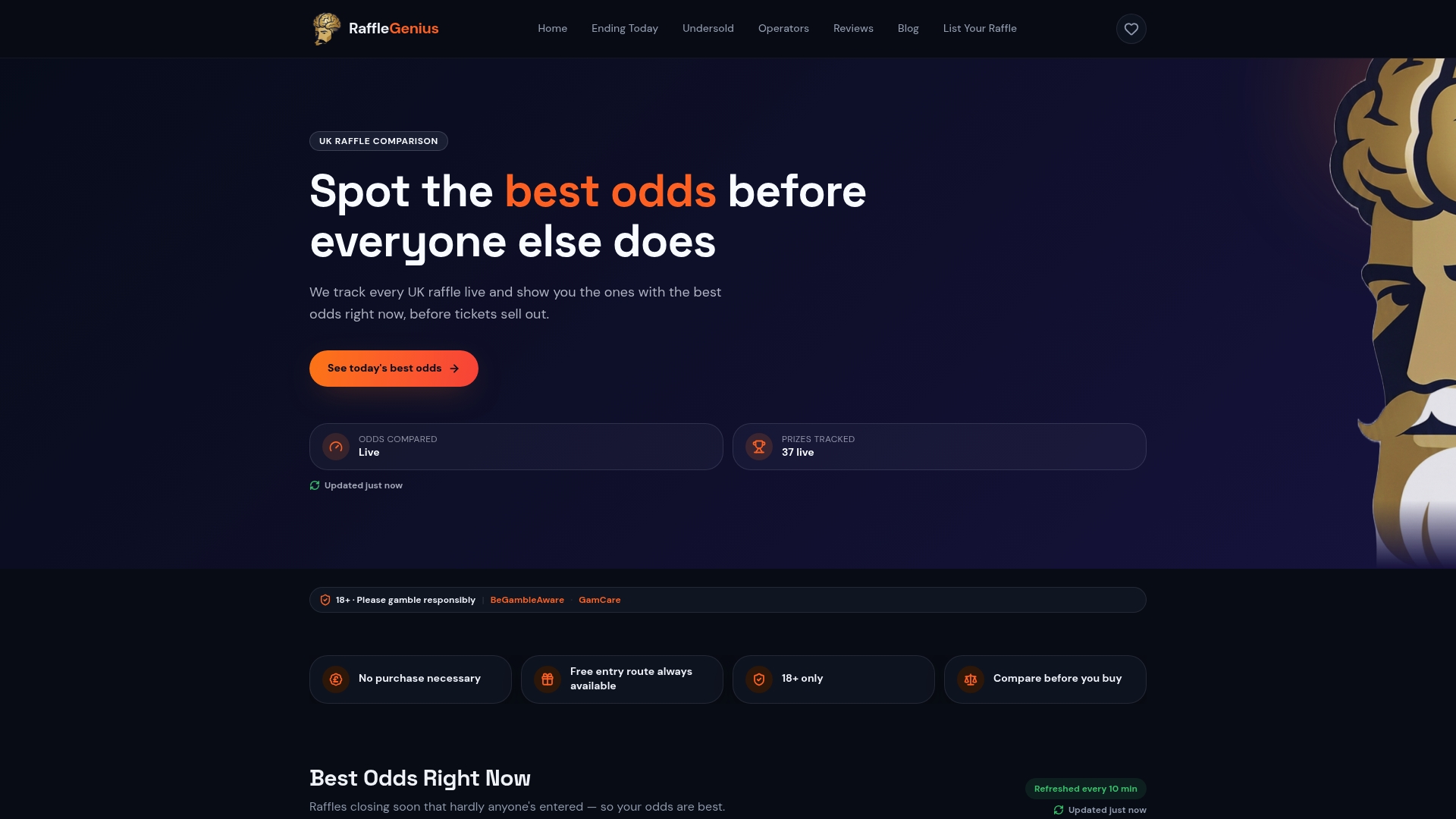
We built Raffle Genius for people who want to comp with their eyes open. The site tracks and compares live UK raffles and prize competitions, with odds updated every 10 minutes, so ticket prices, prize values, tickets sold and closing times sit in one place. You can browse by category: cars, cash, homes, watches and jewellery, tech, holidays and motorbikes. Operators are verified, listed with user-facing trust ratings and reviews, and free-entry routes are always highlighted. A weekly newsletter alerts you to competitions worth a look.
If you prefer to play without ads, the ad-free plan is £4 per month on the play to win page. We are also launching a Play to Earn feature, where you play games to earn raffle tickets and enter for a chance to win cash prizes, which gives mobile gamers and students a free, engagement-based way in alongside the listings.
Running a competition yourself? You can get your raffle listed on Raffle Genius.
Our view on comping
Comping rewards people who treat it as a numbers exercise rather than a hunch. The first question we ask of any competition is how many tickets are left, because that decides your odds more than anything on the poster.
The second is whether the price makes sense against the prize. We think every comper should be able to see ticket price, prize value, tickets sold and closing time side by side, refreshed often enough to act on. That is why our odds update every 10 minutes.
The third is trust. A great price from an operator that hides its free route is not a great price. We verify operators, show trust ratings and always surface free-entry routes, because comping should be something you can enjoy with a clear head and a fixed budget.
matt
FAQ
What does comping mean?
Comping is a British informal word for regularly entering competitions, prize draws and raffles in order to win prizes. A person who does it is called a comper. The Cambridge Dictionary describes it as a potentially profitable hobby, but not a guaranteed way to make money.
What is comping in jazz or music?
In music, comping means accompanying a soloist, typically by playing chords and rhythms behind them. It is unrelated to competitions. In a restaurant, “comping” a meal means giving it free, which is a third separate meaning.
Is comping legal in the UK?
Yes, provided the competition follows the rules. A chance-based draw that charges to enter must offer a free entry route at the standard rate, and a prize competition must involve real skill, knowledge or judgement. The Gambling Commission and the ASA publish the detail, and our checklist guides help you spot anything that does not fit.
Can you comp without spending money?
Yes. Properly run paid draws must offer a free entry route, normally by post at ordinary first- or second-class rates, with the same chance of winning as a paid ticket. Free entry usually means one entry at a time, so it is slower, and Raffle Genius highlights these routes on each listing.
How do I know which competition has the best odds?
Compare how many tickets are sold against the cap, then check the ticket price against the prize value. Competitions with fewer tickets sold generally offer better odds at that moment, and our undersold competitions page lists them as they update.
Sources
- COMPING | English meaning, Cambridge Dictionary
- Voluntary Code of Good Practice for Prize Draw Operators, GOV.UK
- Understanding the consumer landscape in free draws and prize competitions, Gambling Commission
- Promotional marketing: Free entry routes, ASA
- Promotional marketing: terms and conditions and significant conditions, ASA
Recommended
18+ · Please gamble responsibly. Raffle Genius is a comparison service and does not run competitions.
Best odds, straight to your inbox
Once a week, Fridays at 10:00 UK time, with varied best-odds competitions ending within 48 hours. No spam, unsubscribe any time. 18+
Stay signed up for a chance to win £50 every month. One random winner drawn from all subscribers.
No purchase necessary. Free entry.