
7 September 2026
Act Fast: 5 Steps to Verify and Report Competition Scams in the UK
If you get an unexpected message saying you’ve won a prize, treat it as a scam until proven otherwise. Don’t click links, don’t send money or bank details, and verify independently through the brand’s official website or a Companies House search. This article shows you exactly how to spot the warning signs, check whether a competition is genuine, and report competition fraud in the UK if you’ve already been targeted.
TL;DR:
- Genuine UK competitions do not contact winners unexpectedly or request payment for fees, taxes, or courier charges upfront.
- Scammers often use fake branding, urgent deadlines, and secretive instructions to manipulate victims into acting quickly without verification.
- Verify by checking official company registration details, official websites, and social accounts before entering or responding to any prize offer.
- Report suspected scams immediately to Action Fraud and contact your bank if you’ve shared financial details or made payments.
- Raffle platforms like Raffle Genius provide live odds and operator transparency to help identify legitimate UK raffles and avoid fakes.
Table of Contents
- How to spot a competition scam: the red flags checklist
- Real UK examples: how these scams actually show up
- If you’ve been contacted: what to do in the first 24–48 hours
- How to verify a competition is genuine before entering
- How to report competition scams in the UK
- How scammers actually extract your money or data
- Precautions when entering legitimate competitions
- How Raffle Genius helps you spot legitimate raffles
- Why vigilance matters more than cleverness
- A safer way to find genuine UK raffles
- Official contacts for checking and reporting scams
- Sources
How to spot a competition scam: the red flags checklist
Genuine competitions don’t chase you. If a brand you’ve never interacted with suddenly says you’ve won something valuable, that’s the first red flag, not the last.
The clearest sign of competition fraud is a request for money before you receive anything. No legitimate UK competition asks winners to pay “release fees,” courier charges, or tax on a prize upfront. Which?'s guidance on spotting scams notes that scammers rely on urgency and psychological pressure to stop victims checking the details properly.
Watch for these signals together, since scammers often stack several at once:
- Contact you didn’t expect, especially for a competition you don’t remember entering
- Any request for bank details, card numbers, or payment via gift cards or wire transfer
- Messages from free email addresses (Gmail, Outlook) claiming to represent major retailers
- Spelling mistakes, odd grammar, or logos that look slightly off from the real brand
- Countdown timers, “reply within 24 hours” deadlines, or instructions to keep the win secret
- Requests to download an app, call a premium-rate number, or pay a small “handling fee”
Pro Tip: Genuine brands never ask winners to keep a prize secret. Secrecy requests exist purely to stop you comparing notes with friends or family who might spot the scam faster than you.
Real UK examples: how these scams actually show up
Competition scams rarely arrive as crude spam. Most copy real branding closely enough to pass a quick glance, which is exactly why so many people fall for them.
Cloned Facebook and Instagram pages impersonating supermarkets, airlines, or tech brands routinely offer cars, iPhones, or holiday vouchers for a like, share, or comment. Some use near-identical logos and follower counts padded with bots. Which? has reported fake Facebook competitions that funnel entrants toward hidden subscription traps rather than a genuine draw.
Common formats reported to UK authorities include:
- Emails posing as supermarkets or delivery firms, asking you to click a link to “claim” a prize
- Survey or quiz pages that hide recurring subscription charges in the small print at checkout
- Texts or calls demanding payment to a premium-rate number before a prize is “released”
- Standalone microsites using a familiar brand name but no verifiable company details or contact address
If you’ve been contacted: what to do in the first 24–48 hours
Act quickly, but don’t act on the scammer’s terms. Speed matters for evidence and for stopping any payment, not for replying.
- Stop. Don’t click links, reply, or send any payment. Screenshot the message, email headers, and any linked pages before they disappear.
- Check whether you actually entered. Search the brand’s official website and social channels for the same promotion. If it isn’t listed there, it almost certainly isn’t real.
- Verify the company. If a company registration number is quoted, look it up on Companies House to check the business is active and genuine.
- Contact your bank immediately if you’ve shared card or account details, and follow their fraud recovery process.
- Report it to Action Fraud or the National Fraud Helpline, plus your local trading standards team, with everything you’ve gathered.
Pro Tip: Never use a “reply” link in the suspicious message to check anything, even to unsubscribe. Navigate to the brand’s known website independently, or call their published customer service number.
How to verify a competition is genuine before entering
A few minutes of checking before you enter saves considerably more time than untangling a scam afterwards. None of these checks require special tools.
Start with the basics: search for a Companies House registration number on the competition site, then confirm the company’s status is active rather than dissolved. Cross-check the promotion against the brand’s own official site and verified social accounts, since a real competition from a major retailer will appear there too, not just in a message sent directly to you.
Beyond that:
- Use official phone numbers or web addresses to confirm details, never the contact info supplied in the suspicious message itself
- Look for clear, accessible terms and conditions covering closing dates, how winners are chosen, and exact prize fulfilment
- Check the site uses https and has a properly registered domain, not a lookalike spelling of a known brand
- For any promotion tied to investment or financial products, run the operator through the FCA Firm Checker to confirm authorisation
The Raffle Genius guide to verifying UK raffle sites walks through this same due diligence process specifically for prize draws and raffles, which are a frequent scam target.
How to report competition scams in the UK
Reporting does two jobs at once: it may help you personally, and it feeds intelligence that helps authorities disrupt wider fraud operations.
Report individual incidents to Action Fraud and contact the National Fraud Helpline for guidance on next steps and recovering funds. If a promotion misuses a well-known brand or looks like part of a wider market problem, you can tell the CMA directly about the operator. Local trading standards teams handle consumer-level enforcement and can advise on your specific case.
If you’ve already paid, contact your bank straight away to dispute the payment; card payments may qualify for a chargeback. When you file any report, include:
- Screenshots of the message and any linked pages
- Full URLs, not just the visible link text
- Email headers, if the contact came by email
- Transaction references, if money changed hands
- A copy of any terms and conditions shown to you
How scammers actually extract your money or data
Most competition scams follow a handful of well-worn mechanics, just dressed up differently each time. Recognising the mechanic matters more than recognising any single brand.
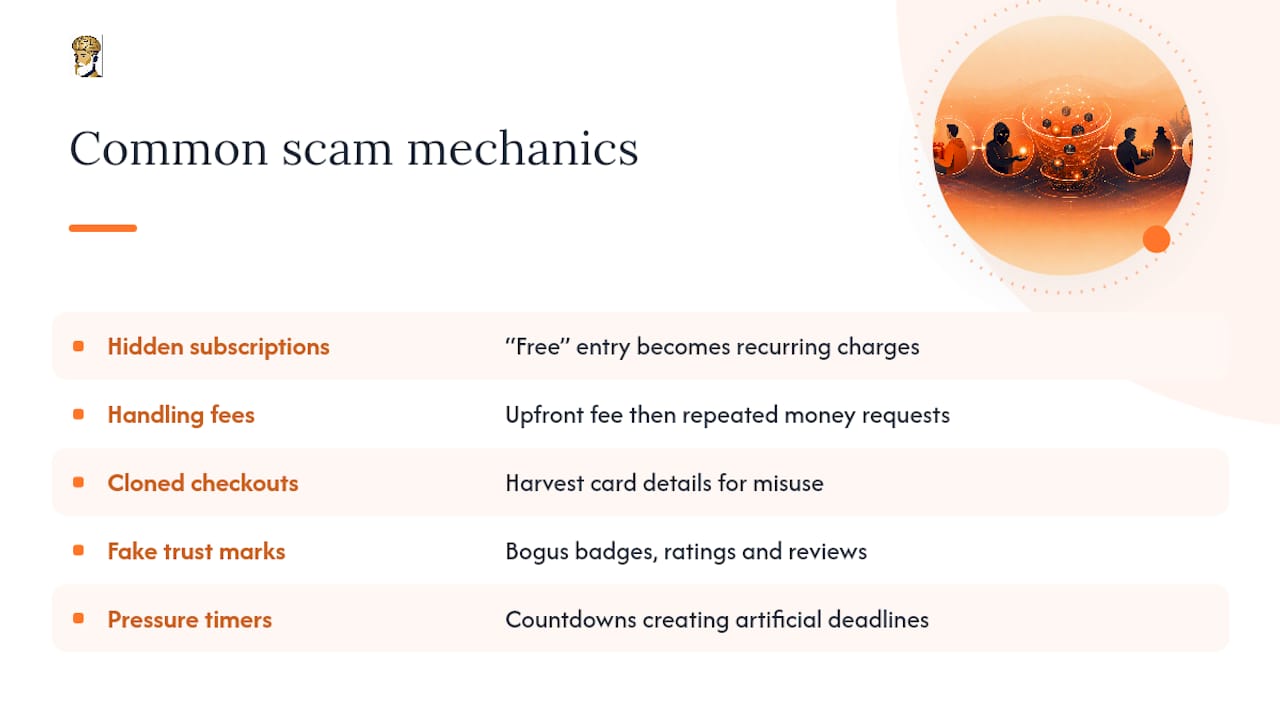
Hidden subscription clauses are among the most common: a “free” prize entry or £1 trial converts into recurring charges buried in checkout small print. Which?'s investigation into fake Facebook competitions found exactly this pattern feeding subscription traps. Others charge an upfront “handling fee” or “tax,” then keep requesting more money once you’ve paid once. Cloned checkout forms harvest card details for later misuse, while fake trust marks, inflated star ratings, and manufactured reviews create false confidence. The DMCC Act explicitly bans claiming to run a competition without awarding the prizes described, alongside fake reviews and misuse of trust marks.
A common pressure tactic scammers rely on is a countdown timer or artificial deadline, designed specifically to short-circuit the checks above before you have time to run them, as explained in the Solana Casino blog on variance and volatility in gambling.
Precautions when entering legitimate competitions
Legitimate prize draws and raffles are still worth entering. A short checklist keeps the enjoyable ones enjoyable.
Favour free-entry routes where possible, and be wary of paying to enter unless the operator is independently verifiable. Read the full terms before submitting any payment, checking specifically for subscription or recurring-charge wording near the checkout button. Use a separate card, or a prepaid one, for operators you don’t know well, and keep receipts along with the operator’s contact details.
- Remove saved card details after use and unsubscribe from marketing you didn’t intend to sign up for
- Follow verified operator accounts rather than shared links from unknown pages
- Sign up to scam alerts from Which? or the National Fraud Helpline
- Check for undersold or unusual competition patterns using a dedicated tracking tool
Pro Tip: Set a personal rule: never enter a paid competition the same day you first see it. That pause alone filters out most impulse-driven scams, which rely on you acting before you think.
How Raffle Genius helps you spot legitimate raffles
Some web platforms track live odds and ticket prices across UK raffle operators, updating frequently so you’re comparing real, current figures rather than a static claim on a single post. Because listings sit alongside operator details rather than an isolated social media link, you’re relying on comparable, visible data instead of a single unverified page. Undersold flags highlight draws with unusually favourable odds, the kind of detail a cloned scam page would never publish. The operator comparison guide covers the transparency checks worth running before you commit any money.
Why vigilance matters more than cleverness
The scams that work best don’t target gullible people. They target excited people, and excitement makes anyone skip a thirty-second check they’d normally run without thinking. Report what you spot, and flag it to friends and family too. Warnings shared early save someone else the fee you avoided.
— matt
A safer way to find genuine UK raffles
There are other ways to hunt for competitions, from following social media pages to searching retailer newsletters, but both leave you checking legitimacy yourself, one post at a time. Raffle Genius does that groundwork for you, tracking live odds, ticket prices, and operator details across UK raffles in one place, refreshed every 10 minutes so you’re never working from stale information.

Some platforms feature undersold-competition alerts that flag draws with unusually strong odds, signals that fake pages cannot fabricate because they depend on real, comparable entry data. Rather than relying on a single unverified post promising a car or a cash prize, you can compare operators side by side and see which ones consistently show transparent pricing and prize fulfilment. Visit Raffle Genius to compare current UK raffles, or check the undersold competitions page to see which draws currently offer the best odds before you enter.
Official contacts for checking and reporting scams
Report fraud via Action Fraud, read Which?'s scam advice, check unfair practices guidance, or report phishing to the NCSC.
Sources
Recommended
18+ · Please gamble responsibly. Raffle Genius is a comparison service and does not run competitions.
Best odds, straight to your inbox
One email a week with the undersold UK competitions closing soon. No spam, unsubscribe any time. 18+