
16 October 2026
Compare live raffles →
Your worst-case chance in a capped draw is the number of tickets you hold divided by the published ticket cap. Convert that to “1 in N” and a percentage and you can compare any two competitions. If fewer tickets sell than the cap allows, your odds improve, and a free postal entry must carry exactly the same chance as a paid ticket.
TL;DR:
- Instant win promotions may use preassigned winning moments or real time random selection, so prize counts alone cannot establish odds without clear allocation details.
- For multiple prizes, estimate your chance with tickets times winners divided by the cap; exact odds subtract the chance of losing all draws from 1.
- Check for an explicit cap and closing date, an equally prominent, convenient free route, and clauses allowing extensions or prize substitution.
- Compare ticket price times the cap with prize value, then favor lower ratios and spread your budget across small cap draws.
Table of Contents
- How do you calculate odds for a capped draw?
- How do instant-win formats differ from scheduled draws?
- How do ticket limits and multiple winners change your chance?
- What should you read in the terms before you buy?
- How do you compare ticket price with prize value?
- A player’s view: why live odds change habits
- Raffle Genius: find better small-prize chances faster
- FAQ
- Sources
How do you calculate odds for a capped draw?
The formula is simple: your tickets ÷ total tickets in the draw. A capped-draw odds calculator states the same rule and adds that the sell-out figure gives you the worst-case odds, because the draw cannot have more tickets than its cap. For a deeper walk-through of how caps shift your chances, see our piece on calculating real odds with 10 tickets against a 5,000 cap.

To turn a chance into “1 in N”, divide the cap by the tickets you hold. To get a percentage, divide your tickets by the cap and multiply by 100.
Here are worked examples for a single prize:
- 50-ticket cap: 1 ticket is 1 in 50 (2%), 5 tickets is 1 in 10 (10%), 10 tickets is 1 in 5 (20%), and 50 tickets is a certain win at 100%.
- 500-ticket cap: 1 ticket is 1 in 500 (0.2%), 5 tickets is 1 in 100 (1%), 10 tickets is 1 in 50 (2%), and 50 tickets is 1 in 10 (10%).
- 1,600-ticket cap: 1 ticket is 1 in 1,600 (0.0625%), 5 tickets is 1 in 320 (0.3125%), 10 tickets is 1 in 160 (0.625%), and 50 tickets is 1 in 32 (3.125%).
With several prizes, a quick estimate is your tickets × number of winners ÷ total tickets. We cover the exact version further down.
How do instant-win formats differ from scheduled draws?
In a scheduled draw, every ticket sits in one pool and a single selection happens after closing. Instant-win mechanics work differently, and that changes what you should check before you spend.
- Pre-seeded winning moments: some promotions allocate prizes to set moments in advance, and whichever entry lands on that moment wins. The ASA’s instant-wins guidance notes that allocation methods vary, with prizes either pre-allocated to winning moments or decided by real-time random generation.
- Real-time random selection: each entry is checked at the point of play, so no fixed pool exists to calculate against.
- Headline versus effective prizes: if a promoter advertises many prizes but ties them to narrow winning moments that few players hit, your effective chance can sit well below what the headline implies.
The same guidance says promoters must explain how prizes are allocated and avoid exaggerating your chances. If an instant-win page cannot tell you how many prizes remain or how they are allocated, treat the odds as unknown, and unknown odds are weaker than a published cap.
How do ticket limits and multiple winners change your chance?
A capped draw gives you something an uncapped one cannot: a figure you can rely on before you enter. Uncapped draws leave the true odds unknowable until closing, so the published cap is the right basis for comparison.
Per-person limits matter too. They stop any one entrant buying enough tickets to guarantee a win, and they cap how much of the pool you can personally hold. Here is how to work out multi-prize chances:
- Count the winners (W), your tickets (T) and the total tickets (N).
- For a fast estimate, calculate T × W ÷ N. With 10 tickets, 5 winners and a 500 cap, that is 10%.
- For the exact chance of winning at least once, calculate the chance of losing every draw. With winners drawn one by one from the pool, multiply (N − T) ÷ N by (N − 1 − T) ÷ (N − 1) and so on for each prize.
- Subtract that product from 1 to get your chance of at least one win.
- Use the published cap for N, so you can compare competitions before entering.
For small T relative to N, the quick estimate sits very close to the exact answer, which makes it a handy mental shortcut when browsing.
Best odds, straight to your inbox
Once a week, Fridays at 10:00 UK time, with varied best-odds competitions ending within 48 hours. No spam, unsubscribe any time. 18+
Stay signed up for a chance to win £50 every month. One random winner drawn from all subscribers.
No purchase necessary. Free entry.
What should you read in the terms before you buy?
The Gambling Commission’s guidance on free draws sets out detailed conditions for free-entry routes: parity of cost and convenience with paid entries, acceptable postal methods and equal prominence in advertising. Use that as the backbone of your check. Our guide to what UK raffles must disclose about ticket caps adds practical pointers on spotting caps before you buy.
- Published ticket cap: the number of tickets should be stated, not implied.
- Free-entry route: it should be explicit, equally prominent and no more expensive or less convenient than paying.
- Clear closing date: with no clause allowing it to move when sales disappoint.
- Prize substitution: a clause letting the promoter swap the prize for cash is a red flag.
- Draw method: look for an independently verifiable process or audit statement.
- Winner notification: the terms should say how and when winners are told.
The ASA has highlighted concerns about closing dates tied to sales targets and prize substitution. If you want the legal background, our explainers on what makes a draw a lawful prize competition and when competitions count as gambling go further.
Pro Tip: Search the terms for the words “extend”, “substitute” and “alternative prize”. If any appear, check what triggers them before you pay.
How do you compare ticket price with prize value?
Start with a cost-per-win estimate. Multiply the ticket price by the cap to get the total money a sell-out would raise, then compare that with the prize value. Run the same sum on every competition you consider.
- Compare the ratio: a lower ratio of total ticket revenue to prize value means a lower cost per unit of prize value. Use the published ticket price, cap and prize value to work it out.
- Favour small caps: small-prize draws often have far smaller caps than headline jackpots, so each ticket carries a bigger slice of the pool.
- Look for undersold draws: when a competition has sold fewer tickets than its cap, your real odds are better than the published worst case.
- Spread your budget: rather than put everything into one big draw, split a fixed budget across several small-capped draws with similar prize-to-price ratios.
- Keep the free route in mind: it has the same chance as a paid ticket, so you can enter without spending where the rules allow.
A player’s view: why live odds change habits
Spotting that one draw has sold fewer tickets than a similar one can reveal a potential odds advantage. Moving a fixed budget to the undersold draw does not increase your spend, and fewer tickets sold can improve your chance of winning. Live updates make that visible. Pair it with a hard spending limit set before you browse, and read our notes on responsible play with free entry and live odds.
— matt
Raffle Genius: find better small-prize chances faster
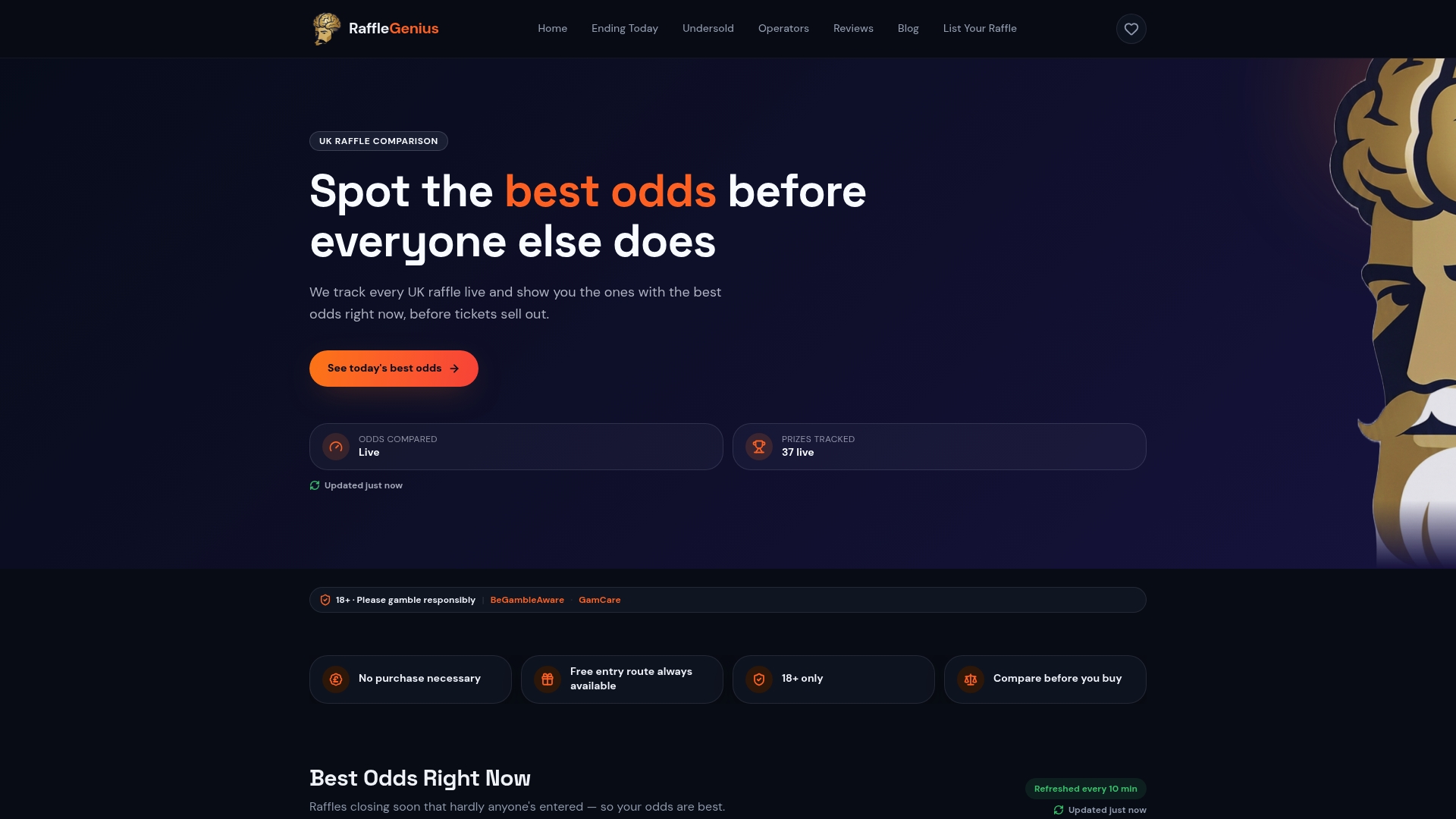
Checking caps, ticket prices, prize values and closing times across dozens of operators is slow work. We built Raffle Genius to do the comparison for you: we update live odds every 10 minutes, show which competitions are undersold, and keep free-entry routes visible so you can see the real chance behind each listing. Our trusted operators page shows which promoters we have verified.
That means you can sort by odds, set ticket price against prize value, and move your budget to the draw with the best chance, all without opening a dozen tabs. If you prefer a cleaner view, you can go ad-free for £4 per month. If you run competitions yourself, you can get your raffle listed on Raffle Genius. Open the comparison now and see which small-prize draws are offering the best odds today.
FAQ
What is an instant win competition?
An instant win competition tells you straight away whether you have won, rather than waiting for a closing-date draw. The ASA explains that prizes may be pre-allocated to winning moments or chosen by real-time random generation, so check how the promoter describes allocation.
What are good odds in a competition?
Good odds are the ones you can verify. A published ticket cap lets you calculate your worst-case chance, and a smaller cap or an undersold draw improves it. Compare 1 in N figures across competitions with similar ticket prices and prize values.
What competitions can I enter to win money?
Cash prize draws and prize competitions run across many UK operators, and the Gambling Commission notes that such formats are lawful when they meet the Gambling Act 2005 tests. Always confirm the cap, the free-entry route and the closing date first.
Does a free entry have the same chance as a paid ticket?
Yes. Free postal entries in a free draw must have the same chance of winning as paid entries, according to the Gambling Commission. If the free route is hidden or less convenient, treat that as a warning sign.
Sources
- Free draws and prize competitions
- Promotional marketing: instant wins
- Competition Odds Calculator: See Your Chances | Grand Draws
Recommended
18+ · Please gamble responsibly. Raffle Genius is a comparison service and does not run competitions.
Best odds, straight to your inbox
Once a week, Fridays at 10:00 UK time, with varied best-odds competitions ending within 48 hours. No spam, unsubscribe any time. 18+
Stay signed up for a chance to win £50 every month. One random winner drawn from all subscribers.
No purchase necessary. Free entry.