
30 August 2026

Calculate real instant win odds for UK raffles: 6 point checklist
Your odds of winning an instant-win raffle equal your tickets divided by total tickets sold. Buy 10 of 5,000 and you hold a small share of that draw. Smaller ticket pools give far better odds than large public raffles, multiple prizes increase your chance of winning at least once, and across most raffles the expected value still runs negative once you weigh prize value against ticket cost.
TL;DR:
- Smaller, capped pools with multiple prizes offer significantly better odds than large, open-entry raffles with the same ticket cost.
- Calculating true winning probabilities requires considering the sampling without replacement, especially for multiple prizes and varying prize values.
- The expected value of most raffle tickets remains negative once prize value and ticket cost are balanced, making them primarily fundraising or entertainment expenses.
- Transparent operators publish ticket counts and past results, while free entry routes that are equally promoted can boost real odds for participants.
- Tracking sale pace and focusing on undersold or capped draws over multiple days provides better insights into genuine odds than just looking at headline prizes.
Table of Contents
- How raffle odds work in practice
- Calculating odds correctly when there are multiple prizes
- What actually changes your chances: operator rules and format
- A practical checklist for picking better instant-win odds
- Common mistakes and pro tips from tracking raffles daily
- Regulatory limits on instant win odds and prize distribution
- How I use odds to choose raffles and what to expect long term
- Find better odds with Raffle Genius
- Sources
How raffle odds work in practice
Every raffle boils down to one fraction: your tickets over total tickets sold. If a competition sells 2,000 tickets and you hold 5, your odds of winning the single prize are 5 divided by 2,000. That’s the whole mechanism behind a single-prize draw, and it’s why the total pool size matters just as much as how many tickets you buy.
Think of it as coverage. You own a slice of the pool, and the smaller the pie, the bigger your slice looks for the same number of tickets. This is why Statistics How To’s explanation of odds versus probability is worth understanding before you compare two raffles side by side: a raw ticket count means nothing until you know the size of the field it’s drawn from.
Two examples make the point clearly:
- A local charity raffle sells 300 tickets. Buying 3 tickets gives you a notably better chance of winning than larger draws.
- A national car raffle sells many tickets. Buying the same 3 tickets gives you a much smaller chance despite identical spend.
Neither example is wrong or unfair; they’re just different games with wildly different maths. The mistake most entrants make is comparing ticket prices across raffles without ever checking the pool size behind them. A £5 ticket in a 500 entry draw is a completely different proposition to a £5 ticket in a 50,000 entry draw, even when the headline prize looks similar.
Calculating odds correctly when there are multiple prizes
Most raffles don’t offer a single prize. They offer several, drawn one after another without putting winning tickets back into the pool. That last detail matters enormously, because it changes the correct formula from simple multiplication to something a little more precise.
The naive shortcut many players use is n × (k/N), where n is your tickets, k is the number of prizes, and N is total tickets. It’s close enough for a rough estimate in huge pools, but it overstates your odds slightly and breaks down completely once the number of prizes gets close to a meaningful fraction of the pool. The correct method is:
- Calculate the probability you win none of the prizes, accounting for tickets being removed from the pool after each draw (sampling without replacement).
- Subtract that figure from 1 to get your probability of winning at least one prize.
- Repeat the without-replacement calculation for each prize tier if the raffle awards different-value prizes at different draw stages.
This without-replacement approach, sometimes called the hypergeometric method, is what raffle odds calculators built on the correct combinatorial formula use rather than the simplified shortcut.
The precise without-replacement calculation gives a very similar figure in a pool this size, though the gap widens noticeably in mid-size draws with several prizes, as detailed hypergeometric worked examples show.
Expected value matters more than odds alone. EV = (prize value × win probability) minus ticket cost. If a £500 prize carries a small win chance and your ticket costs £3, your EV is less than the ticket cost, meaning a loss per ticket. Across most commercial raffles, worked EV examples confirm this negative pattern holds true, which is precisely why raffles function as fundraising or entertainment spend rather than investment vehicles.
What actually changes your chances: operator rules and format
The maths only tells half the story. How an operator runs the draw can shift your real-world odds just as much as pool size does.
Free entry routes are the biggest legal and practical variable. Under Gambling Commission guidance on free draws and prize competitions, operators offering both paid and free entry avoid needing a gambling licence, but only if the free route is no more expensive or inconvenient than the paid one, and both are promoted equally. If an operator buries the free-entry method in small print, that’s a transparency red flag worth noting, not just a legal technicality.
Other factors worth checking before you enter:
- Ticket caps — a hard maximum on tickets sold is far more favourable to you than an uncapped or “sells until closing date” structure, since it puts a ceiling on how diluted the pool can get.
- Format — reverse raffles, split-the-pot draws and multi-winner formats all change the underlying probability curve differently from a single-prize draw, so read the rules rather than assuming standard maths applies.
- Draw mechanism — look for independent oversight, an auditable random number generator, or a certified physical draw machine.
The Voluntary Code of Good Practice for prize draw operators, introduced in 2025, recommends operators publish maximum ticket numbers or previous-draw data so entrants can judge likelihood before spending. Not every operator follows it, so treat its presence as a genuine trust signal.
Pro Tip: Before entering, check whether the operator publishes a running ticket count. A draw that shows “347 of 2,000 sold” with two days left is a far better bet than one that hides the number entirely.
A practical checklist for picking better instant-win odds
Comparing raffles gets easier once you run each one through the same short checklist rather than judging on prize photos alone.
- Total tickets or cap — always check this first; it’s the denominator in every odds calculation you’ll make.
- Number of prizes — more prizes generally means a better chance of winning at least one, even if the top prize odds stay slim.
- Prize value versus ticket cost — a rough EV sense-check, even without exact probabilities, filters out obviously poor value draws.
- Free-entry availability — check it exists and is genuinely equal to the paid route, per Gambling Commission rules.
- Operator transparency — published ticket counts, past-draw results and clear draw mechanics all matter.
- Closing time and sales pace — a competition closing soon with a low sold count is often undersold, meaning better odds for late entrants.
| Factor | Better odds signal | Weaker odds signal |
|---|---|---|
| Ticket pool size | Small, capped total | Uncapped or very large |
| Prize count | Multiple prizes | Single prize only |
| Operator disclosure | Live ticket counts published | No sales data shown |
| Closing status | Undersold, near deadline | Heavily oversubscribed |
Buying extra tickets meaningfully improves your odds only when the pool is small. In a small draw, doubling your tickets notably improves coverage; in a very large draw, the same doubling makes an almost negligible difference. Match your spending to pool size, not to prize size.
Common mistakes and pro tips from tracking raffles daily
The single biggest misconception is treating raffles as investments. Prize draws exist primarily to raise funds for the operator or cause, and once you accept that, a negative expected value stops feeling like a trap and starts looking like the cost of playing. The second most common error is relying on the naive n × (k/N) shortcut for multi-prize draws with many winners, which overstates real chances more than most players realise. The third is ignoring free-entry routes entirely, even when they carry identical odds to paid tickets.
A few habits consistently improve decision-making:
- Check undersold competition lists rather than only browsing headline prizes.
- Watch draws closing within 24 hours, since sales pace often reveals which competitions are genuinely undersubscribed.
- Favour capped draws over open-ended ones wherever prize value is comparable.
- Run the numbers through a proper calculator rather than eyeballing percentages.
Pro Tip: Track two or three raffles over a full week rather than judging on a single snapshot. Ticket sales pace tells you more about your real odds than the headline prize ever will.
Regulatory limits on instant win odds and prize distribution
There’s no statutory cap in UK law dictating a minimum odds ratio or a maximum prize-to-ticket ratio for free draws and prize competitions, which surprises many entrants who assume regulation works like it does for licensed gambling products. Instead, the framework focuses on structure and disclosure rather than fixed odds thresholds.
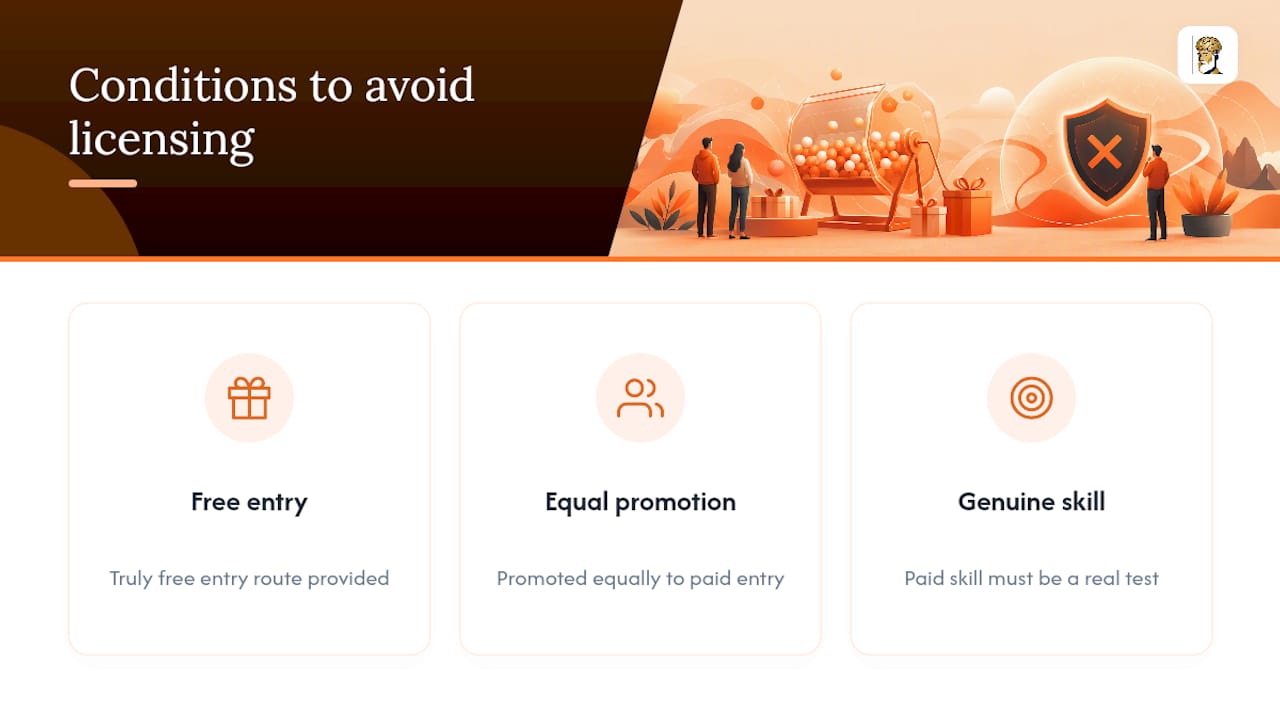
Under the Gambling Act 2005, a prize competition or free draw avoids licensing requirements by meeting specific conditions rather than odds limits: it must include a genuinely free and equally promoted entry route, and any skill element in a paid competition must be a real test rather than a token barrier. The Gambling Commission’s guidance sets out these conditions in detail, and falling outside them shifts an operator into licensed gambling territory with much stricter rules.
The 2025 Voluntary Code adds a layer of best practice on top of that legal minimum, encouraging operators to disclose maximum ticket numbers, previous-draw results, and clear information on how draws are conducted. It’s voluntary rather than mandatory, so adherence varies by operator, and checking for it remains one of the more reliable ways to separate transparent operators from ones offering little more than a leap of faith.
How I use odds to choose raffles and what to expect long term
Set a fixed monthly budget before browsing anything, then treat every ticket purchase against that ceiling rather than deciding raffle by raffle. That single habit prevents chasing losses across multiple draws, which is where most entrants overspend without noticing.
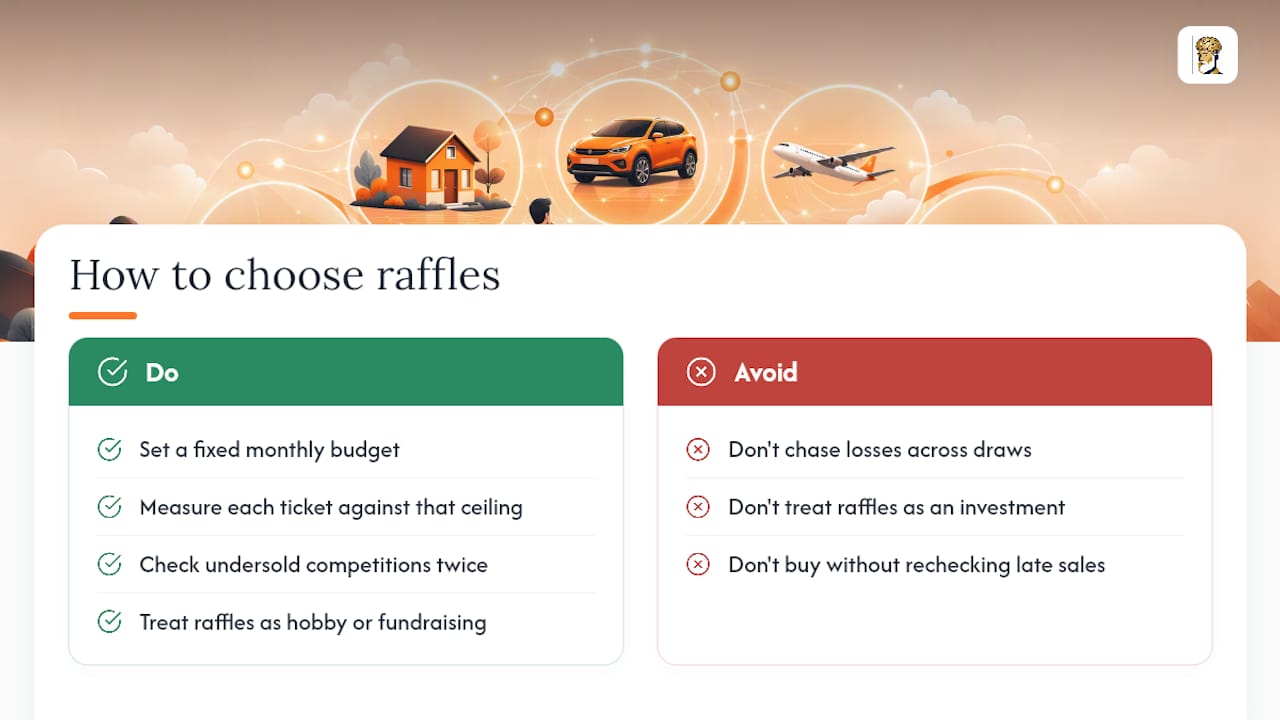
When I track an undersold competition, I check the ticket count at least twice before deciding: once early to spot the pattern, and again close to the deadline to see whether sales picked up.
The habit worth repeating to yourself: raffles are fundraising or hobby spend first, and a prize win is a genuine bonus on top, not the expected outcome. Anyone chasing a raffle as a financial strategy is working against the maths, not with it. Understanding how the numbers actually work changes how you play, even if it doesn’t change the odds themselves.
— matt
Find better odds with Raffle Genius
Checking pool size and ticket caps manually across dozens of operators takes real time, which is exactly the gap Raffle Genius was built to close. The platform tracks live odds, ticket prices, and closing times across UK raffles, updating every 10 minutes so you’re never comparing stale numbers against a competition that’s already sold out its cheaper tickets.
Start with the undersold competitions list if you want draws where the ticket pool genuinely favours new entrants, or check what’s closing in the next 24 hours to spot draws with sales patterns worth watching. If you’d rather build ticket credit without spending, the Play to Win game offers a free route to real prizes, which sits alongside the paid raffles you’ll find across the wider platform.
Sources
- Gambling Commission: free draws and prize competitions
- Gov
- AgentCalc: raffle odds calculator
- Practical Web Tools: Raffle odds calculator guide (2026)
Recommended
18+ · Please gamble responsibly. Raffle Genius is a comparison service and does not run competitions.
Best odds, straight to your inbox
One email a week with the undersold UK competitions closing soon. No spam, unsubscribe any time. 18+