
26 September 2026

Spot 50–100 Ticket Caps Before You Buy: What UK Raffles Must Disclose
UK raffle operators can set minimum ticket purchases, per-person caps and payment rules, provided the raffle qualifies as a lawful lottery under the Gambling Act 2005 and those rules are disclosed clearly in the terms and conditions. Whether an operator may lawfully charge for entry at all depends on its licence or local-authority registration status. Before buying, check the operator’s terms and its regulatory standing rather than assuming a social-media raffle is automatically legitimate.
TL;DR:
- Raffles that charge an entry fee must be properly licensed or registered; unlicensed social-media lotteries are illegal and can lead to prosecution.
- Most UK charity raffles set a ticket price around £1 with per-person purchase limits typically between 50 and 100 tickets, often with an annual cap.
- Checking the full terms and the operator’s licensing details before buying helps avoid hidden minimums or caps that could be enforced automatically at checkout.
- Breaching a stated ticket or spending cap may be automatically declined by the payment system, but running an unlicensed raffle is a criminal offense with potentially serious penalties.
- Raffle comparison platforms, like Raffle Genius, update live odds and disclose the rules to help entrants choose fair, transparent draws.
Table of Contents
- UK legal framework: lottery, prize competition or free draw
- What ticket rules look like in practice
- How to check terms and spot hidden minimums or caps
- What to do if terms are unclear or an operator breaks the rules
- Raffle Genius perspective: verifying operators and surfacing limits
- Definition and legal basis of minimum ticket caps under UK law
- Rationale and objectives behind imposing minimum ticket caps
- Examples of typical minimum ticket caps across different raffle operators
- Enforcement mechanisms and penalties for breaching minimum ticket caps
- What actually matters when you read the small print
- Compare odds and check ticket rules before you buy
- Sources
- FAQ
UK legal framework: lottery, prize competition or free draw
The legal category a raffle falls into decides whether an operator can charge for tickets at all, let alone set minimums or caps. Under the Gambling Act 2005, a draw that charges an entry fee and does not include a genuine test of skill is classified as a lottery, and lotteries must be run under a licence or registered with a local authority. This is confirmed directly by the Gambling Commission’s guidance on social media raffle licences, which states that unlicensed lotteries, including those run on social media, are a criminal offence and can lead to prosecution.
The Commission also sets out where the line sits between smaller and larger operations:
- Smaller fundraising lotteries typically need registration with a local authority rather than a full Commission licence.
- Larger, ongoing or higher-turnover lotteries generally require a licence from the Gambling Commission, which covers online fundraising and social-media draws under the same tests.
- A free draw with no purchase necessary, or a genuine prize competition requiring a real skill test, falls outside lottery rules entirely.
Alongside licensing, the ASA’s guidance on promotional marketing requires promoters to state significant conditions, including entry limits, clearly and at or before the point of entry. If a draw turns out to be an unlicensed lottery, any minimum or cap the operator has imposed is beside the point: the entire structure is unlawful, and buying a ticket carries its own risk.
What ticket rules look like in practice
Once you know a raffle is properly licensed or registered, the rules you will meet at checkout tend to follow a familiar pattern. Charity raffles are the clearest public example, since many publish their terms in full.
- Ticket price: many UK charity raffles price entries at £1 per chance, sometimes with bundled discounts for buying several at once.
- Per-person caps: operators commonly limit how many tickets one person can buy in a single draw, often somewhere between 50 and 100.
- Annual aggregate caps: some charities also apply a combined-value limit across the year, separate from the per-draw cap.
- Payment rules: debit-only payment, no credit cards and payment in advance are standard, largely to reduce fraud and to keep spending traceable.
- Non-refundable policies: once a ticket is purchased and the draw is confirmed to proceed, refunds are typically not offered outside cancellation.
A worked example from published charity terms shows the range clearly. Alder Hey’s Grand National raffle terms set entries at £1 each with no bulk discount and cap purchases at 100 tickets per person, while other charities set lower per-person limits and some add an annual combined-value cap across their raffle products.
These rules exist for reasons beyond bureaucracy. Per-person caps and payment controls support responsible gambling by limiting how much any one entrant can spend, they reduce fraud by making unusual buying patterns easier to spot, and they help operators allocate prizes fairly across a wider pool of entrants. Enforcement usually happens through verification holds at the payment stage rather than after the fact, so a purchase that breaches a stated cap may simply be declined or refunded automatically.
How to check terms and spot hidden minimums or caps
A few minutes of checking before you pay can save a lot of frustration later, particularly with newer or less established operators.
- Read the full terms and conditions page, not just the summary on the entry screen, and look specifically for per-person limits, annual aggregate caps, payment timing and refund conditions.
- Confirm the operator’s licence number or local-authority registration, since a legitimate raffle will usually display this or link to it.
- Check that entry limits and closing dates are stated clearly rather than buried in a linked document, in line with ASA guidance treating these as significant conditions.
- Treat missing terms, contradictory clauses between the advert and the small print, or adverts that omit any mention of limits as red flags.
- Use a resource such as Raffle Genius’s trusted operators list to see which operators publish transparent terms alongside live odds.
Pro Tip: Screenshot the terms and conditions at the moment you buy a ticket, since some pages change wording after a draw closes.
What to do if terms are unclear or an operator breaks the rules
If something feels off, whether that is a cap that was not disclosed or a payment that does not match what you agreed to, there is a clear order of steps to follow.
- Contact the operator first. Ask for specific clarification or a refund in writing, and keep a copy of every message.
- Escalate misleading advertising to the ASA, and report licensing or registration breaches to the Gambling Commission or the relevant local authority.
- Consider a bank chargeback for a payment that was unauthorised or clearly misdescribed, and speak to a solicitor if the sum involved is significant.
Keep your evidence organised as you go: screenshots of the terms at the time of purchase, payment receipts, the original advert and a log of your correspondence with the operator. This is the same evidence a regulator or your bank will ask for if the matter is escalated.
Raffle Genius perspective: verifying operators and surfacing limits
Raffle Genius reviews raffle listings for the details that matter before you pay: ticket price, per-person caps and any annual aggregate limits, alongside live odds that update every 10 minutes. That update frequency matters because value and ticket limits interact constantly. A raffle capped at 100 tickets per person looks very different in value once half those tickets have sold than it did at launch.
The trusted operators listing groups raffles by how clearly they disclose their terms, and the Play-to-Earn feature offers a route into prize draws without a paid ticket at all, which sidesteps minimum spend questions entirely for readers who would rather not commit money upfront.
— matt
Definition and legal basis of minimum ticket caps under UK law
A minimum ticket cap, in the sense that matters to UK raffle entrants, is a rule set by the operator specifying the fewest tickets or the minimum spend required to enter a particular draw. There is no separate statute that names or regulates “minimum ticket caps” as their own legal category. Instead, the operator’s freedom to set one flows from the same legal basis that allows it to run the raffle at all.
Once a draw is properly licensed with the Gambling Commission or registered with a local authority under the framework the Commission sets out for fundraising lotteries, the operator has broad commercial latitude over pricing, including minimum purchase requirements, bundle pricing and per-person maximums. The legal constraint sits not on the figure itself but on disclosure: any minimum must be stated as a significant condition under ASA and CAP Code rules, so it is visible to an entrant before they pay.
In other words, there is no fixed minimum ticket price or purchase requirement set by law. What the law does fix is the requirement that whatever minimum an operator chooses is disclosed honestly and applied consistently, and that the underlying draw itself is lawfully licensed or registered in the first place.
Rationale and objectives behind imposing minimum ticket caps
Operators set minimum ticket requirements for reasons that are largely practical rather than regulatory. A minimum spend, even a modest one, helps cover the administrative and payment-processing cost of each transaction, which matters more for smaller charity raffles where every pound of overhead reduces the amount raised for the cause.
Minimums and related purchase rules also support fair prize allocation. A draw with a very low or no minimum can attract a flood of single-ticket entries that make the maths of running the draw unpredictable, so a small minimum purchase can help operators plan prize funding and payout ratios more reliably.
There is a responsible-gambling dimension too. Pairing a minimum spend with a per-person maximum, as many UK charity raffles do, sets boundaries at both ends of the spending range rather than leaving entry open-ended. This reflects the same principle behind the per-person caps discussed earlier: bounded, predictable spending is easier for both the operator and the entrant to manage than an unlimited free-for-all.
Examples of typical minimum ticket caps across different raffle operators
Published UK charity raffle terms give the clearest real-world picture, since these organisations are required to be transparent about pricing and limits. Ticket prices across major raffles are often set at a modest per-entry price, with per-person maximums varying by operator.
Alder Hey’s Grand National raffle sets a straightforward structure: £1 per chance, no bulk discount, and a maximum of 100 tickets per person. Other well-known UK charity raffles set lower per-person ceilings, with limits of 60 and 50 tickets appearing in comparable fundraising draws. Sands’ raffle terms illustrate a slightly different structure again, combining a per-draw ticket limit with a broader annual cap of £1,000 across combined raffle purchases, a feature also noted in RNIB’s raffle terms guidance as a pattern some fundraising organisations use to manage frequent players.

The consistent thread across these examples is not a single universal minimum but a shared approach: a modest per-entry price, a clearly stated per-person ceiling, and occasionally a wider annual limit layered on top. Commercial raffle operators outside the charity sector may structure minimums differently, which is exactly why checking each operator’s own published terms matters more than assuming a standard figure applies everywhere.
Enforcement mechanisms and penalties for breaching minimum ticket caps
Enforcement of ticket rules operates on two separate levels, and it helps to know which one applies to a given problem. The first is contractual: if an entrant attempts to buy above a stated per-person or annual cap, the operator’s payment system will typically decline the excess order or flag it for a manual review, since this is the practical mechanism referenced when operators talk about verification holds.
The second level is regulatory, and it is far more serious. If the underlying raffle is not properly licensed or registered, running it at all is a criminal offence under the framework confirmed by the Gambling Commission, and unlicensed operators can face prosecution, fines or imprisonment. This penalty attaches to running an unlawful lottery, not to the specific ticket limits it sets.
Separately, if an operator advertises a raffle without disclosing a significant condition such as a ticket cap, or if its promotional material misleads entrants about pricing, the ASA can uphold a complaint and require the advert to be withdrawn or amended. This is a reputational and regulatory sanction rather than a criminal one, but it is often the fastest route for an individual entrant to get a misleading claim corrected.

What actually matters when you read the small print
The conventional advice on this topic tends to focus entirely on finding the “official” rule, as though every UK raffle followed one uniform minimum or cap. It does not. The more useful habit is treating every operator’s terms as its own document, worth ten minutes of attention, because the variation between a £1 charity draw with a 100-ticket cap and a commercial raffle with a different structure entirely is exactly where confusion and complaints tend to start.
What gets underestimated is how much weight sits on disclosure rather than the figure itself. A cap of 50 tickets and a cap of 100 tickets are both perfectly lawful; a cap that is not stated clearly before you pay is the actual problem, and that is where ASA and Gambling Commission complaints tend to originate. Readers should prioritise checking licensing status and reading the full terms over hunting for a “standard” number that does not really exist.
If there is one habit worth building, it is checking a raffle’s registration and terms with the same care you would give a financial commitment, since that is functionally what a ticket purchase is.
— matt
Compare odds and check ticket rules before you buy
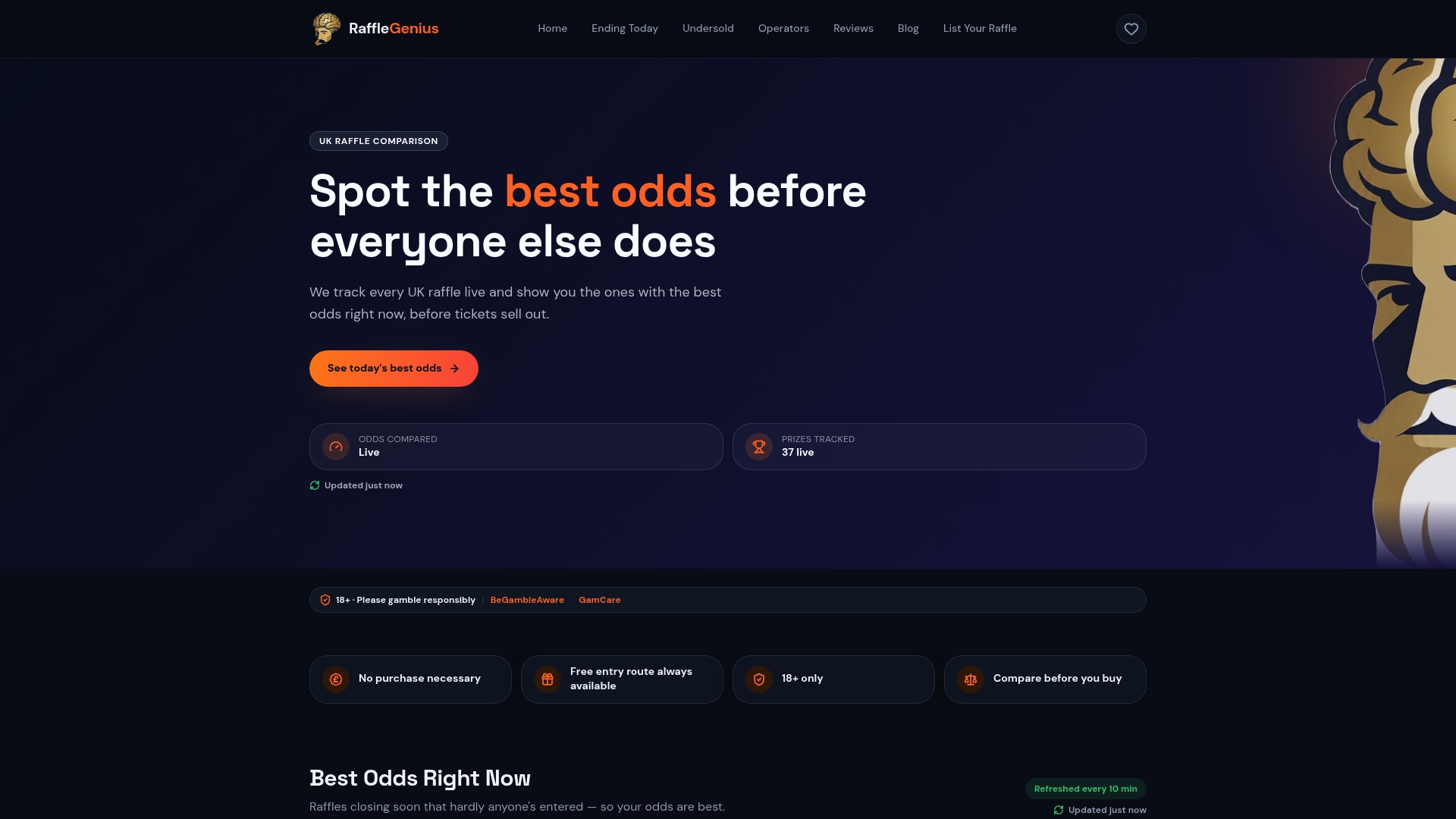
Once you know what to look for in an operator’s terms, the next step is comparing raffles that actually meet that standard. Raffle Genius tracks live odds across UK raffles, updating every 10 minutes, and groups listings so you can see ticket price, per-person limits and value side by side rather than digging through separate terms pages one at a time.
- Browse verified listings and compare odds on the Raffle Genius homepage.
- Look at undersold competitions for draws with more favourable odds relative to ticket price.
Comparing operators this way takes the guesswork out of spotting a fair minimum versus a poorly disclosed one, and it means you are working from the same live data every time you check.
This article is general information, not a substitute for advice from a qualified lawyer. Consult a qualified legal professional about your own circumstances before acting on anything here.
Sources
- Gambling Commission: social media raffle licences
- ASA: promotional marketing — lotteries guidance
- Alder Hey grand national raffle terms and conditions
FAQ
Can a UK raffle operator legally set a minimum ticket purchase?
Yes, provided the raffle is properly licensed with the Gambling Commission or registered with a local authority and the minimum is disclosed clearly in the terms before you pay. The legal basis comes from the Gambling Commission’s lottery rules, not from a separate law about minimums specifically.
What is a typical per-person ticket cap in UK charity raffles?
Published charity terms show caps commonly set between 50 and 100 tickets per person, with Alder Hey’s Grand National raffle using a 100-ticket limit as one example. Some operators also add a separate annual aggregate cap on top of the per-draw limit.
How do I check if a raffle operator is licensed or registered?
Look for a licence number or local-authority registration reference on the operator’s website, and cross-check it against the Gambling Commission’s public guidance on lottery licensing. If this information is missing or unclear, treat that as a warning sign rather than an oversight.
What should I do if a raffle’s terms are missing or misleading?
Contact the operator directly first and keep a written record of your request. If the issue involves misleading advertising, you can raise it with the ASA, and licensing or registration concerns should go to the Gambling Commission or the relevant local authority.
Does Raffle Genius set its own minimum ticket caps?
No, Raffle Genius is a comparison platform rather than a raffle operator, so it does not set ticket prices or caps itself. It tracks and displays the terms, live odds and per-person limits that individual operators publish, updating this information every 10 minutes.
Recommended
18+ · Please gamble responsibly. Raffle Genius is a comparison service and does not run competitions.
Best odds, straight to your inbox
One email a week with the undersold UK competitions closing soon. No spam, unsubscribe any time. 18+