
17 September 2026

Track live UK raffle odds with hypergeometric math and find better EV
The fastest way to know your chance is to work out the hypergeometric probability using the current tickets-sold figure and the prize count, not the total tickets on offer. Feed that into a live odds calculator alongside your ticket number and the number of prizes, then check the expected value before you pay anything. If the sums don’t clear a sensible bar, walk away, however tempting the prize.
TL;DR:
- Raffle odds are accurately calculated using the hypergeometric distribution, especially for multi-prize draws, not by simple multiplication of single-ticket odds.
- Ticket sales, not the advertised number of tickets, determine your real-time chances, so tracking current sold figures is essential for accurate probability estimates.
- Live odds fluctuate rapidly near the closing time, making frequent updates and last-hour checks crucial for a true assessment of your winning chances.
- Expected value considers prize value, ticket cost, and win probability, providing a more meaningful indicator of whether participating is worthwhile than odds alone.
- Playing in undersold draws and using platforms that track live ticket sales can significantly improve your odds, but only if you avoid common mistakes like relying on stale data or confusing tickets on offer with tickets sold.
Table of Contents
- How do you calculate raffle odds accurately?
- How do you track live odds as ticket sales change?
- What is expected value and why does it matter more than odds alone?
- Practical strategies to shift the odds in your favour
- Common mistakes that throw off your odds calculations
- How Raffle Genius applies this to live raffles
- When is tracking odds actually worth your time?
- Try Rafflegenius for live odds without the guesswork
- Sources
- FAQ
How do you calculate raffle odds accurately?
For a single-prize draw, the maths is simple division: your tickets divided by total tickets sold gives your win probability. Ten tickets in a pool of 2,000 gives you a small chance, or roughly “1 in 200”. That framing, “1 in X”, tends to feel more concrete than a percentage, which is why most calculators offer both.
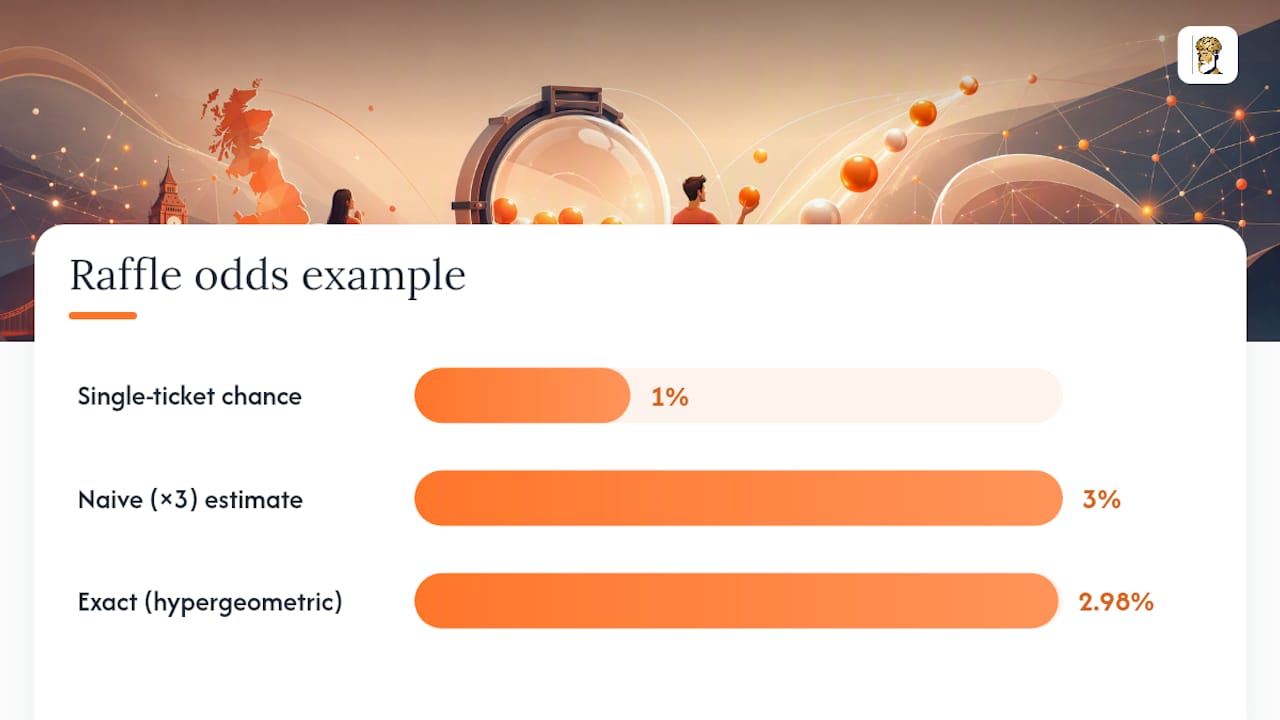
Multi-prize draws need different maths entirely. You cannot just multiply your single-ticket odds by the number of prizes, because that overstates your chances once you account for the fact tickets are drawn without replacement. The correct method is the hypergeometric distribution, where the probability of winning at least one prize equals 1 minus the probability of winning none: P(at least one) = 1 − C(N − k, n) / C(N, n).
Here’s the contrast in practice:
- Naive method: 500 tickets sold, you hold 5, 3 prizes drawn. Multiply single-ticket odds (1%) by 3 prizes and you might guess a 3% chance.
- Exact method: run the hypergeometric formula properly and the real answer comes out at roughly 2.98%, close to the naive guess here but not always so forgiving.
- Where it breaks down: as the number of prizes or your ticket count rises, the gap between naive multiplication and the exact figure widens fast, sometimes by several percentage points.
A raffle odds calculator will print the exact chance of winning zero, one, two or more prizes, plus your expected number of wins, so you’re never relying on a rough approximation for a decision involving real money.
How do you track live odds as ticket sales change?
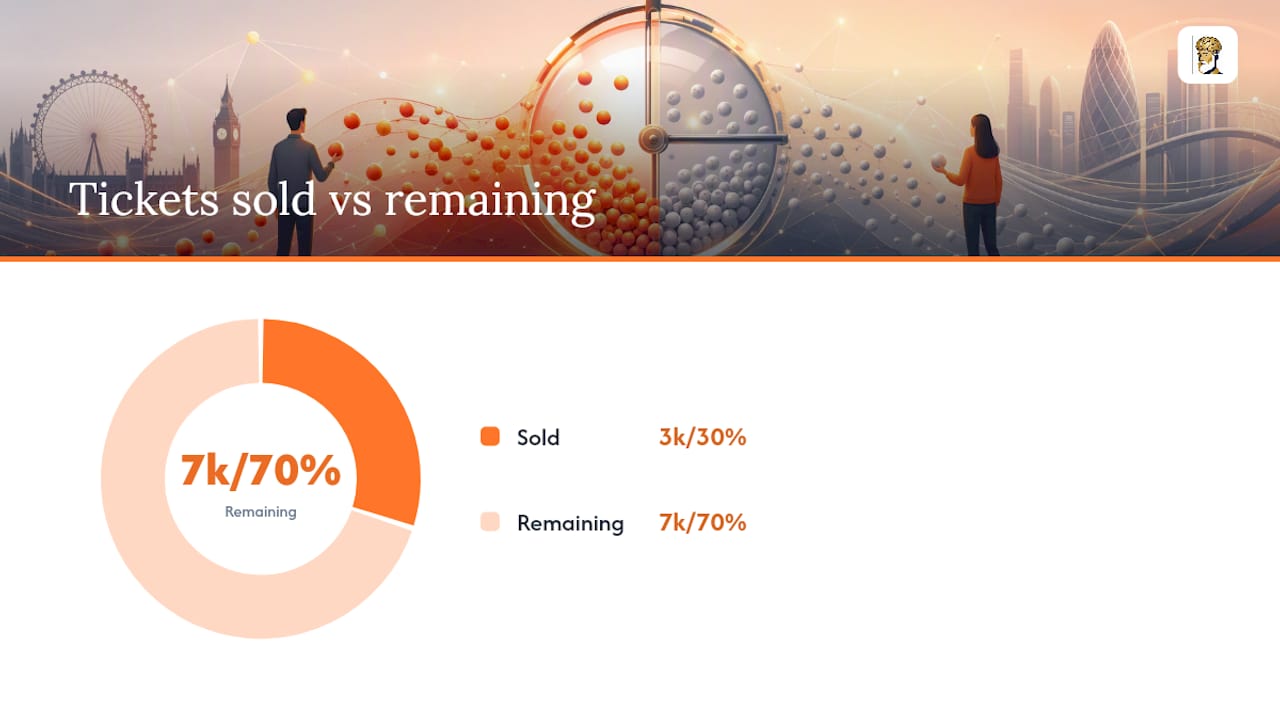
Odds are not fixed the moment a raffle opens. They shift constantly as tickets sell, which is why “tickets on offer” is close to useless for calculating your real chance and “tickets sold” is the number that matters. A draw advertised as having 10,000 tickets available might close having sold only 3,000, and your odds at that lower figure look very different from the odds implied by the advertised cap.
Before you calculate anything, gather these figures:
- Total tickets sold so far (not the maximum on offer)
- Your own ticket count
- Number of prizes on offer
- The draw’s closing time
- The cash alternative value, if one exists
Three types of tools handle the maths from there. One-off calculators, such as the Calculator City raffle tool, take your three core inputs and return an instant probability. Live aggregator trackers pull ticket-sold data from operators automatically and update the odds without you re-entering anything. Spreadsheet templates using the hypergeometric formula suit anyone who wants to track several draws side by side and is comfortable building their own combinatorial formula, as described by CountingMethods.
Refresh frequency matters more than most players assume. A tracker updating every 10 minutes gives you a meaningfully sharper picture near closing time than one refreshing hourly, since ticket sales often accelerate in the final hours of a draw.
Pro Tip: Always check the odds again in the last hour before close. That’s when ticket-sold figures move fastest, and a draw that looked oversubscribed at breakfast can look very different by evening.
What is expected value and why does it matter more than odds alone?
Probability tells you how likely you are to win. Expected value (EV) tells you whether winning is worth the money you’re putting in, which is the question that actually decides whether a raffle is a good idea.
The formula is straightforward:
- Work out your win probability using the hypergeometric method above.
- Multiply by the cash-equivalent prize value. If the operator offers a cash alternative lower than the advertised prize, use that lower figure, since it reflects what the prize is genuinely worth if won.
- Subtract your ticket cost. A positive result suggests reasonable value; a sharply negative one suggests the ticket price outstrips what the odds justify.
Say a £100,000 car has a £60,000 cash alternative, your odds are 1 in 5,000, and the ticket costs £3. EV = (1/5,000 × £60,000) − £3 = £9. That’s a decent return relative to stake, though prize-sharing clauses (where multiple winners split one prize) can quietly shrink this further, so check the rules before assuming the EV is clean.
Practical strategies to shift the odds in your favour
Bulk buying works differently depending on pool size. In a small draw with a few hundred tickets, five extra tickets can move your odds meaningfully. In a draw with tens of thousands of tickets sold, the same five tickets barely register, since your marginal gain shrinks as the pool grows.
That makes undersold draws worth actively hunting. A competition that’s sold slowly relative to its ticket cap, checked close to its deadline, often carries far better odds than one that’s flying towards capacity. Rafflegenius’s best odds this week roundup is one way to see which draws currently fit that pattern without checking every operator individually.
- Look for free-entry routes, which give you extra coverage at no cost to your budget.
- Consider a syndicate to split ticket costs and prizes among a group.
- Set a fixed spending cap before you start browsing, not after.
- Treat any win as a bonus, not an expectation, and never chase losses to recover a bad run.
Pro Tip: Undersold draws found early rarely stay undersold. Check again close to the deadline; a slow starter can fill fast in the final 48 hours.
Common mistakes that throw off your odds calculations
Most bad raffle decisions come from a handful of repeated errors rather than genuine bad luck.
- Confusing tickets on offer with tickets sold. Only the sold figure reflects your real, current odds.
- Treating expected count as probability. In multi-prize draws, n × k/N gives the expected number of wins, not your chance of winning at least one, which is a different figure entirely.
- Ignoring fees and cash-value reductions. A prize’s advertised value and its actual cash alternative can differ substantially.
- Relying on a stale snapshot. Odds checked days before close can be meaningless once ticket sales accelerate near the deadline.
How Raffle Genius applies this to live raffles
Some platforms update odds frequently, tracking tickets sold against tickets on offer across UK raffles to avoid working from a stale snapshot. They compare live odds across operators and may flag free-entry options as they appear.
The workflow mirrors the method above: find a draw, note the current tickets-sold figure, run the probability and EV maths, then decide. Rafflegenius’s undersold competitions listing does much of the first step for you, surfacing draws worth checking before you calculate anything by hand.
When is tracking odds actually worth your time?
Tracking pays off most in small to medium pools with genuinely high-value prizes, where a few hundred tickets’ difference changes the maths meaningfully. For huge national draws, micro-optimising rarely moves the needle. Always play within a budget you’ve set in advance, and lean on BeGambleAware if spending ever starts to feel less like fun and more like pressure.
— matt
Try Rafflegenius for live odds without the guesswork
This kind of platform saves time compared to manually checking multiple operator sites when you want to know your real odds. Such platforms track tickets sold, compare live odds across UK raffles, and update frequently, so the numbers behind your decision are rarely stale.

If you’d rather browse without ads interrupting the comparison tables, the Go ad-free plan runs £4 per month. Otherwise, head straight to the live raffle comparison to see which draws currently offer the strongest odds and where the free-entry routes sit today.
Sources
For the underlying formulas, the Emory Math Center’s hypergeometric guide and CountingMethods’ probability calculator cover the combinatorics in full. For safer-play support, BeGambleAware and GamStop are the standard UK resources.
- Hypergeometric distribution tech tips — Emory Math Center
- Raffle odds calculator — AgentCalc
- Raffle Odds Calculator – Calculator City
- Comprehensive raffle probability calculator — CountingMethods
- BeGambleAware
FAQ
How do I calculate my odds of winning a raffle?
Divide your ticket count by the total tickets sold for a single-prize draw, or use the hypergeometric formula for multi-prize draws, where P(at least one win) = 1 minus the probability of winning nothing. A live calculator fed with current sold figures gives you the exact answer without manual combinatorics.
What is the best strategy to win raffles?
There’s no single tactic that guarantees a win, but favouring undersold draws, checking odds close to closing time, and using free-entry routes all improve your realistic chances for the same spend. Rafflegenius’s undersold competitions page is built specifically to surface draws matching that pattern.
What are common raffle mistakes to avoid?
The biggest error is calculating odds from tickets on offer rather than tickets actually sold, which can make a draw look far worse than it really is. Close behind that is ignoring cash-alternative reductions and prize-splitting rules, which quietly shrink the real value of a win.
How often should I check a raffle’s odds before it closes?
Odds move fastest in the final hours before a draw closes, so a check on day one tells you very little about your actual chances at close. Tools that refresh every 10 minutes, rather than hourly, give you a meaningfully more accurate picture when it matters most.
Recommended
18+ · Please gamble responsibly. Raffle Genius is a comparison service and does not run competitions.
Best odds, straight to your inbox
One email a week with the undersold UK competitions closing soon. No spam, unsubscribe any time. 18+