
6 September 2026

Double Your Odds by Halving the Pool: A Practical Raffle Strategy
The most effective raffle strategy is simple: target undersold draws with small ticket pools, and allocate your entries using expected value rather than gut feeling. Pick raffles with limited entrants over flashy big-prize draws, use bulk or bonus entries only when they genuinely lower your cost per ticket, and track total pool sizes before you buy. The rest of this guide explains why that works and how to apply it.
TL;DR:
- Focusing on small, undersold raffles with transparent, capped pools offers higher odds for the same ticket cost compared to large, heavily promoted draws.
- Concentrating tickets in a single low-entries raffle yields better chances than spreading across multiple large pools unless prizes are cash or vouchers aimed at maximizing win frequency.
- Regularly monitoring pool sizes closer to closing and applying expected value calculations help avoid impulsive, unprofitable entries.
- Using syndicates or batching entries only makes sense for expensive draws if the split is agreed upon beforehand and no secondary reselling is involved.
- Understanding how psychological biases like prize glamour and herd behavior distort rational choices is key to consistent success.
Table of Contents
- What raffle strategy actually means in mathematical terms
- Ticket allocation strategies — when to concentrate and when to spread
- How to find and choose raffles with the best odds
- Money management, syndicates and responsible play
- A practical workflow: monitor, calculate, act
- Common mistakes and a one-page decision checklist
- Why entrants behave irrationally, and how to counter it
- Legal considerations and compliance in entering raffles
- Strategies for secondary markets or trading raffle entries
- The impact of timing and entry windows on winning chances
- What historical winning patterns actually tell you
- Why playing smart beats superstition
- Sources
What raffle strategy actually means in mathematical terms
Raffle strategy, in its truest sense, is a probability exercise dressed up as a game of chance. Your odds of winning a single-draw raffle come down to one ratio: your tickets ÷ total tickets sold. Buy 5 tickets in a pool of hundreds, and your odds are small but meaningful. Buy the same 5 tickets in a much smaller pool, and your odds jump proportionally, with no extra spend.
That formula is the backbone of every tactic in this article, and the Raffle Odds Calculator guide sets out the worked maths behind it clearly.
Multi-prize draws work slightly differently. Instead of calculating each prize separately, work out your probability of winning nothing, then subtract that from 1. If a raffle draws multiple prizes and your odds of missing each one are high, your chance of winning at least one prize is found by subtraction from 1 of the product of missing each prize, resulting in a substantially higher overall chance.
Expected value ties it together: EV is prize value times win probability minus ticket cost. Lower ticket costs improve expected value, though most raffle tickets have a negative expected value.
- If total tickets sold aren’t published, assume the pool is large unless the organiser states a cap.
- Skill-based or capped-entry raffles tend to have smaller, more transparent pools.
- Always calculate EV before comparing prize sizes; a bigger prize with worse odds is often the weaker bet.
Statistic to remember: halving your effective pool size (from 500 to 250 entrants, say) doubles your odds without spending an extra penny on tickets.
Ticket allocation strategies — when to concentrate and when to spread
Deciding how to split tickets across multiple raffles or multiple prizes is where most players get it wrong. Concentrated allocation, putting most or all of your budget into one raffle, makes sense when the pool is genuinely small and there’s a single prize you actually want. Spreading tickets thinly across many raffles rarely beats putting a meaningful stake into one undersold draw.
Spread allocation earns its place in different circumstances: when a platform runs several simultaneous draws with similar entry costs and you want to maximise your chance of winning something, rather than one specific item. This works especially well when prizes are cash or vouchers rather than a single dream item, since any win counts equally.
A workable decision rule:
- Estimate the pool. If it’s under a few hundred entries, lean towards concentrating your budget there.
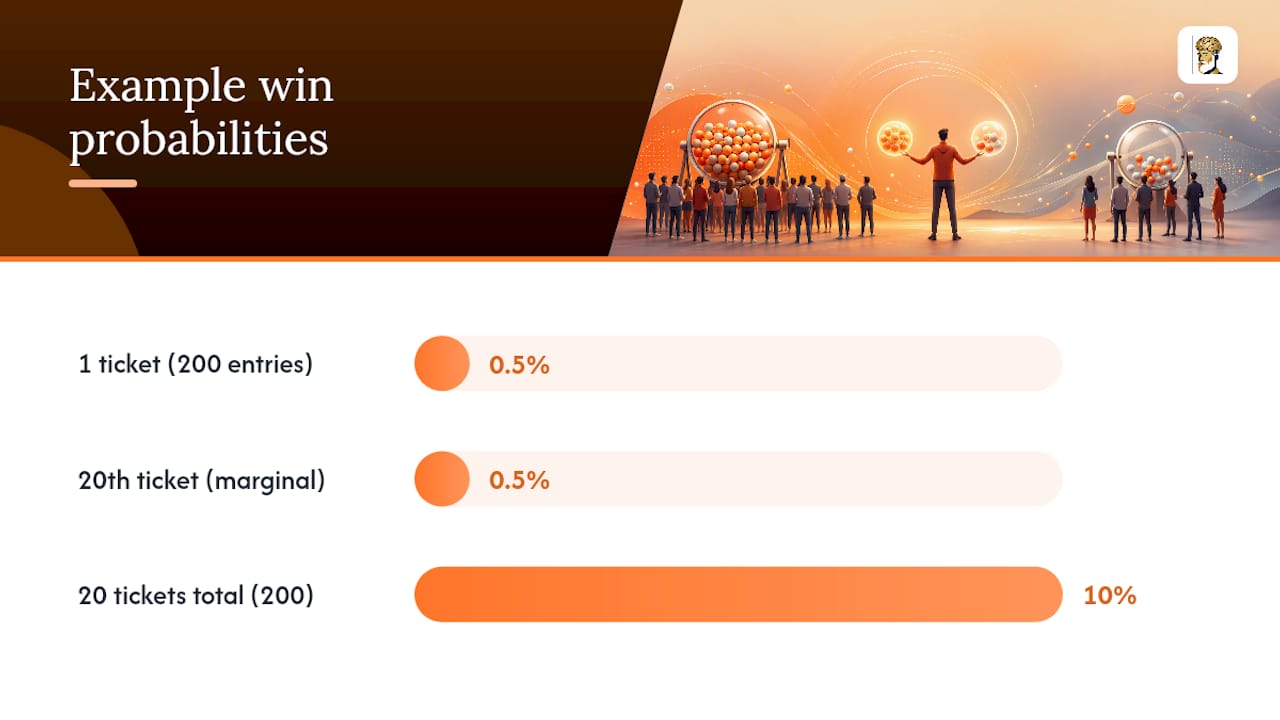
- Check the marginal benefit of each extra ticket. Your first ticket in a 200-entry pool moves your odds from 0% to 0.5%. Your 20th ticket only moves you from 9.5% to 10%, a shrinking return for each additional pound spent.
- Diversify only when pools are large and roughly equal in odds. Spreading five tickets across five 1,000-entry raffles beats putting all five into one, if your goal is “win anything” rather than “win this specific prize.”
Where pool sizes fluctuate and you can observe them before entries close, borrow the intuition behind the multi-armed bandit problem: keep watching which “bowl” is performing best (smallest pool relative to prize value) and shift remaining tickets there as the picture becomes clearer.
Pro Tip: Check a raffle’s entrant count an hour before closing, not the day it opens. Late surges or lulls tell you far more about your real odds than day-one numbers ever will.
How to find and choose raffles with the best odds
Undersold raffles rarely advertise themselves as undersold, so you have to go looking. Community fundraisers, school events, and niche hobby-club competitions typically draw far fewer entrants than nationally marketed prize draws, because visibility is lower.
- Skill-based entry (answer a question, write a tiebreaker) filters out casual entrants and shrinks the effective pool, even though the barrier itself doesn’t guarantee better odds mathematically, just fewer competitors in practice.
- Restricted-entry raffles (local, membership-only, or low-budget marketing) tend to have smaller pools than nationally advertised ones.
- Bulk discounts and referral bonuses only help your odds if they genuinely lower your cost per entry. Ten tickets for the price of eight is worth taking. Ten tickets for the price of nine and a half usually isn’t worth chasing.
- Daily entry mechanics (one free entry per day) reward consistency more than lump-sum spending. Track them like a habit, not a gamble.
Bookmark organisers who run frequent, smaller draws and note their typical closing times. A running list of pool sizes, even rough estimates, turns guesswork into a genuine comparison of odds across live competitions.
Money management, syndicates and responsible play
Set a monthly raffle budget before you buy a single ticket, and treat every additional purchase against a simple rule: only buy more if the marginal EV improvement justifies the extra spend, not because “just one more” feels tempting.
- Fix a ceiling. Decide your monthly spend in advance and stick to it regardless of how attractive a prize looks.
- Consider a syndicate for expensive draws. Pooling money with friends or colleagues to buy more tickets in one raffle, then splitting any win proportionally to contribution, improves your collective odds without individual overspend.
- Separate charity giving from strategy. If a raffle supports a cause you care about, treat that portion as a donation, not an EV calculation.
Pro Tip: Agree on the split rule in a syndicate before you buy a single ticket, not after someone wins. Verbal promises fade fast once a prize is on the table.
A practical workflow: monitor, calculate, act
The strongest raffle players don’t rely on memory. They track pools, run a quick EV sum, cap their spend, then act, in that order, every time.
A basic spreadsheet does the job: raffle name, closing time, estimated entrants, your ticket count, cost, prize value, and a calculated EV column that spits out a yes or no. That structure alone cuts down on impulsive buys more than any single tactic in this article.
For live monitoring, a platform that refreshes pool data regularly beats checking manually. A platform that updates odds frequently and lists undersold competitions alongside prize values and closing times can help you spot a shrinking pool without refreshing multiple operator sites manually, much like how table games platforms present odds and responsible play information to players. This way, you can spot a shrinking pool without refreshing ten different operator sites yourself.
- Track pools daily for draws closing within a week.
- Recalculate EV whenever the advertised pool size changes materially.
- Watch for early-bird bonuses (often better value than late top-ups) and last-minute pool dips near closing time.
Common mistakes and a one-page decision checklist
The same errors crop up again and again. Chasing the flashiest prize while ignoring pool size, buying “just a few more” tickets without recalculating EV, and treating every raffle as equally worth entering are the three biggest.
Compare two entrants: one buys ten tickets in a 5,000-entry supercar raffle because the prize looks incredible. The other buys ten tickets in a 150-entry raffle for a £2,000 cash prize. The second entrant’s odds are roughly 33 times better, despite spending the same money.
- Ignoring pool size entirely.
- Fixating on prize glamour over odds.
- Buying bulk tickets that don’t actually reduce cost per entry.
- Spending beyond a set monthly ceiling.
| Checklist question | Why it matters |
|---|---|
| Is the pool size known or estimable? | Unknown pools make EV impossible to judge |
| Is expected value positive or acceptably close to zero? | Confirms you’re not overpaying for the odds on offer |
| Does the bulk deal genuinely cut cost per ticket? | Many “discounts” barely move the maths |
| Does this purchase stay within budget? | Protects against emotional overspend |
Why entrants behave irrationally, and how to counter it
Raffles exploit a handful of predictable psychological patterns, and recognising them is half the battle. The “near miss” effect, seeing your number almost called, keeps players buying more even though a near miss carries zero informational value about future draws. Every draw is independent; a near miss changes nothing about your next ticket’s odds.
Prize glamour skews judgement too. A £2 ticket for a shot at a supercar feels more exciting than the same £2 spent on a raffle for £500 cash, even when the cash raffle offers dramatically better odds. This is why concrete EV maths matters more than gut appeal.
Social proof plays a role as well. Seeing “1,200 tickets sold already” can push people to buy purely because others have, a herd instinct that has nothing to do with your actual probability of winning. If anything, high visible sales should push you towards a different, quieter raffle with a smaller pool.
Loss aversion also distorts decisions. Once someone has spent £20 on tickets for a single draw, they often keep buying to “justify” the sunk cost, even when a fresh EV calculation says stop. Treating each additional ticket as a brand-new decision, disconnected from what you’ve already spent, keeps you rational. The players who consistently do well tend to be the ones who treat entry as a resource-allocation exercise rather than an emotional response to a shiny prize photo.

Legal considerations and compliance in entering raffles
Raffle law varies by structure and jurisdiction, and the distinction that matters most is whether a competition is a game of pure chance or includes a skill element. In the UK, pure chance draws where entrants pay to enter are tightly regulated, which is why many prize competitions include a free-entry route or a skill-based question, keeping them outside strict gambling regulation.
Always check that an operator publishes clear terms: how winners are selected, when the draw closes, and how prizes are delivered. A legitimate operator will disclose total ticket numbers or a maximum cap, state the free-entry route clearly if one exists, and provide contact details for a real business. Entering competitions run by unregistered or opaque operators carries genuine risk, both of losing your stake and of personal data being mishandled.
Age restrictions apply almost universally; UK raffles and prize competitions generally require entrants to be 18 or over. If a raffle involves alcohol, tobacco, or cash prizes above a certain threshold, additional licensing rules may apply to the organiser, though this is the operator’s compliance burden rather than yours as an entrant.
If you’re ever unsure whether a competition is operating within UK consumer protection rules, checking the operator’s terms and conditions before paying is the simplest safeguard. When something looks off, no odds calculation makes it worth the risk.
Strategies for secondary markets or trading raffle entries
A smaller but growing corner of raffle strategy involves trading or transferring entries, particularly for group-organised or syndicate draws where tickets are sometimes shared, sold on, or swapped between participants before a draw closes.
Most licensed UK operators explicitly prohibit reselling individual entries once purchased, since ticket ownership is usually tied to the account or details used to buy it. Attempting to trade entries on an operator that bans it risks disqualification, so check terms before assuming a transfer is possible.
Where trading is genuinely permitted, most commonly informal syndicate arrangements among friends or colleagues, the maths only helps if the split is agreed and recorded before the draw, not after. A verbal “we’ll sort it out if we win” agreement is the single most common source of syndicate disputes.
Some players also swap surplus entries across different raffles with the same total spend, effectively diversifying pool exposure without extra cost. This only works when both parties are entering comparable-value draws; swapping ten tickets in a 5,000-entry raffle for ten tickets in a 200-entry raffle is a lopsided trade dressed up as a fair one.
Treat any secondary trading as a trust exercise rather than a maths one. The EV calculations in this article assume you control your own tickets outright; the moment ownership becomes shared or informally transferred, the safest approach is a written agreement, however simple, before any ticket changes hands.
The impact of timing and entry windows on winning chances
Timing affects your odds in two separate ways: how the pool fills over the entry window, and when bonus mechanics are weighted.
Pool size rarely grows evenly. Many raffles see a slow trickle of entries early, then a sharp spike in the final 24 to 48 hours as marketing pushes intensify and social sharing peaks. Checking a raffle’s entrant count early in its window can be misleading; a raffle that looks undersold on day one might balloon to ten times that size by closing time.
This cuts both ways for strategy. If you’re chasing a genuinely small, capped-entry raffle, entering early locks in your ticket before a possible late surge, though it doesn’t change your odds once the pool is fixed. If you’re using EV calculations to decide whether to enter at all, checking pool size close to the deadline gives a far more accurate picture than an early snapshot.
Early-bird bonuses, extra entries for entering within the first few days, can shift the maths in your favour if the bonus tickets are free or heavily discounted relative to standard price. Weigh that bonus against the likelihood the pool will still grow substantially afterwards; a free bonus ticket in a raffle that ends up with 10,000 entrants isn’t worth much.
Daily-entry mechanics reward showing up consistently across the whole window rather than dumping your budget in on day one. A player who claims a free daily entry for 30 days accumulates 30 chances at zero extra cost, comfortably outperforming someone who buys the same 30 entries in one lump sum with no bonus attached.
What historical winning patterns actually tell you
Detailed public data on individual winners across raffle operators is limited, since most platforms don’t publish granular entrant-to-winner ratios beyond the headline pool size and the eventual winner’s name. That gap matters, because it means most “patterns” repeated online, lucky numbers, particular days of the week, specific ticket ranges, are anecdotal rather than evidenced.
What can be stated with confidence, because it follows directly from the maths, is that smaller historical pools produce proportionally more winners relative to entrants over time. A raffle series that consistently runs at 200 to 400 entries will, across dozens of draws, produce a noticeably different distribution of winning odds than one that regularly tops 10,000 entries, even though any single draw’s outcome is still down to chance.
The more useful historical exercise isn’t hunting for lucky patterns in past winners. It’s tracking an operator’s typical pool sizes over several draws to build a realistic expectation of what you’re buying into. An operator whose competitions routinely close with a few hundred entries is a fundamentally different proposition to one whose flagship car draw regularly exceeds 50,000, regardless of what either draw’s past winners happened to pick.
Why playing smart beats superstition
Superstition survives in raffles because maths feels cold next to the thrill of a lucky number. But tracking pool size and running a two-line EV sum takes less time than scrolling for “lucky ticket” advice, and it actually moves your odds.
None of this guarantees a win. What it does is stop you paying over the odds for hope. Use the checklist, log your entries, and watch whether smaller, quieter raffles start paying off more often than the big glamorous ones.
— matt
Sources
The Raffle Odds Calculator guide walks through worked probability and EV examples in more depth than fits here. For the adaptive allocation logic behind reallocating tickets across draws, the multi-armed bandit explainer is the clearest starting point. For resource-allocation tactics applied specifically to raffles and sweepstakes, see the mathematical strategies guide.
Ready to put the maths into practice? Raffle Genius tracks live odds across UK raffles and refreshes them every 10 minutes, or you can start with zero stake on the Play to Win free-entry game to test the workflow before spending a penny.
- Raffle Odds Calculator: Calculate Your Chances of Winning Any Prize Draw (2026) - Practical Web Tools
- Multi-armed bandit — Wikipedia
- Mathematical Strategies for Improving Raffle and Sweepstakes Odds — RummyFuture
Recommended
- How to Find the Best UK Prize Raffles: A Complete Operator Comparison Guide
- UK prize competition operators compared: BOTB, Raffall, Premier Prize, Seven Days Performance and Raffle House
- Cash alternative or the car? The maths most winners get wrong
- How to spot an undersold competition before it closes
18+ · Please gamble responsibly. Raffle Genius is a comparison service and does not run competitions.
Best odds, straight to your inbox
One email a week with the undersold UK competitions closing soon. No spam, unsubscribe any time. 18+