
24 September 2026

Spot Silent Extensions Every 10 Minutes: UK Extended Closing Dates
Operators can only extend a raffle’s closing date in narrow, unavoidable circumstances, not because ticket sales are lagging. The Advertising Standards Authority’s CAP Code says any date change must be genuinely outside the promoter’s control, and the Gov explicitly rules out extensions for weak sales. If you suspect a date change was made purely to hit a ticket target, you have grounds to request a refund or lodge a complaint.
TL;DR:
- Extensions due to low ticket sales are not permitted and can lead to complaints or refunds if the reason is not linked to genuinely unavoidable circumstances.
- Operators must clearly state and prominently display the closing date, and any change requires a public, timely explanation aligning with rules on fairness.
- Valid reasons for extending a raffle, such as technical failures or weather disruptions, must be specific, verifiable, and communicated through the same advertising channels.
- Vagueness, silence, or reasons that imply boosting sales as the motive for a date change are signs of unfair practices and warrant suspicion.
- Using tools like Raffle Genius’s live odds tracker helps detect unexpected deadline changes and verify if a closure extension is legitimate before entering or acting.
Table of Contents
- What the ASA and CAP Code say about closing dates
- When is an extension actually legitimate?
- How to check if a closing-date change is legitimate
- What to do if you think an extension is unfair
- The Raffle Genius view on closing-date transparency
- Track closing dates before they catch you out
- Primary sources to verify rules and guidance
- Sources
- FAQ
What the ASA and CAP Code say about closing dates
Closing dates are not a minor footnote in a raffle’s terms. Under Rule 8.17 of the CAP Code, they count as a “significant condition” of the promotion, which means operators must state them clearly and prominently wherever the competition is advertised, not bury them in a lengthy terms page. The logic is straightforward: entrants make a decision to buy a ticket based partly on when the draw will happen and how many people they are likely to be competing against.
The ASA has been consistent on this point in practice, not just in theory. In rulings involving operators including KS Competitions and HMV Competitions, the regulator found that pushing back a closing date to sell more tickets disadvantaged people who had already entered, because it diluted their odds without their consent. Low sales, on their own, do not meet the threshold of an “unavoidable circumstance” under Rule 8.17.4.e, which is the specific clause that governs when a date can move at all.
Marketers carry three obligations that flow directly from this rule:
- Publish full, accurate terms and conditions before the first ticket is sold, not after.
- Present the closing date as prominently as the prize itself in adverts, emails, and social posts.
- Avoid any wording that implies the date is flexible unless a genuine unavoidable-circumstances clause is spelt out from the start.
Where an operator’s own T&Cs quietly reserve the right to “extend at our discretion,” that clause still has to survive contact with the ASA’s test of what counts as genuinely unforeseeable. A vague reservation of rights does not override the Code.
When is an extension actually legitimate?
Not every date change is a red flag. The ASA accepts that some events genuinely sit outside a promoter’s control, and in those cases, moving the closing date can be the fairer option for everyone involved, including the entrants who already bought tickets.
Examples that typically pass the test include:
- Technical failure — a payment gateway or entry platform goes down for a significant stretch, preventing people from entering as advertised.
- Extreme weather or infrastructure disruption — a widely reported case saw a community competition extend its submission deadline after a scheduled event was postponed by weather, with the operator explaining the change publicly rather than quietly editing a webpage.
- External regulatory or platform disruption — action taken by a third party (a hosting provider, a payment processor) that stops entries being processed correctly.
What separates these from a low-sales extension is that none of them were foreseeable or within the operator’s control, and none of them exist to inflate the entrant pool for commercial reasons.
Where a genuine change does happen, the ASA expects operators to communicate it through the same channels used to advertise the competition in the first place, promptly and clearly, rather than a quiet edit to small print. Many operators also offer a limited refund or opt-out window, sometimes around 14 days, for anyone who no longer wants to take part once the date has moved.

Pro Tip: If an operator changes a closing date without emailing entrants or posting the update on the same social channels it used to advertise the competition, that silence is itself worth flagging in a complaint.
The GOV.UK voluntary code, published in November 2025, goes further than the CAP Code by naming the specific practice it wants stopped: operators should not change a draw’s end date because of low ticket sales. Signatories are expected to have the code fully implemented by 20 May 2026, which gives consumers a concrete date against which to judge whether a business is keeping its public commitment.
How to check if a closing-date change is legitimate
Before you accept an operator’s explanation, or demand a refund, run through a short verification process. It takes a few minutes and puts you in a far stronger position if you need to escalate.
- Reread the original T&Cs for any pre stated extension mechanic, and note whether it ties the closing date to a ticket-sales threshold rather than an unforeseeable event.
- Ask whether the stated reason genuinely fits the ASA’s “unavoidable circumstances” test, or whether it reads more like a commercial justification dressed up as one.
- Screenshot the original closing date and the new one, with timestamps, and check whether an archived version of the page exists via a web archive tool.
- Look for a public statement from the operator, ideally on the same channel used to advertise the competition, explaining what happened and when.
- Check whether the operator claims to be a signatory to the GOV.UK voluntary code, since that status carries a public commitment not to extend for low sales.
Extending a closing date does more than annoy existing entrants. Because a raffle’s odds are simply the number of prizes divided by the number of tickets sold, adding more time to sell more tickets mathematically reduces the winning chances of everyone who already entered, which is the core reason the ASA treats commercially motivated extensions as inherently unfair rather than a harmless delay.
If the stated reason is vague, generic, or simply “to give more people a chance to win,” treat that as a warning sign rather than a satisfactory answer. Genuine unavoidable circumstances are usually specific, dated, and verifiable.
What to do if you think an extension is unfair
Acting quickly matters, both for your own refund window and for the strength of any complaint you might file later.
- Request a refund or opt-out directly from the operator, citing the specific clause in their T&Cs and, where relevant, Rule 8.17.4.e of the CAP Code.
- Gather your evidence before you contact anyone else: dated screenshots of the original and revised closing dates, proof of payment, a saved copy of the T&Cs as they stood when you entered, and any marketing material showing the original deadline.
- Complain to the ASA if the operator refuses a reasonable response, since closing-date manipulation falls squarely within its advertising remit.
- Contact Trading Standards for wider consumer-protection concerns, and be aware the Gambling Commission does not license free draws and prize competitions the way it does gambling products, so it steps in only where a promotion breaches the Gambling Act 2005.
- Consider a card chargeback through your bank if the operator becomes unresponsive, though this works best when you can show the prize or fair terms were never delivered as advertised, and it has limits if too much time has passed since payment.
The Raffle Genius view on closing-date transparency
Closing-date changes are exactly the kind of detail that gets lost between checking a competition once and coming back to buy a ticket days later. That gap is where trust breaks down, and it is why Raffle Genius refreshes odds and closing times every 10 minutes rather than relying on a static snapshot.
When a deadline moves unexpectedly, that shift shows up fast, and our “Ending Today” filter is built specifically to surface competitions closing imminently, so you are not caught out by a quiet edit to someone else’s terms page. Our practical advice is simple: treat any sudden extension with the same scepticism the ASA does, and check whether the stated reason would actually survive scrutiny before you top up your entries.
— matt
Track closing dates before they catch you out
Raffle Genius exists because chasing down closing-date changes across dozens of operator sites manually wastes time you could spend actually comparing odds. Instead of refreshing ten browser tabs to see who has quietly pushed a deadline, Raffle Genius updates live odds and closing times every 10 minutes across the UK raffle market, so a sudden date shift shows up on our tracker almost as fast as it appears on the operator’s own site.
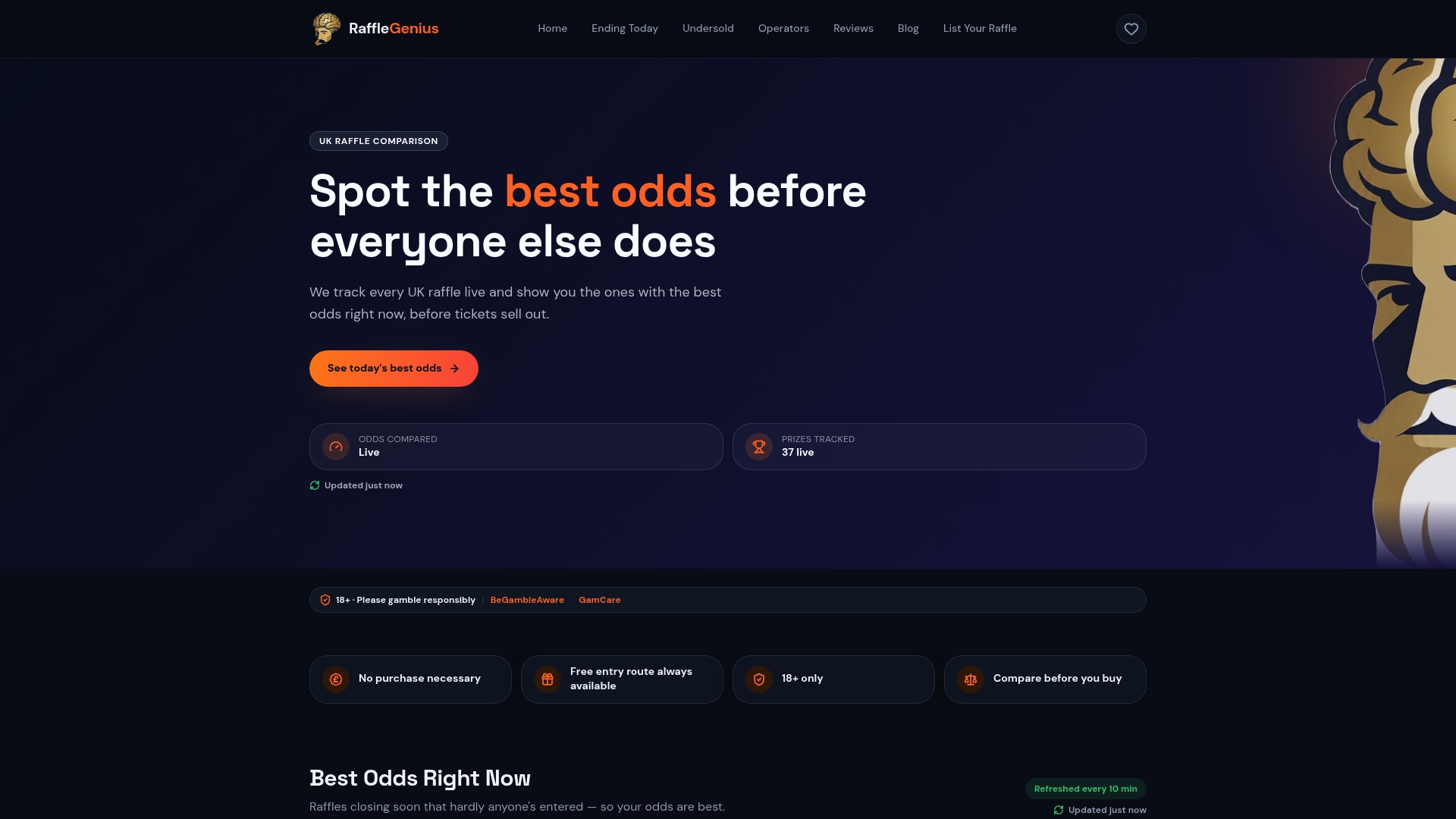
Start with our “Ending Today” filter to see exactly which competitions are closing soon and which have recently changed. If you want a cleaner browsing experience while you compare, the Go ad-free plan costs £4 per month and strips out distractions so you can focus on odds, not banner ads. Bookmark the Raffle Genius homepage and check it before you enter anything new.
Primary sources to verify rules and guidance
- Advertising Standards Authority: Closing dates — the core CAP Code guidance on Rule 8.17.
- Voluntary Code of Good Practice for Prize Draw Operators — GOV.UK’s industry code and signatory expectations.
- Consumer information notice: Free draws and prize competitions — Gambling Commission’s position on oversight.
- ASA: Dealing with unexpected events when running promotions — communication duties during genuine disruptions.
- Are UK raffle sites legit? — Raffle Genius’s practical operator checklist.
Sources
- Advertising Standards Authority: Closing dates - Advice Online
- Gov
- Consumer information notice: Free draws and prize competitions - Gambling Commission
- ASA: Dealing with unexpected events when running promotions
FAQ
Can a UK raffle operator change the closing date after I’ve entered?
Only in narrow circumstances that were genuinely outside the operator’s control, such as a technical failure or extreme weather, under CAP Code Rule 8.17.4.e. Extending a date simply because ticket sales were slow does not meet that bar and can breach the Code.
Is it legal for operators to extend a raffle because sales are low?
It is not compliant with ASA guidance, and the GOV.UK voluntary code explicitly tells signatories not to change a draw’s end date for that reason. Operators doing so risk an ASA ruling against them and a damaged reputation with entrants.
What should I do if a competition I entered gets extended?
Check the operator’s T&Cs for the stated reason, request a refund or opt-out if you no longer want to take part, and keep dated screenshots as evidence. If the operator refuses a reasonable response, you can complain to the ASA or Trading Standards.
Does the Gambling Commission regulate raffle closing dates?
No, the Gambling Commission does not license free draws and prize competitions the way it does gambling products, and steps in mainly where a promotion breaches the Gambling Act 2005. Closing-date disputes are usually handled through ASA advertising rules instead.
How can I spot a suspicious closing-date extension before I enter?
Look for vague or unexplained reasons, no public notice on the operator’s usual channels, and terms that tie the closing date to ticket-sales targets rather than unforeseeable events. Tools like Raffle Genius’s “Ending Today” filter make it easier to spot a deadline that has shifted since you last checked.
Recommended
18+ · Please gamble responsibly. Raffle Genius is a comparison service and does not run competitions.
Best odds, straight to your inbox
One email a week with the undersold UK competitions closing soon. No spam, unsubscribe any time. 18+