
15 September 2026

Find Better Odds: Weekly UK Raffle Roundup of 5 Notable Draws
This week’s roundup covers five notable UK draws worth your attention, from St Margaret’s Hospice weekly prize draw to high-profile Omaze house competitions. Before entering any of them, check the operator’s published odds and terms and conditions, and confirm exactly how much of your ticket price reaches the named charity. The Gambling Commission sets the regulatory backdrop for all of this, and a live-odds tool such as Raffle Genius makes the comparison faster.
TL;DR:
- Most UK raffles with large prizes rely on a cap on ticket sales, making the expected value more favorable when sales are low.
- Published odds or maximum ticket numbers are essential for estimating your actual chances of winning in a raffle.
- Competitions with minimum sales thresholds can convert your win into a cash payout if the advertised prize isn’t funded fully.
- Live tools like Raffle Genius update odds and sales data every 10 minutes, helping you identify the most promising draws before they close.
- Many operator claims about large odds or prizes are unreliable if they lack transparent funding, official charity registration, or verifiable winner announcements.
Table of Contents
- This week’s notable UK raffles and why each matters
- How do you compare weekly raffles before entering?
- What does UK law say about raffles and prize draws?
- How do you spot a realistic prize and believable odds?
- How Raffle Genius helps you compare weekly UK raffles in real time
- Play for fun, not as an investment
- Try Raffle Genius to compare live UK weekly raffles
- Sources
- FAQ
This week’s notable UK raffles and why each matters
Weekly raffle news in the UK tends to cluster around a handful of recognisable formats: hospice draws, house competitions, and celebrity-backed charity giveaways. Here’s what stands out right now and why each one earns a place on this week’s UK raffle news list.
- St Margaret’s Hospice Care weekly prize draw. This hospice runs a structured weekly draw offering 28 separate prizes ranging from £10 to £1,000, with a rollover mechanism that can build a jackpot up to £10,000 when nobody claims the top prize. It’s a solid example of a charity draw with genuinely tiered odds rather than one enormous prize and thousands of losers.
- Omaze UK house and charity prize draws. Omaze pairs a headline prize, usually a renovated house, with a named charity partner. Recent coverage confirmed a Scottish winner took home a £4 million Cornwall mansion for a modest ticket price, which shows the scale these draws can reach. The trade-off is that entry volumes are large, so your individual odds on the headline prize are thin even when the charity impact is real.
- Raffall house competition example. A Pembrokeshire family recently listed their £240,000 home on Raffall for £10 a ticket, capped at 30,000 tickets. Crucially, if the organisers don’t sell enough tickets, the winner receives a cash share of revenue instead of the house. That minimum-sales clause is worth reading twice before you buy in.
- Age-related and national charity weekly draws. Charities such as Age UK and Tommy’s run their own weekly prize draws, often with published odds for specific number matches, giving entrants a clearer sense of what they’re actually buying into compared with vaguer commercial competitions.
- Free-entry weekly competition listings. Sites like ThePrizeFinder aggregate no-purchase-necessary weekly competitions. Treat this as a resource for finding free routes to entry, not as an endorsement of any single competition listed there.
Local charity raffles matter too. The BBC recently reported on a guitar raffle raising funds for the Rothbury Estate, a reminder that community fundraisers with modest prizes are just as much a part of the UK raffle landscape as the headline-grabbing house draws.
How do you compare weekly raffles before entering?
Five criteria separate a genuinely good weekly raffle from one that only looks generous on the surface.
- Ticket price versus prize value. Divide the prize value by the maximum number of tickets sold to get a rough expected value per ticket, then compare that against the entry price. A £10 ticket for a £240,000 house with a 30,000 ticket cap has a very different expected value to the same price with no cap disclosed at all.
- Published odds, or the ability to estimate them. Some operators, including Tommy’s Weekly Win, publish exact odds. Where they don’t, a stated maximum ticket number lets you calculate implied odds yourself.
- Minimum sales targets and cash alternatives. Check whether the prize converts to a cash share if the operator doesn’t hit its sales target, as happened with the Raffall house listing above. This single clause changes what you’re actually playing for.
- Charity transparency. Look for a registered charity number and a clear statement of how much of each ticket sale reaches the cause, rather than a vague “supporting” claim.
- Draw frequency and closing times. Weekly draws with rollovers reward patience, since a jackpot that isn’t claimed one week often carries into the next, as with St Margaret’s.
Pro Tip: If a competition page doesn’t state a maximum ticket number anywhere, treat any odds claim on that page as unverifiable until you find one that does.
What does UK law say about raffles and prize draws?
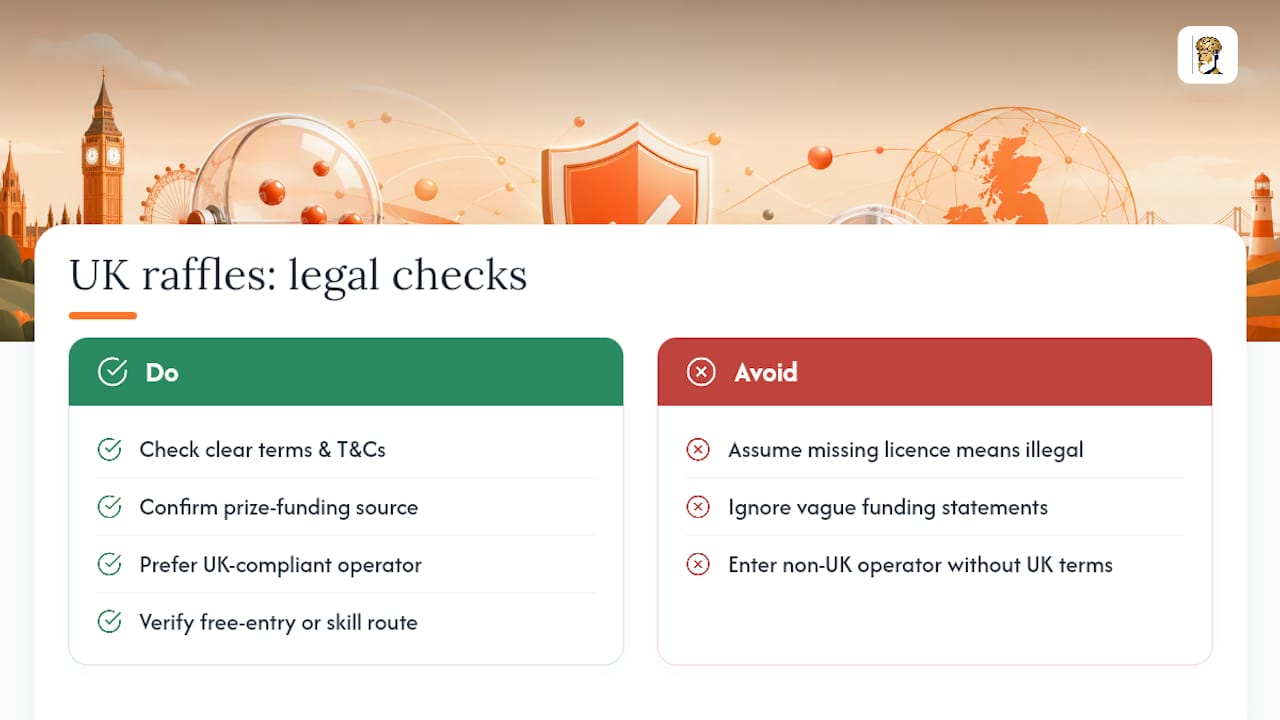
Not every prize competition in the UK is a licensed lottery, and that distinction matters more than most entrants realise. The Gambling Commission’s guidance draws a clear line: prize competitions and free draws must be genuinely distinct from a lottery, usually by requiring a skill element or offering a free entry route, and organisers carry the responsibility for keeping their competition on the right side of that line.
Running a legal free raffle in the UK doesn’t require a licence provided it meets these conditions, but that doesn’t mean every competition you see has done its homework. A missing regulator stamp doesn’t automatically mean a raffle is illegal, since most operate legally without one. What should worry you is the absence of clear terms and conditions, vague statements about where prize funding comes from, or a non-UK operator specifically targeting UK entrants without UK-compliant terms.
How do you spot a realistic prize and believable odds?
A few quick checks separate credible weekly raffles from ones built on hope rather than funding. Search for independent news coverage or published winner announcements. If an operator has been running for months and nobody outside its own site has reported a winner, treat that as a warning sign rather than proof of anything.
- Verify that large prizes have visible funding behind them and that a cash alternative clause exists in the terms.
- Estimate real odds from the maximum ticket cap rather than trusting phrases like “huge odds” with no numbers attached.
- If a minimum sales threshold is written into the terms, understand what happens if it isn’t met. As the Raffall house competition showed, that can mean a reduced cash payout instead of the advertised prize.
Where operator pages and independent news reporting agree on the same facts, that alignment is the strongest signal you’ll get that a prize is genuinely funded.
How Raffle Genius helps you compare weekly UK raffles in real time
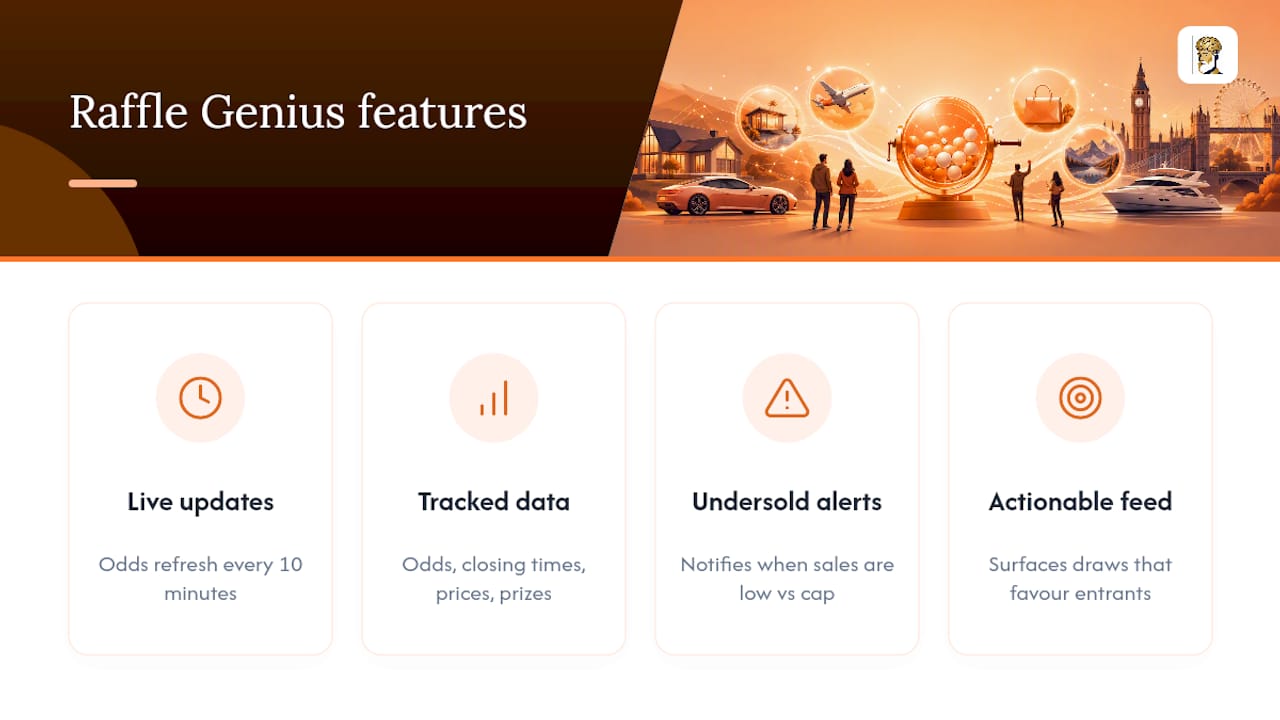
Tracking every operator’s odds and closing times by hand takes time you probably don’t have. Raffle Genius updates odds every 10 minutes across tracked UK competitions, alongside ticket prices, prize values, and alerts for undersold competitions where fewer tickets have sold relative to the cap, often the best window for genuine value.
That live feed means you’re not relying on outdated information or vague marketing claims. It surfaces where the numbers currently favour entrants and lets you prioritise which draws are actually worth your ticket budget this week. Visit the best odds this week page or set up alerts to get notified before the strongest opportunities close.
Play for fun, not as an investment
Set a weekly raffle budget you’d be entirely comfortable losing, and stick to it regardless of how tempting a rollover jackpot looks. Odds on headline prizes are usually long, even on well-run charity draws, so treat any win as a bonus rather than an expectation. Always verify a competition’s terms and conditions yourself before entering, rather than taking a listing’s headline claims at face value.
— matt
Try Raffle Genius to compare live UK weekly raffles
Raffle Genius exists because comparing dozens of weekly UK raffles by hand wastes time you could spend actually entering the ones with decent odds. Instead of checking five operator sites separately, you get live odds, ticket prices, and closing times in one place, refreshed every 10 minutes.

A typical workflow looks like this: browse the undersold competitions page to spot draws with fewer tickets sold relative to their cap, click through to the operator to enter, then set an alert so you don’t miss a closing rollover. If you’d rather build ticket entries without spending outright, the Play to Win feature lets you earn entries through free gameplay instead. Head to Raffle Genius to start comparing this week’s odds.
Sources
Claims about UK regulation come from the Gambling Commission’s prize competition guidance. Operator terms are drawn from St Margaret’s Hospice Care’s weekly draw page, while recent wins are reported by the Daily Record and Pembrokeshire Herald. News reports describe specific wins; organiser pages describe the actual draw terms, so check both.
- St Margaret’s Hospice Care — weekly prize draw
- Gambling Commission — free draws and prize competitions guidance
- Daily Record — Scots granny wins incredible £4m mansion in coastal Cornwall
- Pembrokeshire Herald — young Pembroke Dock family offers £240,000 home in £10-a-ticket competition
FAQ
Are raffles illegal in the UK?
No. Most weekly raffles and prize competitions operate legally in the UK provided they’re structured as a genuine prize competition or free draw rather than an unlicensed lottery, as set out in the Gambling Commission’s guidance.
Has anyone ever won £10,000 a month for 30 years in a UK raffle?
Some UK prize competitions do advertise long-term monthly income prizes as a headline draw, but odds on this specific top prize are typically very long. Check the operator’s own published terms for the exact structure rather than relying on marketing copy, since these offers vary considerably between operators.
What are the best raffle prizes in the UK right now?
Current standout examples include Omaze’s high-value house draws, which recently delivered a £4 million Cornwall mansion, and St Margaret’s Hospice weekly draw with its rollover reaching up to £10,000.
How do I run a raffle legally in the UK for free?
A small raffle can run without a licence if it’s structured as a genuine private or society lottery under the relevant exemptions, or as a prize competition with a free entry route, per Gambling Commission rules. Always check the current exemption thresholds before organising one, since these depend on ticket sales and audience.
Are winnings from UK raffles taxed?
Raffle and prize competition winnings in the UK aren’t taxed as income, since they’re treated as windfalls rather than earnings. Any interest or investment growth generated after you receive the prize could still be taxable separately, so it’s worth checking with HMRC guidance if your win is substantial.
Recommended
18+ · Please gamble responsibly. Raffle Genius is a comparison service and does not run competitions.
Best odds, straight to your inbox
One email a week with the undersold UK competitions closing soon. No spam, unsubscribe any time. 18+