
1 October 2026

Two minute test for skill question fairness in UK prize draws
Most skill questions in prize competitions are weaker than they look, and the fastest way to judge one is to time yourself finding the answer online. If it takes under two minutes, the question has probably failed its legal purpose. The Gambling Act test asks whether the question is hard enough to deter or prevent a significant proportion of entrants from winning, not whether it sounds clever.
TL;DR:
- Many skill questions in prize competitions are too easy and can be answered within two minutes online, making them unreliable as genuine skill tests.
- Common question flaws include answerable trivia, obvious multiple-choice distractors, and mechanics that inadvertently incorporate chance rather than skill.
- Operators should publish transparent rules, odds, and independent judging processes to ensure questions are fair and defendable legally.
- Red flags include rule changes without notice, hidden or slow free-entry options, and absence of prize fulfillment evidence.
- Using tools that track live odds and flag undersold competitions helps entrants identify valuable and legitimate prize draws.
Table of Contents
- What UK law and regulator guidance say about the skill test
- Common ways skill questions fail entrants
- A quick checklist for judging any skill question
- Red flags and what to do if a question seems unfair
- How fair operators design defensible questions
- Why skill question fairness matters beyond one entry
- How Raffle Genius helps you find competitions worth entering
- Sources
- FAQ
What UK law and regulator guidance say about the skill test
The Gambling Act’s test for a genuine prize competition rests on one phrase: the question must require enough skill, judgement or knowledge to deter or prevent a significant proportion of people from entering or winning. The Gambling Commission’s guidance puts the responsibility on the operator to justify that standard, not on the entrant to prove it wrong.

A Gov found that 90% of prize competition operators include a skill-testing element in at least some competitions, yet many of those questions are trivially easy or answerable with a quick web search.
There is no fixed numeric threshold for “significant proportion”, and that is deliberate.
- The required skill level depends on the target audience and the value of the prize.
- A luxury car draw can reasonably demand more from entrants than a modest cash giveaway.
- Operators are expected to document why they chose a particular question and difficulty.
Common ways skill questions fail entrants
Entrants run into the same weak question formats again and again, and most share one flaw: they look like a barrier but function as decoration.
- Internet-searchable trivia. Questions such as naming a country’s capital city are answered in seconds and prove nothing about the entrant’s judgement, a pattern the Gov highlights directly.
- Multiple choice with obvious distractors. When two of three options are absurd, the question stops testing anything beyond common sense, and sometimes the answer sits in the promotional copy itself.
- Mechanics that let chance creep in. Insufficient time limits, inconsistent controls or memory games without enough information can turn a supposed skill test into a game of chance in practice, a risk the Gambling Commission’s prize machine guidance flags for similar mechanics.
None of these formats are illegal on their own, but they weaken an operator’s ability to justify the competition as skill-based rather than a disguised lottery.
A quick checklist for judging any skill question
Running through a short sequence of checks before entering, or while comparing several competitions, takes a few minutes and tells you most of what you need to know.
- Search the question online and time yourself: if the answer appears in the first page of results within two minutes, treat the question as weak evidence of skill.
- For multiple choice, check whether any option is clearly implausible or whether the correct answer is hinted at in nearby marketing copy.
- Confirm a genuine free-entry route exists and is roughly as easy to use as the paid route, since a buried or deliberately clunky free route undermines the whole competition.
- Look for published odds, a stated maximum number of tickets and a prize value that looks realistic against the number of entries sold, details our guide on spotting undersold competitions walks through in more depth.
- Screenshot the question, the rules and the entry page before you commit, since this record becomes your evidence if you later want to raise a complaint.
Pro Tip: Keep a simple folder of screenshots for every competition you enter regularly; it costs nothing and turns a vague complaint into a documented one.
Red flags and what to do if a question seems unfair
A handful of signs tend to cluster together when a skill question is there for show rather than substance.
- The question or rules change partway through the campaign without clear notice.
- The free-entry route is hidden, slower, or requires extra steps the paid route skips.
- Selection or judging is never explained, especially for subjective answers.
- No odds, maximum ticket count or prize fulfilment evidence is published anywhere.
If you spot these, start by gathering your screenshots and emailing the promoter directly with a specific question about the rule or figure you’re querying, then note the date and how long they take to respond. Our guide on checking legitimacy covers what a reasonable response looks like. If the promoter doesn’t resolve it, the ASA handles misleading advertising, the Gambling Commission handles cases that look like an unlicensed lottery, and Trading Standards covers general consumer unfairness.
How fair operators design defensible questions
Operators that take the rules seriously tend to publish a similar set of safeguards, and these are worth checking for before you spend money on an entry.
- Clear, permanent rules that aren’t quietly edited once the competition is live.
- An auditable random draw or a named independent judge where the correct answer involves any judgement call.
- A free-entry route that’s publicised as prominently as the paid one.
- Disclosure of odds, a maximum ticket cap and some evidence that past prizes were actually delivered.
The Voluntary Code of good practice for prize draw operators sets out exactly this kind of transparency, and the ASA/CAP guidance separately requires independent judging wherever a selection is subjective.
Fairness is a measurable gap, not a guess: a 2025 GOV.UK market study found 90% of operators use a skill question in at least some competitions, which means the design choices above apply to almost the whole market, not a minority of operators.
Raffle Genius tracks these signals across the operators it monitors, refreshing live odds every 10 minutes and flagging undersold competitions where ticket sales look low against the prize on offer, details covered in our comparison of UK prize competition operators.

Why skill question fairness matters beyond one entry
A trivial skill question doesn’t just annoy the entrant who spots it. It quietly erodes trust in the whole prize competition market, and once entrants stop believing the skill element means anything, they stop distinguishing honest operators from careless ones. That’s a loss for both sides: honest operators lose the credibility a genuine skill test should earn them, and entrants lose a useful signal for deciding where to spend money. Clearer disclosure on odds, rules and judging benefits everyone who plays by the rules.
— matt
How Raffle Genius helps you find competitions worth entering
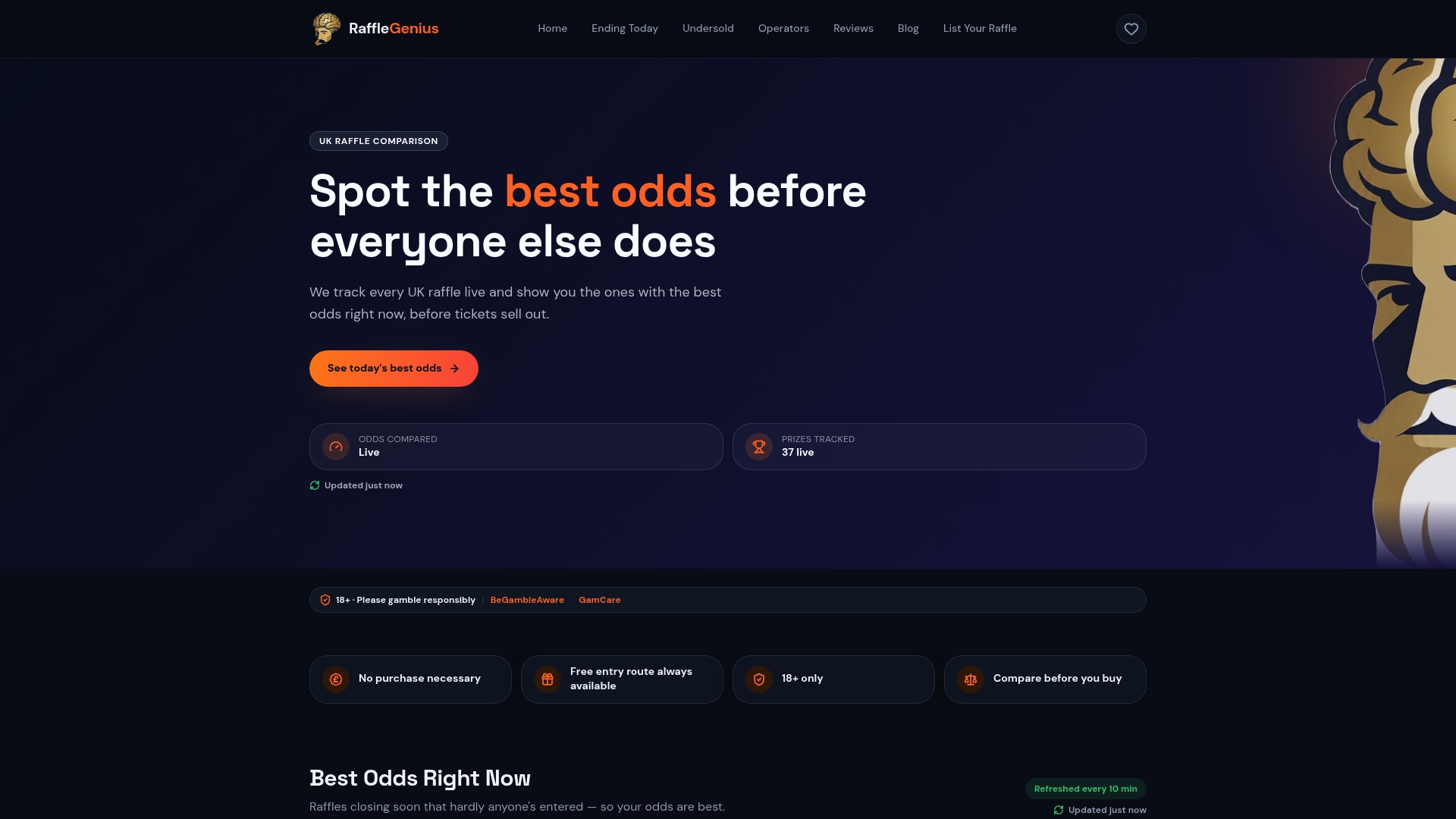
Checking every competition’s rules, odds and skill question by hand takes time most entrants don’t have. Raffle Genius tracks live odds across the market, refreshing every 10 minutes, so you can see which competitions offer genuinely better value before you commit to an entry.
- Our Trusted Operators list highlights operators that publish clear rules, odds and free-entry routes.
- The undersold competitions page flags draws where ticket sales lag behind the prize value, often the best odds going.
- Our blog breaks down how to find the best prize raffles without wading through every operator’s small print yourself.
If you run competitions yourself, you can get your raffle listed on Raffle Genius so entrants can find you alongside the operators we already track. For a lighter browsing experience, the Go ad-free plan is available for £4 per month.
Sources
- Online prize draws and competitions market study: assessment of harm and review of potential interventions
- Free draws and prize competitions
- Promotional marketing: competitions
FAQ
What makes a skill question legally fair in a prize competition?
A skill question is legally sound when it requires enough knowledge or judgement to deter or prevent a significant proportion of entrants from winning, a standard set out in the Gambling Commission’s guidance. There’s no fixed numeric threshold, so operators must justify the difficulty against their audience and prize value.
Can I tell if a skill question is too easy?
Try answering it with a quick internet search: if you find the answer within a couple of minutes, the question is likely too easy to count as a genuine barrier, a pattern the GOV.UK market study found common across the market. Multiple choice questions with one obviously correct option fail for the same reason.
Is a free entry route legally required?
Yes, a free entry route is generally required for a competition to avoid being classed as an illegal lottery, and the Voluntary Code expects that route to be clear and reasonably convenient. A hidden or deliberately slow free route is a strong red flag.
Who do I complain to if a competition seems unfair?
Start with the promoter directly and keep a record of your correspondence, then escalate depending on the issue: the ASA handles misleading advertising under its promotional marketing guidance, the Gambling Commission handles potential unlicensed lottery concerns, and Trading Standards covers broader consumer unfairness.
How does Raffle Genius help me avoid weak competitions?
Raffle Genius refreshes live odds every 10 minutes and flags undersold competitions where the ticket count looks low against the prize value, alongside a Trusted Operators list for operators that publish clear rules and odds. These signals help you compare value quickly rather than reading every operator’s terms from scratch.
Recommended
18+ · Please gamble responsibly. Raffle Genius is a comparison service and does not run competitions.
Best odds, straight to your inbox
One email a week with the undersold UK competitions closing soon. No spam, unsubscribe any time. 18+