
28 August 2026

3 Rare UK Prize Categories to Prioritise With Verifiable Odds
The best route to genuine rare UK prize competitions is an odds-aware aggregator paired with a habit of watching institutional and membership draws directly. Prioritise three categories: heritage experience draws like English Heritage’s Stonehenge access prize, recurring building-society member draws, and sponsored season prizes tied to motorsport or creative industries. Check live odds before entering anything, and bookmark a tracker that updates ticket counts and closing times in real time.
TL;DR:
- The odds in rare UK prize competitions are highly variable and depend on specific factors like booking volume, eligibility, and competition structure, not just prize value.
- Verifying competition legitimacy takes minimal effort but is crucial, especially checking winners’ publication, terms, and transparency of odds and eligibility restrictions.
- Entry routines should involve carefully noting deadlines, confirmation proof, and understanding whether the draw rewards skill, relationship, or chance with low or high effort.
- Official sources and specialized aggregators like Raffle Genius provide the most reliable information and live updates on current odds, ticket sales, and undersold competitions.
- UK law generally protects competition entrants from unfair practices, but prizes from genuine draws are tax-free unless they generate income through investment or are linked to a professional activity.
Table of Contents
- What counts as a rare prize competition in the UK?
- How do you check if a rare prize competition is legitimate?
- What’s the right way to enter and track rare prize competitions?
- Where can you find rare and unusual UK competitions online?
- How Raffle Genius tracks the odds behind rare prize competitions
- What UK laws protect prize competition entrants?
- Do you pay tax on prizes from UK competitions?
- Is chasing rare prize draws actually worth your time?
- Track live odds before you enter another raffle
- Sources
What counts as a rare prize competition in the UK?
A rare prize competition sits apart from the standard car-and-cash raffle circuit because the prize itself, not just the jackpot size, is scarce. You cannot buy exclusive access to Stonehenge on the open market. You cannot pay your way into a fully funded MINI CHALLENGE racing season without going through Motorsport UK’s selection process. That scarcity is the whole appeal, and it changes how you should evaluate odds, cost, and effort.
Four types dominate the UK landscape right now: heritage experience draws run by charitable trusts, recurring cash draws tied to financial institution membership, high-value literary or creative prizes with formal judging panels, and staged sponsorship competitions in sports like motorsport. Each behaves differently when it comes to entry cost, eligibility, and how transparent the operator is about your actual chances.
The table below sets out the headline facts for five representative competitions, drawn from published terms and official announcements rather than marketing copy.
| Competition | Prize type / headline value | Entry method and typical cost | Odds transparency | Eligibility and geographic restrictions |
|---|---|---|---|---|
| Have Stonehenge to yourself (English Heritage) | Private access to the stone circle for up to 10 people | Automatic entry with advance ticket booking, at least 72 hours before visit | One winner per day in August, notified 48 hours ahead; odds depend on daily entrant volume | UK and international visitors; prize is non-transferable |
| Skipton Building Society members’ draw | £540,000 in prizes | Automatic entry for qualifying members | Monthly draws from October 2026 to September 2027; entrant pool is the full qualifying membership | Excludes Northern Ireland residents |
| Mogford Prize | £10,000 for a single short story on food and drink | Formal written submission by the published deadline, following entry rules on the Mogford Prize site | Shortlist and winners are published annually, giving a visible track record | Open to UK-based writers per the competition’s own eligibility rules |
| MINI CHALLENGE season prize (Motorsport UK) | 2027 MINI CHALLENGE racing season prize | Multi-stage selection starting with a paid karting event around £99, followed by further paid stages | No published win-rate; the field narrows at each paid stage | UK entrants per Motorsport UK’s announced criteria |
| Quirky championship (e.g. cheese rolling, snail racing) | Symbolic trophy or small prize, occasionally cash | Usually free or low-cost entry on the day, organised locally | No formal odds reporting; entrant numbers vary by event and weather | Open to spectators and locals, restrictions set by the organising community |
A few things stand out once you line these up side by side.
- The Stonehenge draw is the cleanest example of a genuinely rare experience with published, checkable terms. English Heritage’s own prize draw terms and conditions confirm the 72-hour booking rule and the daily winner selection, which means your odds are tied directly to how many people book a visit on any given day in August.
- The Skipton draw rewards existing relationships rather than active entry effort. If you already bank with them and meet the balance threshold, you are automatically in the pool for £540,000 in prizes without lifting a finger.
- The Mogford Prize sits furthest from a raffle model. It rewards skill and submission quality, and the published shortlist and winners give you a real sense of the standard required.
- The MINI CHALLENGE prize looks glamorous on paper, but the staged paid entry structure means your £99 buys a shot at the next round, not the car. Motorsport UK’s own announcement describes five stages before the final prize is awarded.
- Community-run quirky championships offer the lowest financial risk and the highest cultural novelty, but you should not expect a cash return. Coverage of events like cheese rolling and snail racing makes clear these are about the story, not the prize pot.
How do you check if a rare prize competition is legitimate?
Legitimacy checks take five minutes and save you from wasting money or hope on a competition that was never going to pay out fairly. Run through this before entering anything you have not heard of before:
- Read the terms and conditions in full, not just the headline prize. Look for the entry deadline, prize substitution clauses, and whether the prize is transferable.
- Search for a published winners list. Operators confident in their process publish who won and when. The Mogford Prize does this annually with a public shortlist.
- Check for trade body membership or a code of conduct, particularly for anything resembling a raffle or lottery rather than a free prize draw.
- Look for independent reviews, including Trustpilot, and read a handful of the negative ones specifically, since these usually reveal payout or communication problems.
- Confirm the odds language is specific, not vague. “Hundreds of winners this year” tells you nothing about your individual chance if millions entered.
Regional exclusions and booking requirements often do more to your real odds than the headline prize value suggests. Skipton’s draw excludes Northern Ireland residents entirely, and Stonehenge’s prize is void if you cannot commit to a 72-hour advance booking window. A brilliant headline prize with a narrow eligibility net can leave you with worse effective odds than a smaller draw open to everyone.
Pro Tip: If a competition’s terms don’t state how many tickets or entries exist in total, treat any odds claim on the marketing page as unverifiable until you find that number somewhere official.
Red flags worth acting on immediately: no fixed closing date, no named operator or company registration, pressure to enter multiple times before you’ve read the rules, and prizes that seem disproportionate to the entry fee with no explanation of funding. If you spot two or more of these, walk away.
What’s the right way to enter and track rare prize competitions?
A consistent entry routine stops you missing deadlines or losing track of what you have actually entered.
- Register or book according to the competition’s specific mechanism, whether that is a ticket purchase, a written submission, or simply holding a qualifying account.
- Read the full terms before confirming, paying particular attention to closing times and any free-entry alternative if one is offered.
- Note the exact closing time, not just the date. Many draws close at a specific hour, and last-minute traffic can cause booking systems to fail.
- Keep a screenshot or confirmation email as proof of entry.
Timelines vary sharply by competition type. The Stonehenge draw requires you to book at least 72 hours before your intended visit date, with English Heritage notifying winners roughly 48 hours out. Skipton’s members’ draw runs monthly from October 2026 through September 2027, with entry happening automatically the moment your account qualifies. If you’re juggling several competitions at once, a simple spreadsheet with columns for entry date, closing date, and confirmation reference keeps things manageable.
- Set calendar reminders for closing dates, not just opening dates.
- Save confirmation numbers somewhere searchable, such as a dedicated email folder.
- Revisit T&Cs if a competition extends its deadline, since rules occasionally change mid-run.
Where can you find rare and unusual UK competitions online?
Official institutional sites remain the single most reliable discovery channel. English Heritage announces its Stonehenge draw directly on its own site, and building societies like Skipton publicise member draws through their own news pages and member communications. Subscribing to a membership newsletter is often the fastest way to hear about a draw before it fills up.
Beyond official channels, specialist aggregators help you filter by prize type, undersold status, and closing time, which matters enormously when you’re trying to spot a competition before ticket volume climbs. Raffle Genius’s undersold competitions list is built specifically for this kind of early-mover advantage.
- Follow official social accounts for live draw announcements and last-minute reminders.
- Use aggregator filters rather than browsing operator by operator.
- Bookmark the specific pages that run recurring draws, since institutional sites rarely promote them heavily elsewhere.
How Raffle Genius tracks the odds behind rare prize competitions
Raffle Genius refreshes odds, ticket price, closing time, and undersold status every 10 minutes across the operators it tracks, which matters most for competitions where entrant volume shifts quickly. A £5 ticket in a draw with 200 entries sold looks very different from the same £5 ticket once 20,000 people have piled in.
The real skill in entering rare prize competitions isn’t finding them. It’s knowing whether the odds you’re being quoted still hold true an hour after you read them.
Take the Stonehenge draw and the Skipton members’ draw as a study in contrast. Stonehenge’s terms fix the mechanism (one winner daily, 72-hour booking window), so your odds depend entirely on how many other people book that day. Skipton’s structure is the opposite: eligibility is fixed by your account balance, and the draw itself pulls from the full qualifying membership pool each month. Neither publishes a live odds ratio, which is exactly why combining ticket price with published entrant data gives you the clearest available signal of expected value when official odds aren’t disclosed outright.
What UK laws protect prize competition entrants?
UK prize competitions sit under a patchwork of consumer protection rules rather than one single prize-competition statute. Free prize draws, where no payment is required to enter or a genuinely free alternative route exists, generally fall outside the Gambling Act 2005’s licensing regime. The moment a competition requires payment with no free-entry route and depends purely on chance, it risks being classed as an illegal lottery unless it holds the right permissions.
This is why nearly every legitimate skill-based competition, such as the Mogford Prize, builds in a judging element, and why free prize draws like Stonehenge’s rely on advance booking rather than a paid ticket. The Consumer Protection from Unfair Trading Regulations 2008 also applies, banning misleading claims about your chances of winning or the true value of a prize. Operators cannot legally claim odds they cannot substantiate.
The Advertising Standards Authority enforces the CAP Code against promotions that misrepresent entry terms, prize values, or closing dates, and it does act on complaints against UK competition operators. If a competition’s marketing conflicts with its own published terms, that’s a reportable breach, not just a grey area. Trading Standards also has powers to investigate competitions operating as disguised lotteries.
None of this guarantees a smooth experience. But it does mean you have somewhere to complain, and a paper trail to point to, if a rare prize competition doesn’t honour its own stated rules.
Do you pay tax on prizes from UK competitions?
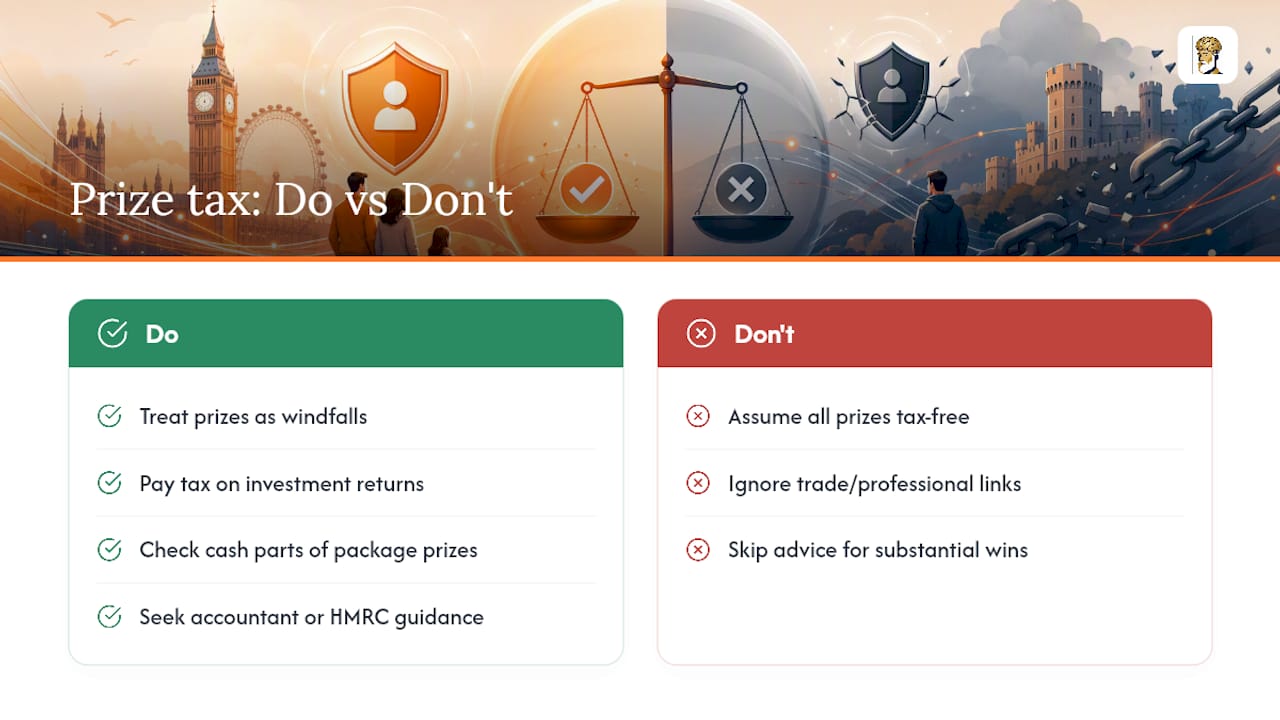
Genuine prize winnings from UK competitions and free draws are not subject to Income Tax in the hands of the winner, because HMRC treats them as windfalls rather than earned income. Whether it’s the Stonehenge experience, a Skipton cash prize, or the Mogford Prize’s £10,000, the amount you receive is yours without a tax bill attached at the point of winning.
Tax can still enter the picture afterwards. If you invest a cash prize and it generates interest, dividends, or capital gains, those returns are taxable in the normal way. A MINI CHALLENGE season prize, being a package of racing costs and support rather than cash, carries no direct Income Tax liability either, though any cash component awarded alongside it would need checking against HMRC’s specific guidance.
Competitions that function more like a business activity are a different matter. If you’re a professional writer entering the Mogford Prize as part of your trade, the prize money could interact with your self-assessment return depending on how HMRC views the activity, since prizes closely tied to a trade or profession can sometimes be treated differently from a one-off windfall. This is a narrow exception rather than the norm for casual entrants.
Worth flagging clearly: none of this constitutes personal tax advice, and the right treatment depends on your specific circumstances. If you win something substantial, a few minutes with an accountant or HMRC’s own guidance is worth far more than assumptions based on a blog post, this one included.
Is chasing rare prize draws actually worth your time?
Most guides to prize competitions treat every draw as equally worth your attention, and that’s the wrong starting point. The MINI CHALLENGE season prize looks spectacular on paper, but the staged paid qualifiers mean most entrants spend money without ever reaching the final selection round. That’s not a criticism of Motorsport UK’s process, which is transparent about the structure. It’s a reminder that a big headline number and a good personal expected value are two different things.
What changed my own approach was noticing how differently institutional draws behave compared with commercial ones. Skipton’s members’ draw doesn’t ask you to do anything beyond holding a qualifying balance, which means the effort-to-chance ratio is unusually good if you’re already a member. Stonehenge’s draw rewards people who simply plan a visit anyway and tick one extra box. Neither needed marketing spin to be worth entering.
My own quick checks before entering anything: does the T&Cs page actually exist and read like a real legal document, is there a fixed closing date I can find within thirty seconds, and would I still think this was worth entering if the prize were half the size. If a competition fails any of those, I move on.
Treat entry fees for staged competitions like the MINI CHALLENGE prize as the cost of a fun experience at best, not an investment. Budget what you’re genuinely comfortable losing, and let the institutional draws do the quiet, low-effort work in the background.
— matt
Track live odds before you enter another raffle
Raffle Genius gives you something a scroll through operator sites never will: odds that update every 10 minutes, so the ticket price you see reflects how undersold a competition actually is right now, not how it looked yesterday.

Start with the undersold competitions list to see which draws currently offer the strongest ticket-to-prize ratio, or check the operators Raffle Genius tracks to confirm coverage of a specific site you’re considering. If you’d rather build up entries without spending, the Play to Win feature lets you earn tickets through gameplay instead of purchase. Whichever route fits your budget, the sensible next step is the same: check the live odds on Raffle Genius before you commit to any competition, rare or otherwise.
Recommended
18+ · Please gamble responsibly. Raffle Genius is a comparison service and does not run competitions.
Best odds, straight to your inbox
One email a week with the undersold UK competitions closing soon. No spam, unsubscribe any time. 18+