
20 September 2026

Stop Losing Value: 9 Odds Mistakes Bettors Must Avoid
The mistakes that cost bettors the most money are rarely about picking the wrong team. They’re arithmetic and habit failures: not shopping for the best price, ignoring the vig baked into every line, sizing stakes emotionally rather than mathematically, chasing losses after a bad week, and stacking parlays without understanding how correlation destroys their value. Fix the habit of comparing prices before every bet and sizing stakes to a fixed unit, and most of these leaks close on their own.
TL;DR:
- Always compare betting lines across multiple platforms to find the best price, especially on key half-point spreads or totals, to maximize value.
- Strip the bookmaker’s vig before evaluating a line’s true probability, ensuring you base decisions on fair odds rather than inflated market margins.
- Log every bet’s stake, odds, and result regularly to analyze closing-line value and distinguish between luck and genuine skill.
- Use fixed, small percentages of your bankroll for stakes and implement weekly routines to identify and correct common arithmetic and behavioral errors early.
- Avoid parlay stacking, chasing losses, and over-betting; instead, focus on disciplined bankroll management and understanding actual risks of different bet types.
Table of Contents
- Odds mistakes to avoid: a working checklist
- Betting math: implied probability, vig and parlay errors
- Bankroll management and stake-sizing rules
- Line shopping: why small price differences add up
- Track your bets and measure closing-line value
- The cognitive biases quietly wrecking your judgement
- Misreading stats and past performance
- Understanding bet types and their real risk
- Why last week’s form fools even careful bettors
- Variance and luck: the part no strategy removes
- A weekly routine that catches mistakes before they cost you
- An easier way to shop odds on prize draws and raffles
- Sources
- FAQ
Odds mistakes to avoid: a working checklist
Most betting losses trace back to a small set of repeatable errors. Each one is fixable the moment you recognise it, and each has a simple corrective action attached.
- Not shopping lines. Settling for the first price you see instead of checking two or three platforms is the single most avoidable leak. A -110 line at one book might be better priced elsewhere, a difference that adds up to money over a season. Fix: check at least two sources before placing anything above your minimum unit.
- Treating implied probability as certainty. A -150 favourite priced at 60% implied probability still loses 40% of the time. Fix: think in ranges of outcomes, not guarantees.
- Poor bankroll sizing. Betting too high a percentage of your bankroll on a “lock” turns one bad beat into a crisis. Fix: cap single bets at a small, fixed percentage of your total roll.
- Parlay math errors. Adding odds together instead of multiplying decimal prices, or stacking legs that aren’t truly independent, inflates perceived value. Fix: multiply decimal odds correctly and avoid same-game correlated legs.
- Betting too many events. Spreading attention across ten matches a night means shallow research on all of them. Fix: cap your daily card at a number you can genuinely analyse.
- Skipping injury and market context. A late scratch or lineup change moves a line for a reason. Fix: check team news within an hour of kick-off, not the night before.
- Not tracking bets. Without a record, you’re guessing whether you’re actually profitable. Fix: log every stake, price, and result in one place, even a basic spreadsheet.
Betting math: implied probability, vig and parlay errors
Odds are just probability dressed up in three formats: decimal, fractional, and American. A decimal price of 2.50 means a $10 stake returns $25, and its implied probability is 1 divided by 2.50, or 40%. Convert American -150 the same way and you land near 60%. That’s the easy part. The part bettors skip is removing the vig.
Add the implied probabilities of both sides of a two-way market and the total usually exceeds 100%, sometimes by 4 to 5 points depending on the book. That excess is the bookmaker’s built-in margin, and stripping it out (dividing each side’s implied probability by the total) gives you the “fair” or no-vig number you should actually be comparing your own view against.
Parlays multiply this problem. The correct calculation multiplies decimal odds across legs, never adds them, and each leg carries its own slice of vig, so the house edge compounds with every addition. Correlated legs (same player scoring and their team winning, for instance) break the independence assumption the pricing relies on, which is exactly why many sportsbooks restrict or reprice same-game combinations.
- Convert every price to decimal before comparing.
- Strip the vig to get a fair probability estimate.
- Multiply, never add, decimal odds across parlay legs.
- Flag correlated legs and treat their combined price with suspicion.
Pro Tip: Run a rough no-vig calculation on any line before you bet it. If the market’s fair price and your own estimate are within a point or two of each other, you probably don’t have an edge, no matter how confident the pick feels.
Bankroll management and stake-sizing rules
A unit system fixes the guesswork. Set your unit as a small percentage of your total bankroll and stake in units, not fixed cash amounts, so your exposure adjusts as your roll changes. Bettors chasing a mathematical edge sometimes size stakes using fractional Kelly, a formula that scales bet size to perceived edge, though it demands honest, unbiased probability estimates to work properly.
Build in hard rules before you need them:
- After three consecutive losing days, cut your unit size in half until the run breaks.
- Set a daily loss limit in cash terms and stop betting the moment you hit it.
- Never raise a stake to “get back to even.” That’s the exact pattern experts identify as the fastest way to deplete a bankroll.
Pro Tip: Shrink exposure after a loss, never increase it. A losing streak feels like a signal to bet bigger; mathematically, it’s a signal to bet smaller until variance settles.
Line shopping: why small price differences add up
Comparing prices across platforms before locking a bet is one of the easiest edges available to any bettor, and it costs nothing but a few minutes. A small price improvement, repeated across many bets, can turn a break-even season into a profitable one.
- Check your primary book’s price, then compare it against at least one other platform before confirming.
- Note key numbers in spread and total markets. On American football spreads, the half-point between 2.5 and 3 changes far more outcomes than any other half-point on the board, so a better number there is worth more than it looks.
- Lock the best price you find rather than the most convenient one, and treat any aggregator or comparison tool as a habit, not an occasional check.
Track your bets and measure closing-line value
Closing-line value, or CLV, measures whether you beat the market’s final price before an event starts. Beating the closing line consistently over a large sample is one of the most reliable signals of genuine skill, because it strips out the noise of any single result.
Record these fields for every bet: stake, odds taken, book used, time placed, your expected edge, and the final result. Review the pattern monthly at minimum, quarterly for a fuller picture, since short samples hide real skill behind normal variance. A tool built for backtesting a betting strategy can speed up this review once you have enough logged data to work with.
The cognitive biases quietly wrecking your judgement
Confirmation bias is the quiet killer. You back a team, then unconsciously seek out stats and headlines that support the pick while dismissing the ones that don’t. It feels like research; it’s actually filtering.
Anchoring does similar damage. If you saw a team as -7 favourites last week, a current +3 line feels like an obvious bet, even when the roster or matchup has completely changed since. The old number anchors your judgement of the new one.
The gambler’s fallacy convinces bettors that a coin due for “heads” after five tails is more likely to land heads. Odds don’t have memory. A team that’s lost four straight isn’t “due” a win any more than a fair coin is due a different result.
Overconfidence after a hot streak leads directly into bigger stakes on shakier picks, right as your process is least tested. And loss aversion, the tendency to feel losses roughly twice as intensely as equivalent gains, is what drives the chasing behaviour covered earlier: it pushes bettors to take worse risks just to avoid confirming a loss on paper.
None of these biases are unique to betting. What makes betting punishing is that odds convert every psychological shortcut directly into cash, immediately, with no delay to reconsider.
Misreading stats and past performance
A team’s last five results tell you far less than most bettors assume. Small samples are noisy by nature, and a five-game stretch can be shaped by soft fixtures, one injury, or plain variance rather than any real shift in quality.
Correlation gets mistaken for causation constantly. A team wins three matches after switching formations, and bettors assume the formation caused the turnaround, when the actual driver might be an easier run of opponents or a key player returning from injury at the same time.
Sample size matters just as much with statistical splits. A player’s “strong record against left-handed pitching” built on 40 at-bats is closer to noise than signal. Treating a small sample as a reliable trend is one of the more subtle odds mistakes to avoid, because it feels like diligence while actually being a shortcut.
Context strips meaning from raw numbers too. A striker’s goals-per-game figure means little without knowing the strength of opposition faced, minutes played, and whether a penalty taker skews the tally. Read the number alongside the conditions that produced it, not instead of them.
Understanding bet types and their real risk
Straight bets (moneyline, spread, total) carry the most transparent risk. What you see priced is close to what you’re actually exposed to, which is exactly why they’re the right starting point for building a disciplined process.
Parlays and same-game combinations look like cheap ways to chase a big payout, but they carry compounded vig across every leg and, when legs are correlated, break the independence assumption that parlay pricing depends on, as covered in the maths section above. Treat them as entertainment stakes, not a core strategy.

Prop bets and futures introduce a different risk: liquidity and time. A futures bet on a season-long outcome ties up your stake for months, and props on obscure statistical markets often carry wider margins because the book has less sharp action to price against.
Live or in-play betting adds speed to the risk equation. Lines move constantly and impulsively during a match, which is precisely the environment where chasing and tilt-driven decisions happen fastest. Knowing which category a bet falls into, and its specific risk profile, is as important as picking the right side.
Why last week’s form fools even careful bettors
Recency bias convinces bettors that a team’s most recent performance is the most predictive one, even when it isn’t. A club that won its last three matches against weak opposition gets priced as though the form is set in stone, while a stronger side coming off one bad result gets undervalued.
Markets aren’t immune to this either. Public money often piles onto teams “in form,” which can push a line further than the underlying quality justifies, occasionally creating value on the side going against recent results. Betting against a hot streak feels uncomfortable precisely because recency bias is working on you too, not just on the market.
The fix isn’t ignoring recent form. It’s weighting it correctly against a longer sample, underlying performance metrics, and the context behind those recent results (opponent strength, injuries, schedule difficulty). A team’s last game is one data point, not the whole story.
Variance and luck: the part no strategy removes
Even a genuinely well-priced bet with a real edge loses regularly. A bet with a 55% true win probability, priced correctly, still loses close to half the time, and short losing runs inside that are completely normal, not evidence the process is broken.
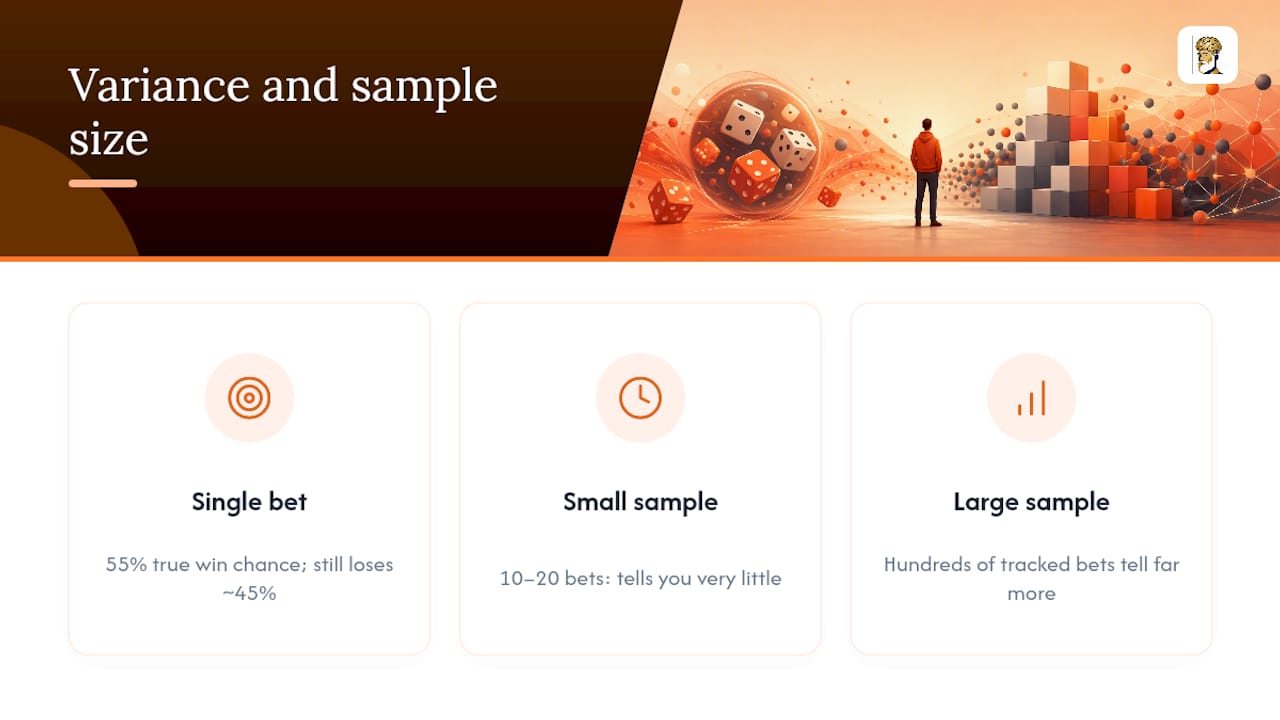
This is where many bettors abandon a sound strategy too early, or double down on a flawed one after a lucky win. Neither reaction is justified by a handful of results. Variance means outcomes over ten or twenty bets tell you very little about whether your process has an edge; results over hundreds of bets, tracked and reviewed, tell you far more.
Accepting variance doesn’t mean ignoring results altogether. It means judging your process by whether your logged prices consistently beat the closing line, not by whether last weekend went your way.
A weekly routine that catches mistakes before they cost you
A repeatable weekly pattern beats reactive betting. Set a fixed research window (an hour, twice a week) for the leagues you actually follow, rather than skimming everything. Line-shop every bet above your minimum unit, without exception. Audit your unit size monthly against your current bankroll, not your best week. Log one tracking task after every bet: stake, price, and result, nothing more.
This routine works because it removes decisions made under pressure, which is where chasing and tilt take hold. It also catches pricing mistakes earlier: platforms like Raffle Genius apply the same logic to prize competitions, refreshing odds regularly so players can spot value before it disappears.
— matt
An easier way to shop odds on prize draws and raffles
Everything above applies to sports lines, but the same “always compare the price” habit matters just as much for UK raffles and prize competitions, where entry costs and odds vary enormously between operators. Rafflegenius tracks live odds, ticket prices, and prize values across the UK raffle market, refreshing the figures every 10 minutes so you’re not relying on a snapshot that’s already gone stale.

That frequency matters because undersold competitions, ones with fewer entries sold relative to the prize on offer, often carry the best odds on the market, and they shift constantly as more tickets sell. Rafflegenius surfaces these alongside free-entry routes, so you can compare value the same disciplined way you’d shop a sports line before committing any money. Browse the current UK raffle comparison to see live odds across cars, cash, homes, and tech prizes, or check the ad-free Go ad-free plan at £4 per month if you’d rather compare without distractions.
Sources
FAQ
Why do odds keep changing?
Odds move as bookmakers adjust to new information, injury news, weather, lineup changes, and the balance of money coming in on each side. A line that opens at -110 can move significantly if heavy public action pushes the price, which is exactly why checking prices close to kick-off matters.
How do I know the correct odds?
There’s no single “correct” price, since different books set slightly different margins, but you can estimate a fair probability by removing the vig from the quoted odds. Comparing that fair number against your own research tells you whether a price genuinely offers value.
What’s the single biggest odds mistake to avoid?
Betting without a bankroll plan is the structural mistake behind most of the others, since it’s what turns a bad beat into a chase and a chase into a wiped-out roll. Fixing stake sizing first tends to fix decision-making everywhere else.
Does Rafflegenius cost anything to use?
Comparing UK raffle odds through Rafflegenius carries no published price for the core service. An ad-free experience with Go ad-free is available for £4 per month for those who want to compare without adverts.
How often should I review my betting results?
Review your logged bets at least monthly, and treat quarterly reviews as the point where sample size starts to say something meaningful about closing-line value. Judging results after just ten or twenty bets mostly measures variance, not skill.
Recommended
18+ · Please gamble responsibly. Raffle Genius is a comparison service and does not run competitions.
Best odds, straight to your inbox
One email a week with the undersold UK competitions closing soon. No spam, unsubscribe any time. 18+