
21 September 2026

Stop Using Maximum Tickets: Calculate Live Raffle Odds for UK Draws
Live raffle odds show your current chance of winning based on tickets sold right now, not the maximum the operator originally listed. Calculate them as your tickets divided by tickets sold, express the result as a percentage or a 1-in-N figure, and recheck the operator’s own counter immediately before you pay. A live-updating tracker can shortcut the maths, but the timestamp on that counter matters as much as the number itself.
TL;DR:
- Live odds should always be based on the current tickets sold, not the maximum advertised capacity, and must be verified just before payment using the operator’s own timestamp.
- Tracking tools that update less frequently or rely on outdated timestamps can give misleading odds, especially for popular draws where ticket sales occur rapidly.
- Comparing raffle value involves calculating each draw’s probability and dividing the ticket price by that probability, favoring undersold draws over cheaper, oversold options.
- Free-entry routes must be equally accessible and promoted alongside paid options, but claim of regulator approval is often misleading, and laws require free entries to be pooled fairly.
- Always cross-check live odds figures immediately before paying, keep recorded proof of the current odds, and beware of stale data or mismatched ticket counts during the buying process.
Table of Contents
- How do you calculate live raffle odds?
- How reliable is a live ticket counter?
- Does the cheapest ticket give the best odds?
- What do UK rules say about free entry and fairness?
- A practical checklist for using live odds
- What should a good live odds tracker show you?
- Why realistic expectations matter more than perfect maths
- Try live odds tracking with Rafflegenius
- Sources
- FAQ
How do you calculate live raffle odds?
The maths behind live raffle odds is simple for a single prize and slightly more involved once multiple winners are drawn.
- Single-winner formula: divide your tickets by the total tickets sold. If you hold 5 tickets out of 500 sold, your odds can be calculated as the number of your tickets divided by the total sold, which converts to a 1-in-100 chance.
- Multiple-winner formula (at least one prize): use the combinatorics-based approach, 1 − C(T−M,W)/C(T,W), where T is total tickets sold, M is the number of prizes, and W is the number of tickets you hold. Naive multiplication overstates your chance because it ignores overlapping outcomes.
- Small draw example: 20 tickets sold, you hold 2, one winner. Odds are 2 ÷ 20 = 10%, or 1-in-10.
- Medium draw example: 3,000 tickets sold, you hold 15, three winners. The at-least-one formula gives roughly 1.5%, noticeably better than the naive 0.5% single-winner figure might suggest.
- Large draw example: 50,000 tickets sold, you hold 10, one car as the single prize. Your odds sit at 10 ÷ 50,000 = 0.02%, or 1-in-5,000.
The Gambling Commission’s guidance on free draws and prize competitions confirms this combinatorics approach for multi-winner draws, and a dedicated chances of winning calculator removes the risk of manual over-counting once the ticket numbers run into the thousands.
How reliable is a live ticket counter?
A live counter is only as useful as its timestamp. A tracker that says “updated hourly” can be badly out of date by the time you reach checkout, especially on popular draws where hundreds of tickets sell in minutes.
Two figures get confused constantly: the maximum tickets an operator says it will sell, and the tickets sold so far. Using the maximum as your denominator when the live sold count is far lower makes your odds look worse than they actually are right now. Treat the maximum allocation as a conservative fallback, and the live-sold figure as the number that matters when it is genuinely current, in line with the Commission’s own distinction between advertised caps and actual entries.
Watch for these red flags before trusting any counter:
- A timestamp that hasn’t moved in several hours despite an active-looking draw
- A ticket count on a comparison site that doesn’t match the operator’s own page at checkout
- Free-entry terms that are vague, buried, or missing entirely
Pro Tip: Always compare the timestamp on a comparison site against the operator’s own counter in the seconds before you pay. A mismatch is a legitimate reason to pause and refresh, not proceed on faith.
Does the cheapest ticket give the best odds?
Not usually. Comparing raffles by ticket price alone ignores the value ratio: how much probability you get for each pound spent.
- Calculate the odds for each draw using the live sold count, converting to 1-in-N.
- Divide the ticket price by your probability improvement to see the real cost per unit of chance.
- Compare that figure across draws with the same budget rather than comparing sticker prices.
A £2 ticket in a draw with 40,000 entries sold can offer worse value than a £5 ticket in an undersold draw with only 800 entries. Buying many tickets in a field of 50,000 also runs into diminishing returns quickly. Doubling your tickets from 10 to 20 barely moves your odds when the total field is that large.
What do UK rules say about free entry and fairness?
Free-entry routes exist because of how UK law separates lotteries from prize competitions and free draws. A free route must be no more expensive and no less convenient than the paid route, and it must be promoted alongside it, according to the Gambling Commission’s guidance. Free entry doesn’t automatically improve your odds unless those free entries are pooled and treated equally alongside paid ones.
Some points worth flagging when you assess any operator’s claims:
- The Gambling Commission does not “approve” individual draws. Any operator claiming regulator approval is misrepresenting its position.
- The Voluntary Code of Good Practice for prize-draw operators sets expectations on disclosing likely demand and keeping free-entry routes genuinely accessible.
- The ASA’s guidance on prize draws requires promoters to avoid exaggerating chances of winning and to show winners were selected fairly, often by random or independently observed methods.
If a structure looks like it might cross into unlawful lottery territory, that’s a matter for the legal definitions in the Gambling Act 2005, not something a comparison site can resolve for you.
A practical checklist for using live odds
Turning the maths into a habit matters more than getting one calculation exactly right. Follow this sequence before you commit any money:
- Set a fixed entertainment budget for the week or month, and decide how much exposure across draws feels comfortable.
- Calculate live odds for each draw you’re considering, converting each to the same comparable metric, either 1-in-N or a percentage.
- Compare value ratios for that budget, favouring undersold draws where your improvement in probability is meaningful rather than marginal.
- Verify the timestamp, confirm the free-entry route is genuinely valid, and check the stated draw method before paying.
- Recheck the operator’s own counter at checkout, since it overrules any comparison site figure.
- Keep a screenshot of the odds, the terms, and your receipt, and resist chasing tiny gains in draws with tens of thousands of entries.
Pro Tip: Treat records like screenshots as insurance, not paperwork. If an operator’s live count looks different after your purchase than it did beforehand, you’ll want proof of what you saw.
What should a good live odds tracker show you?
A trustworthy tracker needs more than a big number on the homepage. Look for a visible live sold count, a clear timestamp, a stated update frequency, the ticket price, the prize value, whether a free-entry route exists, and some indication of operator transparency.
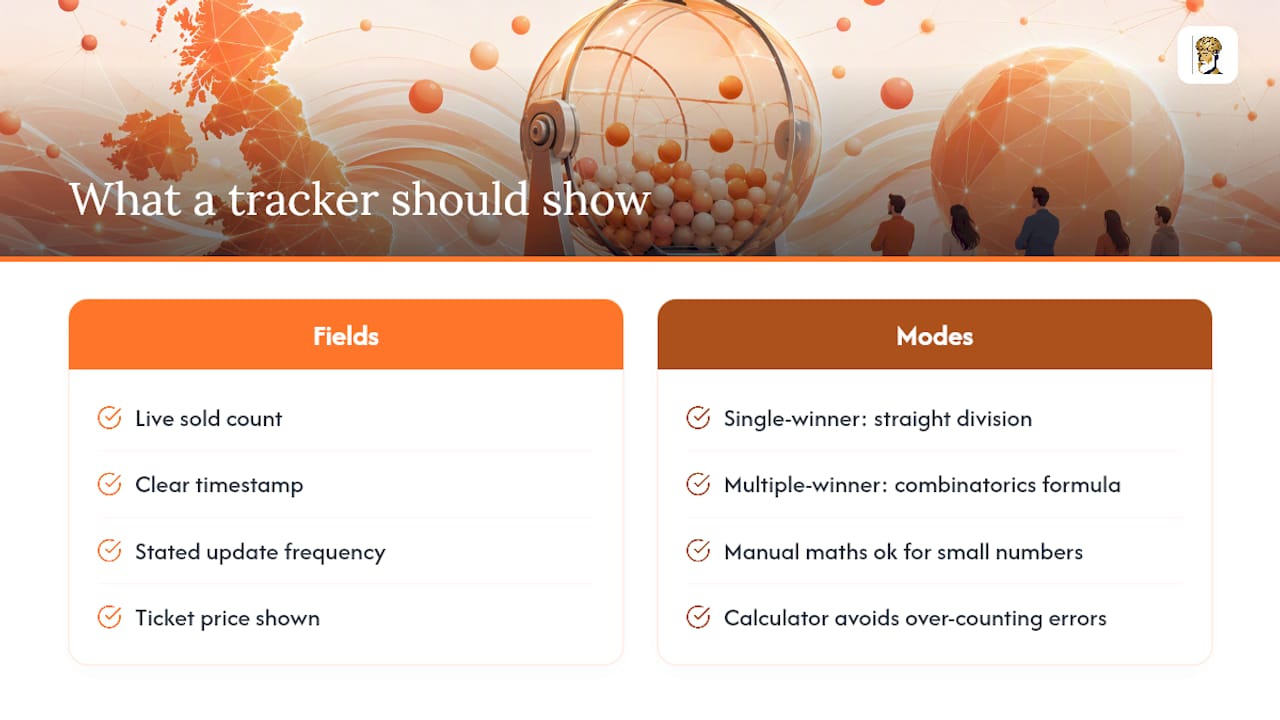
Calculators typically run in two modes: single-winner, which is a straight division, and multiple-winner, which needs the combinatorics formula described earlier. Manual maths works fine for small numbers, but once a draw has thousands of entries and several prizes, a calculator avoids the over-counting errors that naive multiplication produces.
Some trackers update live odds every 10 minutes, flag free-entry routes clearly, and verify operators for transparency, which is a genuinely different cadence from trackers refreshing only hourly. Even so, always cross-check any tracker’s figure against the operator’s own page immediately before paying.
Why realistic expectations matter more than perfect maths
Live odds are comparative tools, not guarantees; the best formula in the world won’t change the outcome of a single draw. Set a fixed budget you’re comfortable losing, and don’t chase tiny marginal gains buying more tickets in fields of tens of thousands. Trust timestamps, transparent terms, and independent signals over marketing claims, and treat every draw as entertainment first. BeGambleAware offers useful guidance on setting those limits before you start comparing draws at all.
— matt
Try live odds tracking with Rafflegenius
Comparing raffles by eye, tab after tab, wastes time you could spend actually deciding. Some platforms update live odds every 10 minutes, so the figures you compare reflect the current field rather than a stale snapshot from an hour ago, and every listing clearly flags free-entry routes alongside operator transparency.

Start with the live raffle comparison to see current odds across cars, cash, homes, watches and jewellery, tech, holidays, and motorbikes side by side. If you’d rather browse without adverts interrupting the odds you’re checking, the Go ad-free option is available for £4 per month. Either way, the next step is the same: pick a draw where the live figures actually favour you, then verify the operator’s own counter before you pay.
Sources
- Free draws and prize competitions
- Voluntary code of good practice for prize-draw operators
- Promotional marketing: prize draws
- Chances Of Winning Calculator - Raffle, Lottery & Tries - Calculator Academy
FAQ
What Are the Odds of Winning a Raffle?
Your odds depend entirely on how many tickets are in the draw when you enter, calculated as your tickets divided by tickets sold. A raffle with 500 entries and one prize gives a 1-in-500 chance per ticket, while an undersold draw with only 50 entries gives a far stronger 1-in-50 chance for the same single ticket.
What Is the Best Online Raffle Platform in the UK?
The strongest platforms show a live, timestamped sold count rather than a static maximum, alongside clear free-entry flags and operator transparency. Some update comparisons every 10 minutes, which gives a closer read on real-time odds than trackers that refresh only occasionally.
What Is the Best Strategy to Win Raffles?
There’s no strategy that beats the maths of a large field, but comparing value ratios across draws for a fixed budget improves your chances more than picking the cheapest ticket. Favouring undersold draws, where a small purchase moves your odds meaningfully, tends to outperform spreading money thinly across huge-field competitions.
What Are Common Raffle Mistakes to Avoid?
The most common mistake is comparing ticket price without checking the live sold count, which ignores how crowded the field actually is. A close second is trusting a stale comparison-site timestamp over the operator’s own counter at checkout, which the Gambling Commission’s guidance treats as the authoritative live source.
Does Rafflegenius Cost Anything to Use?
The core raffle comparison service on Rafflegenius carries no published price for readers. An optional ad-free experience is available through Go ad-free for £4 per month.
Recommended
- Are UK raffle sites legit? What to check before you enter
- How to Find the Best UK Prize Raffles: A Complete Operator Comparison Guide
- UK prize competition operators compared: BOTB, Raffall, Premier Prize, Seven Days Performance and Raffle House
- Cash alternative or the car? The maths most winners get wrong
18+ · Please gamble responsibly. Raffle Genius is a comparison service and does not run competitions.
Best odds, straight to your inbox
One email a week with the undersold UK competitions closing soon. No spam, unsubscribe any time. 18+