
28 August 2026

30 seconds to spot UK competition refund policies that protect you
There’s no automatic government right to a refund on a UK raffle or prize competition ticket. Whether you get your money back depends almost entirely on the operator’s own terms and conditions. Refunds are usually granted when the draw is cancelled, when you’re charged twice, or when an underage entry is discovered. Outside those situations, refunds are rare, and operators are legally entitled to say no.
TL;DR:
- Refunds are granted mainly for draw cancellations, duplicate charges, or underage entries, but are unlikely otherwise and depend on specific T&Cs.
- Prize competitions under UK law are unregulated, with no statutory refund rights unless operated as an illegal lottery under the Gambling Act 2005.
- Reading the operator’s refund and cancellation clauses in detail before purchasing is crucial, as most disputes hinge on these terms.
- Common scenarios such as draw postponements or prize swaps often rely heavily on the specific wording in the T&Cs to determine refund eligibility.
- Choosing operators with clearly published and easy-to-find refund policies significantly reduces the risk of encountering refund disputes.
Table of Contents
- Why the legal and regulatory position matters in the UK
- What to check in operator terms and conditions
- Common refund scenarios and what usually happens
- How to claim a refund: the step‑by‑step process
- When refunds are unlikely: red flags to watch for
- If the operator refuses: your dispute options
- Raffle Genius view: cut refund risk by picking transparent operators
- Do refund rules differ between raffles, sweepstakes and skill contests?
- How data protection rules affect refund disputes
- What consumer rights actually apply to prize competitions
- Legally mandated refunds versus operator goodwill
- Editorial take: read the contract before you read the odds
- How Raffle Genius helps you avoid refund headaches altogether
- Sources
Why the legal and regulatory position matters in the UK
Prize competitions and free draws sit outside the Gambling Commission’s licensing regime in most cases, which surprises a lot of entrants. The Gambling Commission itself states that these schemes are generally unregulated, meaning there’s no statutory refund mechanism to fall back on. You’re relying on a private contract between you and the operator, not a licensed gambling product with regulator oversight.
That changes if a “competition” is actually an illegal lottery in disguise, for instance one where entry is based purely on chance and payment is effectively a stake. The Gambling Act 2005 sets out formal requirements for lotteries, including ticket rules and exemptions for small society and customer lotteries, and operators who fall foul of these can face enforcement action.
- Genuine prize competitions require a level of skill and aren’t regulated like lotteries.
- Free entry routes must exist for a competition to legally avoid lottery classification.
- The Gambling Act 2005 schedules govern ticket documentation and pricing for licensed lotteries specifically.
Statistic callout: The Gambling Commission has publicly warned about raffling big-ticket items, noting that schemes structured incorrectly risk breaching licensing law entirely, which can leave entrants with no clear route to a refund at all.
What to check in operator terms and conditions
The refund clause in an operator’s T&Cs is the single most important thing you’ll read before buying a ticket, yet most entrants skip straight past it. It’s usually the difference between a smooth refund and a dead end.
Look for three specific things: a named refund or cancellation clause, eligibility and disqualification rules, and any force majeure or duplicate-charge wording. Operators who spell these out clearly tend to be the ones who honour them without a fight.
- Find the T&Cs link, usually in the footer or on the ticket purchase page, and read the section headed “refunds,” “cancellation,” or “entry rules.”
- Screenshot the wording at the point of purchase. Terms can change, and having a dated copy protects you if the operator later edits the page.
- Save your order confirmation email, the transaction ID, and a bank statement screenshot showing the charge.
- Note the draw date and any stated contact window for refund requests, since some operators impose short deadlines.
Pro Tip: Copy the exact refund clause into any complaint you send. Operators respond far faster when you quote their own words back at them rather than paraphrasing what you think the policy means.
A useful habit before you ever enter is checking what to inspect before entering a UK raffle site, since legitimacy checks and refund clarity tend to go hand in hand.
Common refund scenarios and what usually happens
Not every situation gets treated the same way, and knowing the pattern in advance saves you a lot of frustrated emails.
- Operator cancels the draw before it happens. Most reputable operators issue a full refund to your original payment method, since they haven’t delivered the service you paid for — this is a key part of maintaining fairness mechanisms in crypto gambling.
- Duplicate or failed payment. This is usually the easiest refund to secure. Operators verify the duplicate charge against their payment processor and refund the extra amount, often within days.
- Underage entry discovered by the operator. Charities in particular tend to refund and void these entries as a matter of safeguarding policy. RSPB’s raffle rules show this pattern clearly, voiding entries and refunding where an underage entrant is identified.
- Postponed draws or substituted prizes. Whether you get a refund here depends heavily on the T&Cs and how materially the terms changed. A short delay rarely qualifies; swapping the advertised prize for something of lower value often does.
- Change of mind or self-discovered ineligibility. Most operators refuse these outright, and they’re within their rights to do so under standard contract principles.
Statistic callout: PDSA’s published refund policy is a good in-market illustration: refunds apply in narrow circumstances such as over-purchase or underage entry, but tickets become non-refundable once a draw has taken place. That’s a common structure across UK charity raffles, not an outlier.
How to claim a refund: the step‑by‑step process
Getting a refund is largely about paperwork and timing, not persuasion.
- Gather your evidence first. Screenshot the T&Cs as they appeared when you bought your ticket, save your order confirmation, and pull a bank statement image showing the exact charge.
- Contact the operator directly with specifics. Include your order ID, the date and time of purchase, a screenshot of the charge, and state clearly what resolution you want. Give them a reasonable timeframe, five to seven working days is typical, to respond.
- Escalate if they decline. Keep every email and message. If the operator won’t budge, you move to a card chargeback or seek guidance through Citizens Advice, both of which carry their own time limits.
Pro Tip: Send your refund request in writing, even if you spoke to someone by phone first. A written trail is what a bank or Citizens Advice adviser will actually want to see if you escalate.
When refunds are unlikely: red flags to watch for
Some wording and situations make a refund very hard to secure, and it’s worth knowing them before you buy rather than after.
- Clear “no refunds” or “all entries are final” wording is routinely enforceable under standard UK contract principles, and operators lean on it heavily.
- If the entrant is at fault, cheating, breaching eligibility rules, or providing false details, operators almost always refuse a refund.
- Operators who don’t publish clear T&Cs, or who won’t provide a transaction record on request, carry the highest risk of a refund dispute going nowhere.
If the operator refuses: your dispute options
When an operator says no and won’t reconsider, you still have practical routes left, though none of them are quick.
- Card chargeback. Appropriate when the operator has clearly breached its own terms or failed to deliver, but act promptly. Chargeback windows are time-limited and vary by card scheme.
- Citizens Advice guidance. Citizens Advice’s own guidance recommends checking seller T&Cs first and warns that change-of-mind refunds aren’t guaranteed by law, which sets realistic expectations before you escalate further.
- Small claims court. A genuine last resort, useful mainly for higher-value disputes given the court fees involved relative to a typical ticket price.
- Legal advice. Worth seeking if the sums involved are significant or the operator’s conduct looks like a pattern rather than a one-off error.
Statistic callout: Chargeback success often depends on timing and documentation. Banks can side with the merchant in some cases, so supplying operator correspondence and transaction evidence promptly is important, sometimes more than the strength of your argument alone.
Raffle Genius view: cut refund risk by picking transparent operators
Raffle Genius indexes UK raffles and updates odds every ten minutes, and part of that process involves flagging operators whose rules and refund language are actually easy to find. The clearest sign of a trustworthy operator isn’t a slick website, it’s a plainly worded cancellation clause you can locate in under a minute.
Pro Tip: Before entering, search the operator’s site for the word “refund.” If it doesn’t appear anywhere in their terms, treat that as a warning sign rather than an oversight.
Browse trusted operators on the platform to see this filtering in practice.
Do refund rules differ between raffles, sweepstakes and skill contests?
Yes, and the differences matter more than most entrants realise. Raffles and free prize draws, the type most common on UK ticket-selling platforms, are pure chance-based mechanisms, so refund clauses depend entirely on what the operator chooses to offer. There’s no skill element to dispute, which makes underage entry and duplicate charges the main refund triggers.
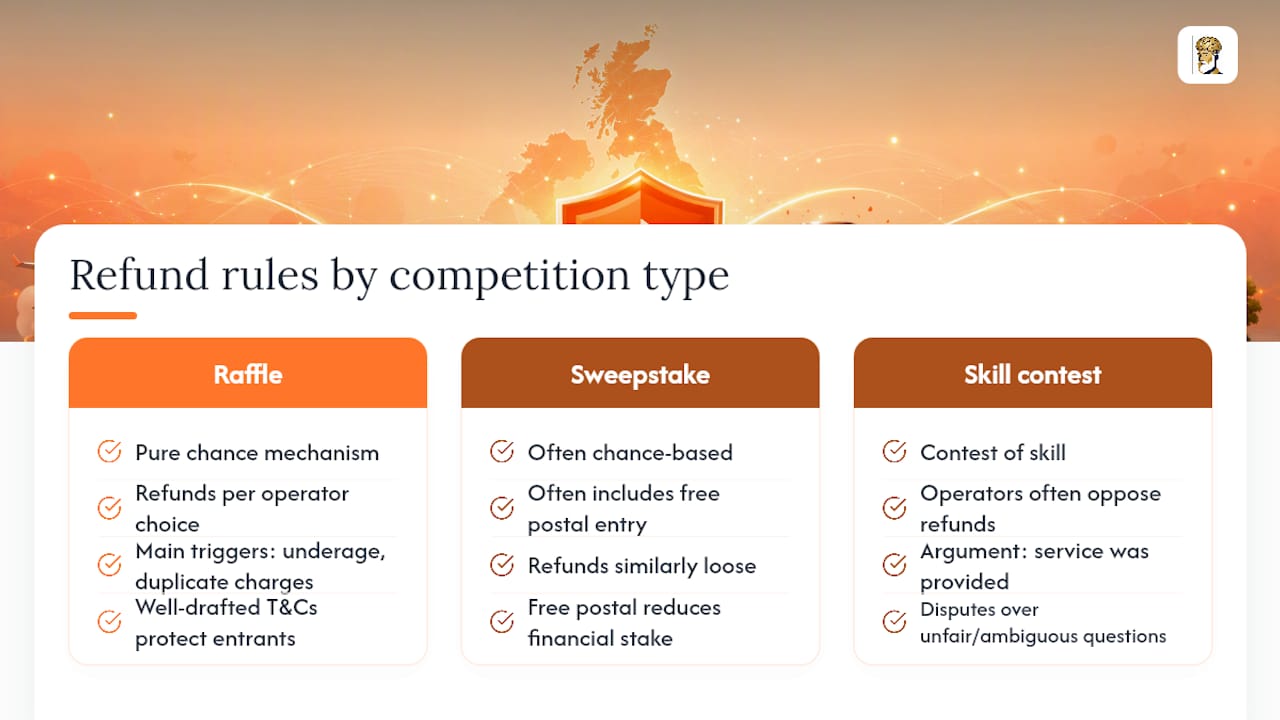
Sweepstakes, often run alongside a retail promotion, tend to follow similarly loose refund conventions, though they’re more likely to involve a free postal entry route that reduces the financial stakes of a dispute.
Skill-based competitions, where entrants answer a question or complete a tie-breaker, sit in a different category. Because you’re paying for entry into a contest of skill rather than a pure chance draw, operators sometimes argue more strongly against refunds, since you received the service, the chance to compete, regardless of outcome. That distinction can work against entrants who feel a question was unfairly difficult or ambiguously worded.
The practical takeaway is that the refund clause matters more than the competition format. A well-drafted raffle T&Cs page will often protect you better than a vague skill-contest entry form, regardless of which category the competition technically falls into.
How data protection rules affect refund disputes
Data protection law rarely decides whether you get a refund, but it shapes how a dispute plays out in practice. Under UK GDPR, operators must hold accurate records of your entry, payment and communications, and you can request a copy of your own data if you need it to support a claim.
That matters practically: if an operator claims they have no record of your duplicate charge or your refund request, you can ask what personal data they hold on you as an entrant. A subject access request won’t force a refund, but it often produces the transaction logs and email trails an operator initially claimed didn’t exist.
Data protection obligations also mean operators shouldn’t be sharing your payment details or entry history with third parties without a lawful basis, which is worth flagging if a dispute reveals your data was mishandled alongside the refund issue.
What consumer rights actually apply to prize competitions
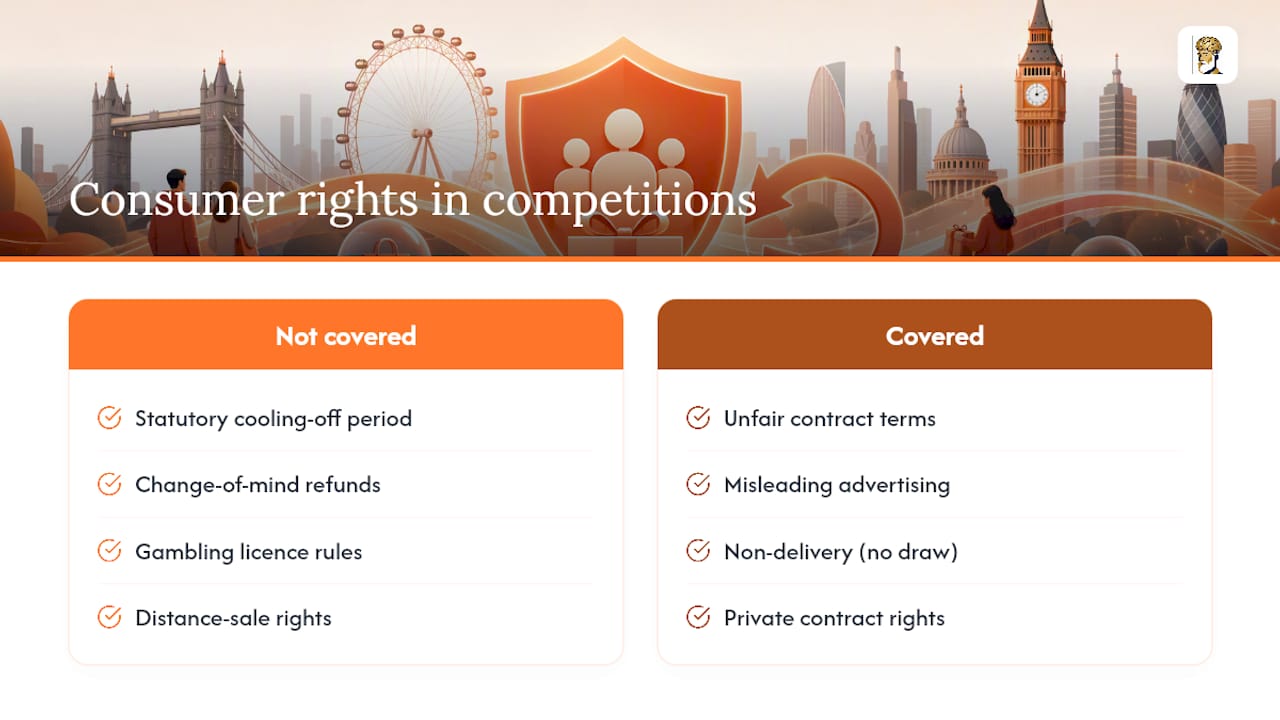
UK consumer law protects you in general commercial transactions, but prize competitions occupy an odd space because you’re not buying goods in the traditional sense, you’re paying to enter a chance-based contract. That means some of the standard protections entrants assume exist simply don’t apply here.
There’s no statutory cooling-off period for competition entries the way there is for many distance sales. Once you’ve entered and the operator has accepted payment, withdrawing because you changed your mind carries no automatic right to a refund. What you do retain is protection against unfair contract terms, misleading advertising, and outright non-delivery, if an operator takes your money and never runs the draw at all, that’s a different and far more serious matter than a routine refund dispute.
The Gambling Commission’s guidance reinforces this: because most prize competitions sit outside licensed gambling regulation, your main protection is the private contract you agreed to when you bought the ticket, not a specific competitions law.
Legally mandated refunds versus operator goodwill
It helps to separate the refunds you’re entitled to from the refunds an operator simply chooses to give.
Legally mandated refunds are rare in this space, but they exist where an operator has genuinely failed to deliver: taking payment for a draw that never happens, charging you twice through a payment error, or running a scheme that turns out to be an unlicensed lottery in breach of the Gambling Act 2005. In these cases, you have a real claim, whether through the operator directly or via chargeback.
Discretionary refunds are everything else, and they’re far more common in practice. Charities such as PDSA and RSPB refunding underage or over-purchase entries aren’t following a legal obligation, they’re applying safeguarding-driven goodwill policies that happen to be generous. That’s a meaningful distinction: a commercial operator under no such reputational pressure may simply decline the same request and be entirely within its rights.
Editorial take: read the contract before you read the odds
Most advice on this topic focuses on what to do after a refund dispute starts, chargebacks, complaints, escalation. That’s backwards. The real leverage sits before you buy a ticket, in the thirty seconds it takes to check whether an operator has published a proper refund clause at all.
Conventional wisdom treats prize competitions like retail purchases with implied consumer protections. They’re not. Once you accept that you’re relying on a private contract rather than a statutory right, the smart move becomes obvious: prioritise operators who write their T&Cs in plain language over operators who simply offer the biggest prize. A generous jackpot means nothing if the small print leaves you with no route back to your money.
The Gambling Act 2005 and Commission guidance exist to police the boundary between legitimate competitions and disguised lotteries, not to guarantee your refund. Treat that boundary as background reassurance, not your safety net.
— matt
How Raffle Genius helps you avoid refund headaches altogether
The smartest way to deal with refund disputes is to avoid needing one. Raffle Genius tracks live odds, ticket prices and closing times across UK raffles, and its operator summaries make it far easier to spot who publishes a clear cancellation clause and who buries it, or skips it entirely.

Rather than discovering an operator’s refund stance only after a problem arises, you can compare listings before you spend a penny. Check undersold competitions for better odds from operators already flagged as transparent, or browse raffles closing soon if you’re working to a deadline. Using Raffle Genius won’t guarantee a refund if things go wrong, but it meaningfully reduces your exposure to operators with vague or missing policies in the first place. Start by exploring Play to Win to see how the comparison works in practice.
Sources
- Free draws and prize competitions
- Gambling Act 2005 (schedules — lotteries and tickets)
- PDSA | Summer Raffle 2026 - Refund Policy
- Getting a refund on an event ticket
Recommended
18+ · Please gamble responsibly. Raffle Genius is a comparison service and does not run competitions.
Best odds, straight to your inbox
One email a week with the undersold UK competitions closing soon. No spam, unsubscribe any time. 18+