
9 September 2026

UK Players: Find Play to Earn Raffle Tickets with 10 Minute Live Odds
Yes, many play-to-earn programmes award raffle tickets for gameplay and platform activity, credited automatically once you meet a qualifying action. Start by creating an account, opting in or tapping “take part,” and checking the raffle window before you begin. Confirming participation matters because some platforms only count activity from the moment you opt in, not before. From there, Raffle Genius can help you track which play-to-earn opportunities currently offer the best odds.
TL;DR:
- Players should verify the specific rules and caps for ticket earning, as daily limits and action-specific restrictions vary across platforms.
- The total prize pool size at the time of the draw significantly affects the odds, so participating early before large pools form is advantageous.
- Repetitive actions like multi-accounting and scripted play are usually detected and penalized, making diversification and natural behavior essential.
- Checking the platform’s transparency regarding random seed generation, draw timing, and terms reduces the risk of encountering unfair or fraudulent raffles.
- Using odds-tracking tools helps identify the best opportunities, especially undersold raffles with smaller pools that offer higher chances of winning.
Table of Contents
- How platforms issue raffle tickets and run draws
- Ticket-earning rules, caps and how pool size alters your real odds
- Anti-farming rules platforms use and what they mean for you
- Lawful, efficient tactics to earn more tickets from play-to-earn systems
- How to verify a raffle platform and how Raffle Genius helps
- Immediate checklist: what to do this cycle
- Legal and regulatory considerations for play-to-earn raffles
- Risks associated with participating in play-to-earn raffles
- What an experienced player actually does differently
- Track the best play-to-earn odds without the guesswork
- Sources
How platforms issue raffle tickets and run draws
Most play-to-earn raffles don’t require you to submit a manual claim. Qualifying actions are tracked automatically in the background, and tickets appear in your account once the system registers the activity. This is standard across GoMining’s raffle mechanics, where purchases and platform actions generate tickets that are assigned sequentially once a player opts in.
Ticket sources vary by platform, but common examples include daily login bonuses, in-game wins, achievement milestones, and even trading or staking volume. Nansen’s raffle system illustrates this well: players earn tickets based on their spot trading volume within a fixed weekly window, running Monday 00:00 UTC to Sunday 23:59 UTC.
Raffle cycles typically reset on a fixed schedule, and tickets earned usually do not carry over to the next cycle. When a cycle closes, unused or unmatched tickets expire, so timing your activity to the current window matters more than banking tickets for later.
One technical detail worth knowing: ticket numbers are often assigned sequentially, from 0 up to N minus 1, where N is the total number of tickets in the pool. This sequential numbering underpins how draws select a winner, whether that’s through a random seed or an on-chain draw mechanism.
Ticket-earning rules, caps and how pool size alters your real odds
Earning tickets is only half the picture. What those tickets are worth depends heavily on caps, resets, and how large the total pool grows before the draw closes.
Platforms typically apply limits at several levels: a daily cap on tickets per player, a per-account maximum, and sometimes category-specific caps that restrict how many tickets you can earn from a single action type. Daemons’ economy documentation gives a concrete example of this layered system:
Daily logins and PvP wins award tickets, with limits on how many tickets a player can earn per day and total account holdings to prevent farming.
Probability doesn’t scale in a straight line. As the total pool grows, each additional ticket you earn contributes a smaller share of the overall chance, a dynamic Nansen’s documentation also flags when discussing how relative odds shift as pool size changes. A simple way to estimate your position: divide your ticket count by the total pool size at the moment of the draw, not at the moment you earned the ticket, since the pool keeps growing until the window closes.
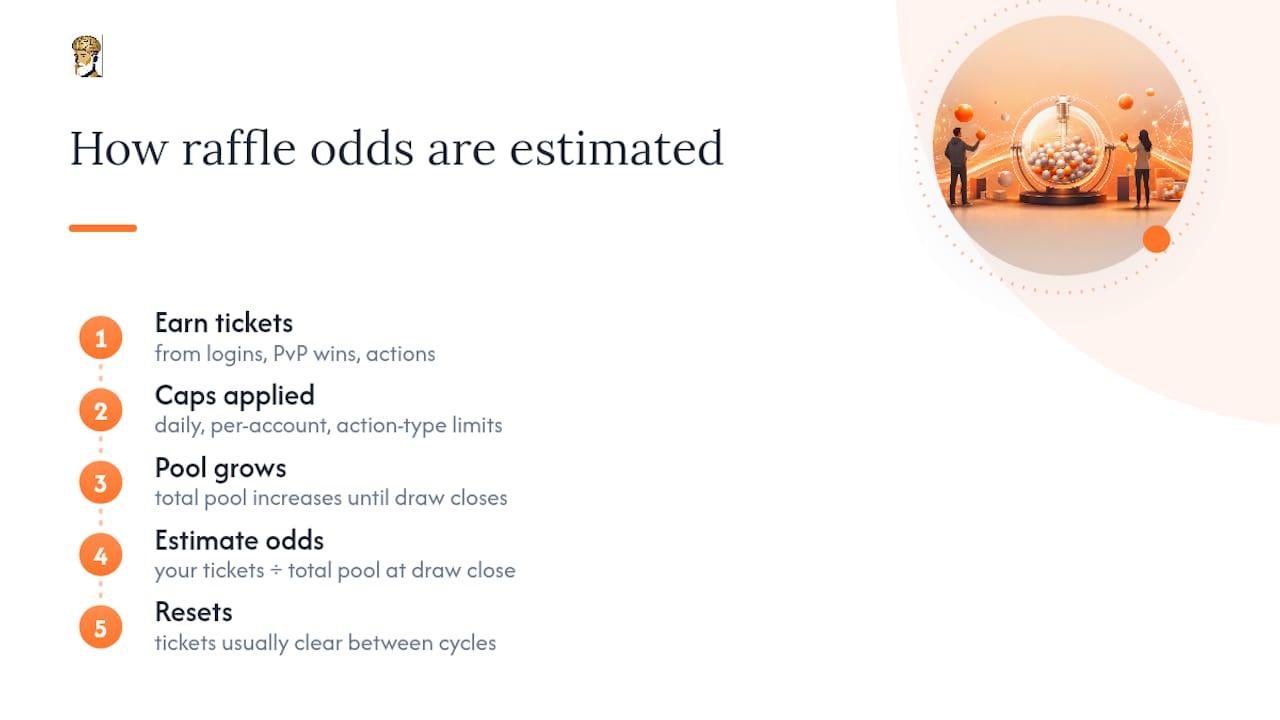
Resets catch out plenty of players. Tickets rarely roll over between cycles, so unused tickets from last week won’t help this week’s draw.
Anti-farming rules platforms use and what they mean for you
Grinding the same action repeatedly rarely works as well as players expect, because most platforms build in mechanics to stop exactly that. Common anti-farming measures include requiring wins against a diverse range of opponents rather than the same easy target, daily resets that cap how much any single account can earn, and limits on ticket accumulation by action type.
Transparent draw mechanisms matter here too. Some platforms publish a random seed before the draw window opens or use blockchain transactions to verify that ticket selection wasn’t manipulated after the fact. Concepts around provable fairness in crypto gaming apply the same logic: if a platform can show its randomness source in advance, players have a genuine way to check the draw wasn’t rigged.
Detection systems flag repetitive or scripted behaviour, and accounts caught farming tickets through bots or multi-accounting typically lose their earned tickets or face suspension. The practical advice is straightforward: never run multiple accounts to multiply your entries, avoid scripted or automated play, and diversify the actions you take rather than repeating one narrow loop.
Lawful, efficient tactics to earn more tickets from play-to-earn systems
Earning tickets efficiently is less about grinding harder and more about spending your time and money where the return is genuinely best.
- Rank your activities by ticket yield. Work out roughly how many tickets you earn per minute of play or per pound spent, then prioritise the highest-yielding actions first.
- Spread your activity across channels. Daily logins, PvP wins, challenges, and referral bonuses (where permitted) often have separate caps, so diversifying lets you accumulate more before hitting a ceiling.
- Watch the timing of the cycle. Joining early gives you more opportunities to earn before the window closes, but joining once the pool size is visible lets you judge whether the odds still look worthwhile.
- Use free-entry routes first. Gacha-style spins, free-play features, and no-cost challenges should be exhausted before you commit any spend.
- Keep a record. Screenshot your ticket history, opt-in confirmations, and draw timestamps as you go.
Pro Tip: Set a reminder near the end of each cycle to check the live pool size before deciding whether to invest more time or money. Committing early into a cycle that later swells with entrants can quietly halve your relative odds.
That last point on recordkeeping isn’t just tidy admin. If a ticket fails to appear after you’ve completed a qualifying action, having a screenshot of the confirmation and a timestamp makes resolving the dispute with support far quicker.
How to verify a raffle platform and how Raffle Genius helps
Before committing time to any play-to-earn raffle, read the terms closely. Look specifically for:
- Where tickets come from and whether the list of qualifying actions is published clearly.
- Daily, per-account, or category caps that limit how many tickets you can realistically earn.
- The exact draw timing and how prizes are fulfilled once a winner is selected.
- Whether the platform requires identity verification before releasing a prize.
Our guide on checking whether a UK raffle site is legitimate covers the operator side of this in more depth.
To confirm your tickets were actually credited, check the platform’s ticket ledger or activity log, make sure any “take part” or opt-in toggle is switched on, and contact support with your saved screenshots if a ticket seems missing.
This is where an odds-tracking tool earns its keep. Raffle Genius updates live odds every 10 minutes across UK raffles and prize competitions, including dedicated Play-to-Earn and Play-to-Win sections, so you can compare where your gameplay is likely to convert into the strongest chances rather than chasing the loudest promotion.
Immediate checklist: what to do this cycle
- Sign up and opt in to the raffle before doing any qualifying actions.
- Confirm which actions count and note any daily caps attached to them.
- Check the draw window and expiry date; set a calendar reminder.
- Use free-entry routes first, then diversify across other earning channels.
- Check Raffle Genius for current odds and set an alert before the cycle closes.
Legal and regulatory considerations for play-to-earn raffles
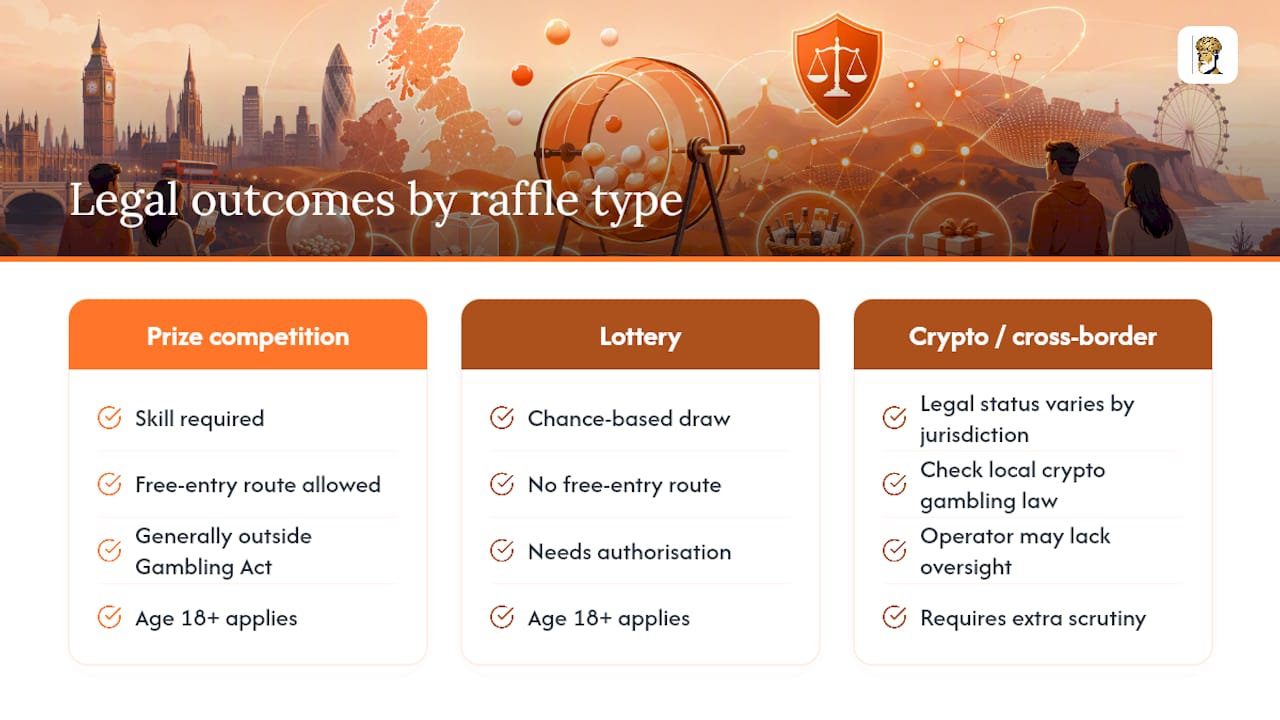
Play-to-earn raffles sit at an intersection of gaming and prize competition law, and the rules differ depending on how a platform structures entry. In the UK, a genuine prize competition that requires skill, or one offering a free-entry route alongside any paid method, generally falls outside the Gambling Act’s licensing requirements, whereas a pure chance-based draw with no free route can be classed as a lottery and needs proper authorisation. Play-to-earn mechanics complicate this because “earning” a ticket through gameplay can look like either a skill contest or a disguised paid entry, depending on how the platform designed it.
Age restrictions apply across UK-facing platforms, with 18 being the standard minimum for anything involving prize draws tied to spending or gambling-adjacent activity. Cross-border platforms, particularly those built on crypto rails, add another layer: the legal status of crypto-based games and raffles varies by jurisdiction, and background on the legality of crypto gambling is worth reading before committing real money to any blockchain-based system.
Before entering, check that the operator publishes clear terms on eligibility, prize fulfilment, and any identity verification required to claim a win. A platform that’s vague on these points, or based in a jurisdiction with no clear regulatory oversight, deserves extra scrutiny regardless of how generous the ticket-earning mechanics look.
Risks associated with participating in play-to-earn raffles
The biggest risk isn’t losing a raffle. It’s losing time, data, or money to a platform that never intended to run a fair draw in the first place.
Fake or poorly regulated platforms sometimes advertise generous ticket-earning rates specifically to attract deposits or personal data, with no intention of ever fulfilling a prize. Watch for platforms that ask for payment details before you’ve earned a single ticket, that have no visible terms on draw timing, or that can’t explain how winners are actually selected.
Exploitation cuts both ways. Some players attempt to farm tickets through multi-accounting or scripted play, but platforms increasingly detect and penalise this, meaning time invested in these tactics can be wiped out entirely. On the platform side, opaque draw mechanisms without a published random seed or verifiable on-chain process leave room for manipulation that’s nearly impossible for a player to prove after the fact.
There’s also the more mundane risk of wasted effort: chasing a raffle with a rapidly growing pool, or one where caps mean your extra activity yields almost nothing, isn’t a scam, but it’s still a poor use of your time. Treat any platform promising unusually high ticket rates with the same scepticism you’d apply to an unusually generous investment offer, and stick to platforms with transparent, published rules over ones relying on word of mouth alone.
What an experienced player actually does differently
Most of the value comes from checking pool size before committing, not from grinding harder. The mistakes that cost people the most are chasing single big jackpots, ignoring how a growing pool dilutes their odds, and running multiple accounts hoping nobody notices. The habit that actually pays off is comparing platforms with a tool like Raffle Genius and tracking tickets earned per minute, not just tickets earned.
— matt
Track the best play-to-earn odds without the guesswork
This platform gives you the advantage of a live view of which raffles across the market currently offer the strongest odds, updated every 10 minutes. Instead of jumping between apps to check pool sizes and caps yourself, you get that comparison in one place.

The site tracks live odds, ticket prices, prize values, and closing times across raffles and prize competitions, including undersold competitions where fewer entrants mean a genuinely better chance. That’s a direct time saving if you’re trying to work out where your gameplay converts into the best relative return, rather than just the most tickets. Visit the Play to Earn page to see current play-to-earn opportunities, or head to Play to Win for free-entry routes, and sign up for alerts so you never miss a cycle with odds worth acting on.
Sources
Recommended
18+ · Please gamble responsibly. Raffle Genius is a comparison service and does not run competitions.
Best odds, straight to your inbox
One email a week with the undersold UK competitions closing soon. No spam, unsubscribe any time. 18+