
25 August 2026
Compare live raffles →
What is expected value in raffles, and does it favour you?
Compare the expected prize value per ticket against its price: if the net figure is positive, the ticket is mathematically favourable; if negative, it isn’t. That single calculation, expected prize value per ticket minus ticket cost equals net expected value, tells you more about a raffle than any prize photo or countdown timer. The worked examples below show exactly how to run it.
TL;DR:
- The net expected value accounts for multi-tiered prizes, probabilities, and ticket costs, often resulting in a negative EV for charity or small-scale raffles.
- Buying multiple tickets offers negligible increase in individual odds unless the raffle has fewer than a few hundred tickets or multiple prizes are drawn without replacement.
- EV calculations rely on accurate data about tickets sold, prize values, and ticket prices; misestimations can significantly skew the expected outcome.
- Variance in raffle outcomes means a positive EV does not guarantee profit, and most players will experience losses despite mathematically favorable odds.
- Using real-time, live data on ticket sales, prize values, and draw timing improves the accuracy of EV estimates and prevents decision-making based on stale information.
Table of Contents
- What is expected value in raffles and how do you calculate it?
- How do you calculate net EV across multiple prize tiers?
- Does buying more tickets change your odds and EV?
- What does a positive or negative EV actually tell you?
- What information do you need to calculate raffle EV yourself?
- How does live-odds data remove the guesswork?
- Why does variance matter as much as expected value?
- When does EV mislead you about a good decision?
- Applying expected value in the real world
- Try a live EV calculator before you buy your next ticket
- Sources
What is expected value in raffles and how do you calculate it?
Expected value (EV) is the weighted average of every possible outcome, expressed formally as E[X] = Σ x·P(x). In plain terms, you multiply each possible prize value by its probability of occurring, then add those products together. For raffles, the useful figure is net expected value: the expected prize value per ticket minus what you paid for it.
Here’s the textbook version of the formula, applied to a single-prize raffle with every ticket sold.
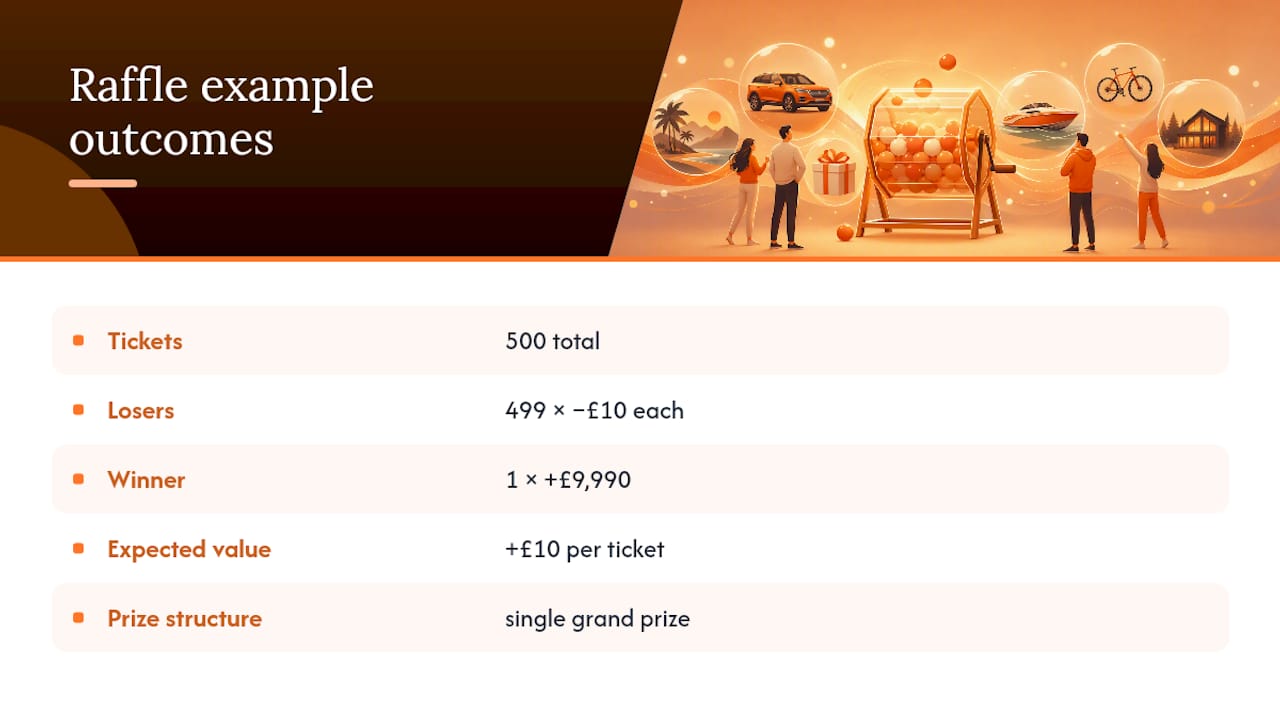
Say a car worth £10,000 is the only prize, 500 tickets are printed, and every one sells at £10 each.
- Work out the probability of winning. With one prize and 500 tickets, your chance of winning with a single ticket is 1/500.
- Multiply by the prize value. £10,000 × (1/500) = £20. That’s your expected prize value per ticket.
- Subtract the ticket cost. £20 − £10 = +£10 net EV.
That result is positive, meaning the average return per ticket exceeds its price, a scenario GiveWell’s analysis of raffle mathematics uses to illustrate exactly this kind of favourable prize-to-ticket ratio. It does not mean you’ll get £10 back. Most people who buy a ticket get nothing, and one person gets a car worth £9,990 more than they paid. EV describes the average across many repeats of the same bet, not the outcome of any single ticket you hold.
This is also where the standard industry term matters: what most people casually call “raffle value” is properly the expected value calculation, the same statistical tool used in insurance pricing, gambling odds and investment appraisal. Learning to run it on a raffle ticket is a genuinely transferable skill.
How do you calculate net EV across multiple prize tiers?
Real raffles rarely offer one prize. School fundraisers, charity draws and online prize competitions typically split the pot into a top prize, several runner-up prizes, and a stack of smaller vouchers. The maths still works, but you calculate the expected contribution of each tier separately, then add them together.
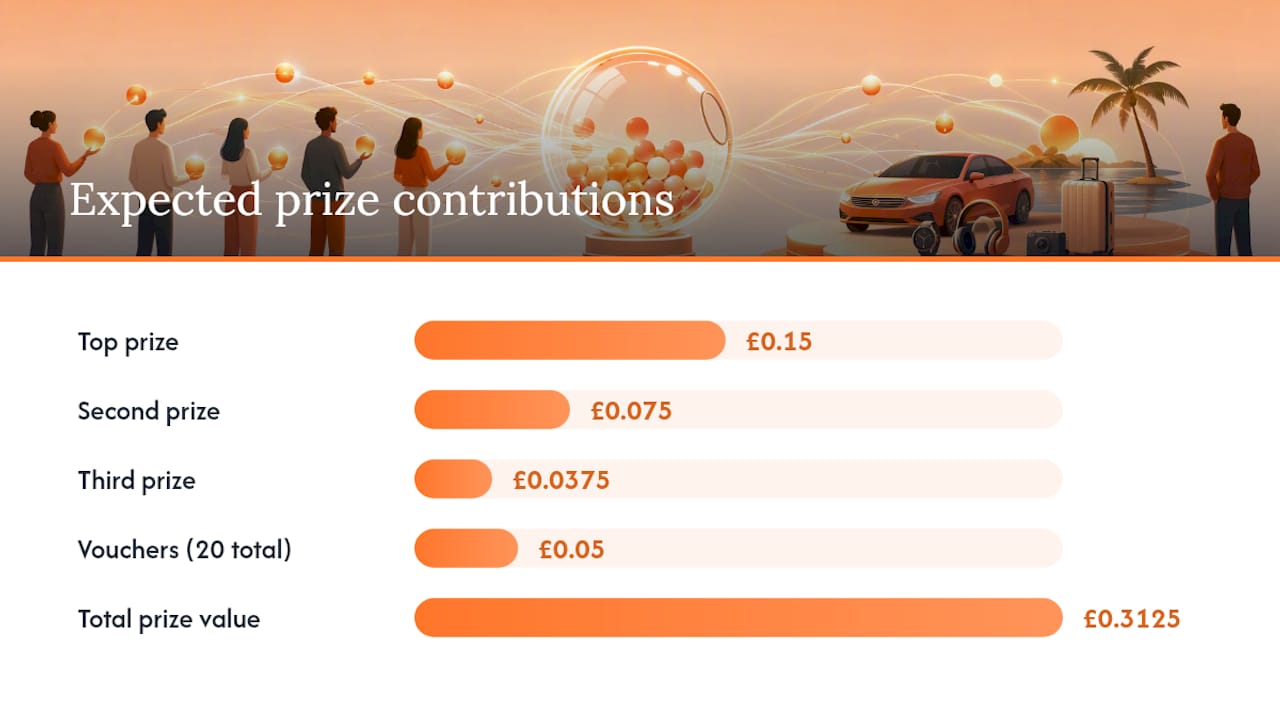
The net payoff for any tier is its prize value minus the ticket cost, and you weight that payoff by the probability of winning that specific tier.
Take a school raffle: 2,000 tickets at £3 each, with a top prize worth £300, a second prize worth £150, a third prize worth £75, and 20 consolation vouchers worth £5 each.
- Calculate each tier’s probability. Top prize: 1/2,000. Second prize: 1/2,000. Third prize: 1/2,000. Vouchers: 20/2,000 (assuming a new ticket is drawn for each, which is the usual convention for smaller giveaways).
- Find the expected contribution per tier. Top: £300 × (1/2,000) = £0.15. Second: £150 × (1/2,000) = £0.075. Third: £75 × (1/2,000) = £0.0375. Vouchers: £5 × (20/2,000) = £0.05.
- Sum the contributions. £0.15 + £0.075 + £0.0375 + £0.05 = £0.3125 expected prize value per ticket.
- Subtract the ticket price. £0.3125 − £3 = −£2.69 net EV, rounded to the nearest penny.
That negative figure is entirely normal for charity draws. A comparable worked example from Mathematics LibreTexts/03%3A_Probability/3.03%3A_Expected_Value) puts a similarly structured school raffle at −£2.40 per ticket. Organisers need ticket revenue to exceed the total prize pool to fund the cause, which by definition pushes buyer-side EV below zero. Comparing prize pools and ticket counts across competitions, rather than trusting a headline prize photo, is exactly the kind of cross-check covered in Raffle Genius’s guide to comparing UK prize raffles.
Does buying more tickets change your odds and EV?
For a single ticket against a single prize, the working odds are the simplest form of probability there is: 1/N, where N is the total number of tickets in the draw. Buy one ticket in a pool of 500, and your win probability is 1/500. No further modelling is needed.
Once you buy multiple tickets, or a raffle draws more than one prize without putting the winning ticket back into the pool, the maths gets more particular.
- Binomial thinking assumes each draw is independent, which is a reasonable approximation when the ticket pool is large relative to how many tickets you hold.
- Hypergeometric thinking accounts for draws without replacement, which is technically what happens in almost every real raffle: once a ticket wins, it’s out of the pool for the next prize.
- For most practical raffle sizes, the difference between the two is small enough to ignore. Analysis on Math StackExchange confirms that buying multiple tickets usually doesn’t shift your per-ticket EV materially, and that hypergeometric corrections only become noticeable in small ticket pools.
Pro Tip: If a raffle has fewer than a few hundred tickets and multiple prizes drawn from the same pool, run the hypergeometric version rather than assuming simple 1/N odds. The gap widens fastest exactly when the pool is smallest.
What does a positive or negative EV actually tell you?
A net EV figure is a long-run average, not a forecast for your ticket. Buy one ticket with a −£2.69 EV and you will almost certainly lose your £3, not lose “£2.69 worth” of anything. The number only becomes meaningful as a description of what would happen, on average, if the same bet were repeated many times, which is the law of large numbers in action.
That’s precisely why EV alone can’t make the decision for you. Several factors sit outside the sum:
- Charitable utility. If part of your £3 funds a cause you value, the “loss” partly buys something real: a donation with a raffle ticket attached.
- Prize desirability. A car you’d genuinely use is worth more to you than its resale value might suggest; a prize you’d never use is worth less.
- Resale uncertainty. Many raffle prizes, especially bespoke or branded items, don’t resell at their advertised retail price, which quietly worsens the real EV even when the maths on paper looks fine.
- Entertainment value. Some people simply enjoy the anticipation, and that enjoyment has a legitimate, if unquantifiable, value.
Analysts on Math StackExchange make the same point: non-monetary utility routinely explains why rational people buy negative-EV tickets. A workable heuristic follows from that: accept a small negative EV when the charitable or prize utility is genuinely high to you, but be wary of a heavily negative EV if profit, and profit alone, is the goal.
What information do you need to calculate raffle EV yourself?
Every EV calculation needs the same four inputs, and missing any one of them turns the sum into guesswork.
- Ticket price. The exact amount charged per entry, including any bundle discounts that change the effective per-ticket cost.
- Total tickets sold or capped. Some raffles cap sales; others sell an estimated or unknown number, which is the single biggest source of error in DIY calculations.
- Number and value of prizes. Every tier, not just the headline prize, and preferably at realistic resale value rather than the advertised retail price.
- Whether a sales cap applies. A capped raffle gives you a fixed denominator; an uncapped one means your odds worsen as more people enter, right up to the closing time.
A fast sanity check: compare total possible ticket revenue against total prize value. If revenue clearly exceeds the prize pool, the organiser likely holds a margin, which typically means buyer-side EV is negative. Raffle Genius’s guide to checking operator legitimacy covers how to verify those prize values before you trust them in a calculation.
Because “tickets sold” is often an estimate rather than a confirmed figure, it’s worth testing how sensitive your EV number is to that uncertainty.
| Estimated tickets sold | Assumed change | Approximate net EV impact |
|---|---|---|
| Base estimate | 0% | Your calculated baseline figure |
| Tickets sold 10% higher | +10% | EV moves further negative |
| Tickets sold significantly higher | +a substantial amount | EV moves substantially further negative |
| Tickets sold 10% lower | −10% | EV moves closer to positive |
| Tickets sold significantly lower | −a substantial amount | EV moves markedly closer to positive |
The direction matters more than the exact number: EV always improves for the buyer as fewer tickets are actually in the pool, and worsens as more are sold. If you can’t confirm real-time ticket counts, treat any EV figure you calculate as a range rather than a fixed answer.
How does live-odds data remove the guesswork?
Every input in that checklist changes constantly. Ticket counts climb hour by hour, prize values get added or adjusted, and closing times shift. Recalculating EV by hand against a moving target is where most manual estimates go stale within a day.
A live-odds tracker solves that by refreshing the same four inputs automatically:
- Current tickets sold, updated continuously rather than at a single snapshot.
- Live ticket price, including any promotional changes.
- Confirmed prize values across every tier, not just the headline prize.
- Time remaining until the draw closes, which affects how many more tickets are likely to enter the pool.
Feed those into the same E[X] = Σ x·P(x) formula and you get a current, sensitivity-checked EV figure in seconds rather than minutes of manual arithmetic, similar in principle to the inputs used by practical odds calculators built for exactly this purpose. Raffle Genius refreshes its own odds data every ten minutes across tracked UK raffles, which keeps the numbers behind that calculation closer to what’s actually happening in the pool rather than what was true when the competition launched.
Why does variance matter as much as expected value?
EV tells you the average outcome across many repeats; variance tells you how far any single outcome typically strays from that average. Raffles have enormous variance relative to their EV, which is precisely why the maths can be genuinely favourable while still delivering nothing to almost everyone who plays.
Consider the £10,000 car example again. The net EV was +£10, but the actual outcomes are binary: 499 people lose £10, and one person gains £9,990. The average across all 500 outcomes lands at +£10, but no individual experiences anything close to that average. This is the gap between EV and lived experience that catches out first-time buyers who read “positive expected value” as “likely to profit.”
High variance also means a positive-EV raffle can still be a poor personal choice if you’re risk-averse, and a negative-EV raffle can still feel fine to someone who values certainty of enjoyment over certainty of profit. Variance shrinks in relative terms only when you repeat the bet many times, or when a prize pool has many mid-sized prizes rather than one enormous one spread across a huge ticket pool. A raffle with 50 modest prizes across 1,000 tickets has far lower variance than one with a single grand prize across the same pool, even if the two have identical net EV. For anyone weighing consistency over a long shot, that structural detail is often more decision-relevant than the headline EV figure itself.
When does EV mislead you about a good decision?
EV assumes every pound is worth the same to you regardless of how you get it, and that assumption breaks down in several common raffle scenarios.
A charity raffle with a firmly negative EV can still be the right purchase if you were going to donate that amount anyway and simply prefer a ticket to a plain donation receipt. The “loss” on paper is partly a transaction, not a bet.
A raffle for a specific, hard-to-buy prize, a rare car model, a fully-loaded gaming setup, a bespoke item, can carry genuine EV even when the resale value used in the calculation understates what the prize is actually worth to a buyer who wants precisely that item and would have paid retail for it anyway.
Psychological factors distort the picture too. The near-miss effect, where a losing ticket feels close to winning, keeps people buying past the point their own EV calculation would recommend stopping. Anchoring on a headline jackpot figure, rather than the realistic net EV once ticket counts and lower tiers are factored in, is another common trap, and it’s exactly why running the full calculation rather than trusting the advertised prize value matters. None of this means EV is the wrong tool. It means EV answers “is this mathematically favourable,” not “should I buy this ticket,” and conflating the two is where most raffle regret starts.
Applying expected value in the real world
The maths in this article isn’t complicated once you’ve run it twice, and that’s the point. Most raffle buyers never calculate net EV at all, they compare prize photos and gut instinct, which is exactly how negative-EV tickets get sold as bargains.
My honest view is that EV should be a filter, not a verdict. Run the calculation, then weigh what’s left against how much you value the cause, the prize, or simply the fun of entering. Treat a wildly negative EV as a warning sign if profit is your only goal, but don’t let a clean spreadsheet talk you out of a ticket that’s genuinely worth it to you for reasons the formula can’t see.
— matt
Try a live EV calculator before you buy your next ticket
Running the sums by hand works, but the inputs behind every calculation in this article, tickets sold, ticket price, prize values, time remaining, shift constantly across live raffles. Rafflegenius tracks those figures across UK raffles and refreshes them every ten minutes, so the EV you calculate reflects what’s actually happening in the ticket pool right now rather than a stale snapshot from when the competition launched.

If you’d rather earn entries than buy them outright, the Play to Win feature lets you collect tickets through free gameplay, which sidesteps the ticket-cost side of the EV equation entirely. Whichever route you take, play within what you’re comfortable losing, and treat any EV figure as a guide rather than a promise. Head to Rafflegenius to check current odds before your next entry.
Sources
The core formula and long-run average interpretation come from Contemporary Mathematics’ section on expected value, a standard reference for the underlying statistics. The multi-prize worked example draws on Mathematics LibreTexts’ expected value chapter. For a practical, real-world framing of positive-EV raffles, see GiveWell’s blog on raffles and statistics, and for the technical distinction between binomial and hypergeometric modelling, this Math StackExchange discussion is worth reading in full.
- Contemporary Mathematics: Section 3.2 Expected Value
- GiveWell blog: Raffles, deworming and statistics
- Math StackExchange: Expected value of winning a raffle with 2 prizes
Recommended
- How to Find the Best UK Prize Raffles: A Complete Operator Comparison Guide | Raffle Genius
- UK Raffle Blog — Best Odds, Guides & Industry News | Raffle Genius
- Are UK raffle sites legit? What to check before you enter | Raffle Genius
- UK prize competition operators compared: BOTB, Raffall, Premier Prize, Seven Days Performance and Raffle House | Raffle Genius
18+ · Please gamble responsibly. Raffle Genius is a comparison service and does not run competitions.
Live raffles worth a look
Fewest tickets sold right now — your best odds.
 Premier Prize Competitions
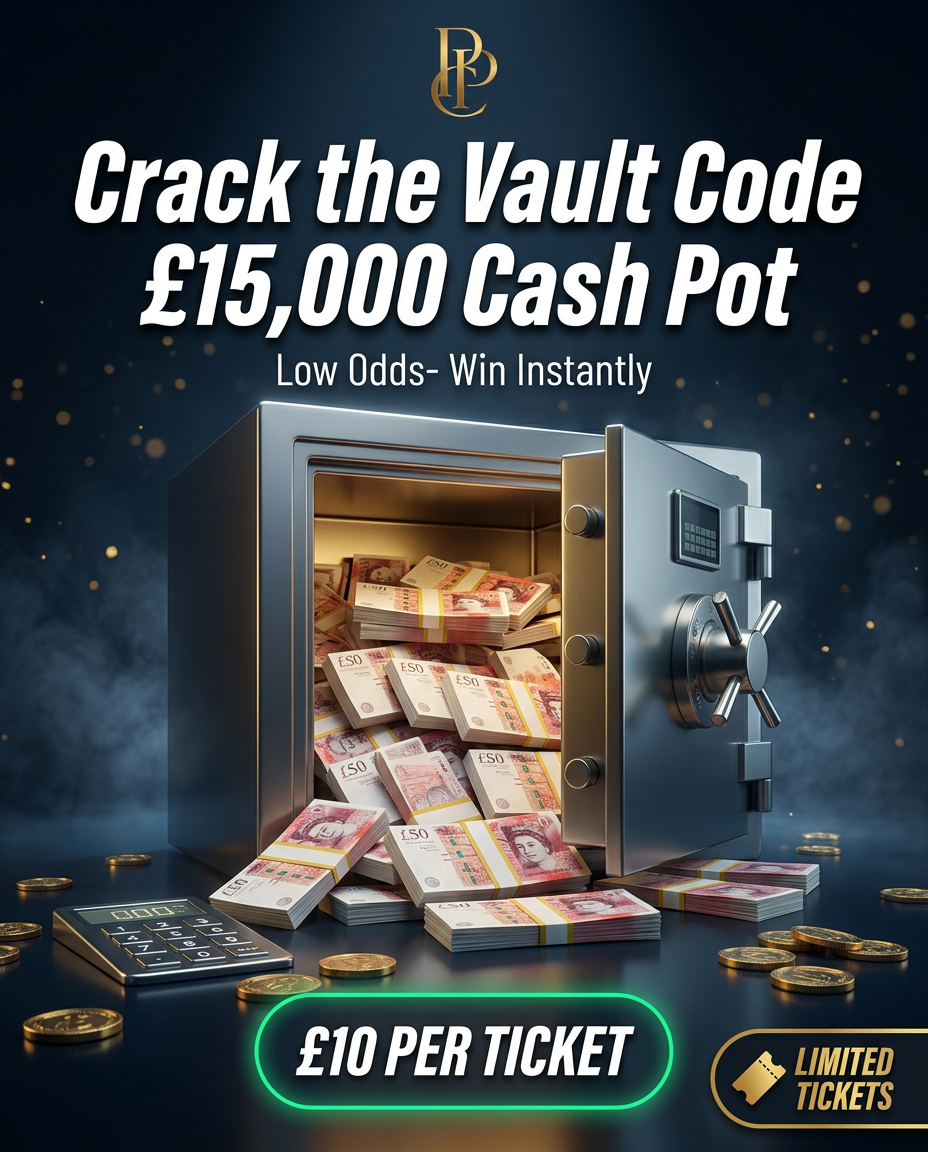
Low Odds Crack the Code £15,000 Cash Pot
Best oddsvia Premier Prize Competitions
Live odds for £25.00
1 in 1.0
1 in 1,373 if it sells out
0%sold
2,745 left
£10.00 per ticket
Closes in
17d 05h 54m 23s
 Premier Prize Competitions
PLINKO £25,000 Jackpot Hunt
Best oddsvia Premier Prize Competitions
Live odds for £25.00
1 in 1.0
1 in 1,596 if it sells out
0%sold
39,906 left
£1.00 per ticket
Closes in
52d 06h 54m 23s
 Elite Competitions
The Pokémon Collectors Dream Bundle + £10,000 Cash
Best oddsvia Elite Competitions
Live odds for £25.00
1 in 61
1 in 6,002 if it sells out
1%sold
4,949,999 left
3p per ticket
Closes in
7d 05h 54m 23s
Best odds, straight to your inbox
One email a week with the undersold UK competitions closing soon. No spam, unsubscribe any time. 18+
Stay signed up for a chance to win £50 every month. One random winner drawn from all subscribers.
No purchase necessary. Free entry.