
19 September 2026

Avoid Prize Delivery Delays: What UK Winners Must Check
Winners across the UK typically receive physical prizes by tracked courier or in-person collection, while digital rewards such as e-vouchers or bank transfers land within hours. High-value items like cars or holidays often mean longer waits and extra steps. Whatever the prize, winners should expect identity checks, a request for accurate contact details, and clear terms on who pays for delivery.
TL;DR:
- Physical prizes are usually shipped within 21 days using tracked courier services, but high-value items like cars may take over a year due to supply and registration delays.
- Digital rewards such as e-vouchers or bank transfers are typically delivered within minutes to five days after verification, depending on the payment method and promoter’s processing speed.
- Winners should prioritize reading the T&Cs for delivery times, especially for holidays or cars, as they follow different schedules and have extensive lead times.
- Promoters often require identity verification with ID documents before releasing prizes, and providing accurate contact information reduces delays or risk of disqualification.
- Assistance from support or escalating claims is recommended if prizes are delayed, lost, or refused, with courier insurance covering some cases of non-delivery.
Table of Contents
- Delivery of prizes UK: physical items, digital rewards and cash alternatives
- Typical delivery timescales in the UK by prize type
- Collection versus delivery: who decides, and who pays
- Verification, proof of identity and eligibility checks
- What to do if your prize is delayed, lost or refused
- Legal basics UK winners should check in promoter T&Cs
- How professional prize fulfilment actually works
- What actually matters once you’ve won
- Check operator delivery terms before you play
- Sources
- FAQ
Delivery of prizes UK: physical items, digital rewards and cash alternatives
Delivery of prizes in the UK splits broadly into three routes: tracked physical shipment, in-person collection, and instant digital transfer. Which one applies depends almost entirely on what you have won and how the promoter’s terms and conditions define it.
Physical prizes are typically sent by Royal Mail signed-for services or a named courier, with a tracking number issued once the item leaves the warehouse. Some promoters, particularly for larger or higher-value goods, insist on collection from a depot or store rather than risking transit damage or loss. A handful offer both, letting the winner choose based on convenience or location.
Digital prizes move faster because there’s no physical handling involved. E-vouchers, gift codes, and streaming subscriptions usually arrive within minutes of verification, sent straight to the email address on file. Bank transfers and PayPal payments for cash prizes generally clear within one to five working days, though this depends on the winner’s bank and how quickly the promoter’s finance team processes the payment.
Cash alternatives work differently again. Some competitions offer a fixed cash sum instead of the advertised prize, and others let winners choose between the two. When a cash alternative is offered:
- The amount is usually stated upfront in the T&Cs, not negotiated after the fact
- Bank transfer typically takes a few working days once account details are confirmed
- Some promoters deduct processing fees from cash alternatives, though this varies
Delays most often stem from incorrect banking details, slow verification, or a promoter waiting on stock for a physical item. Reading the delivery clause in the T&Cs before you enter tells you which of these routes applies to any given prize.
Typical delivery timescales in the UK by prize type
Timescales vary enormously by prize category, and setting the wrong expectation is the most common source of winner frustration.
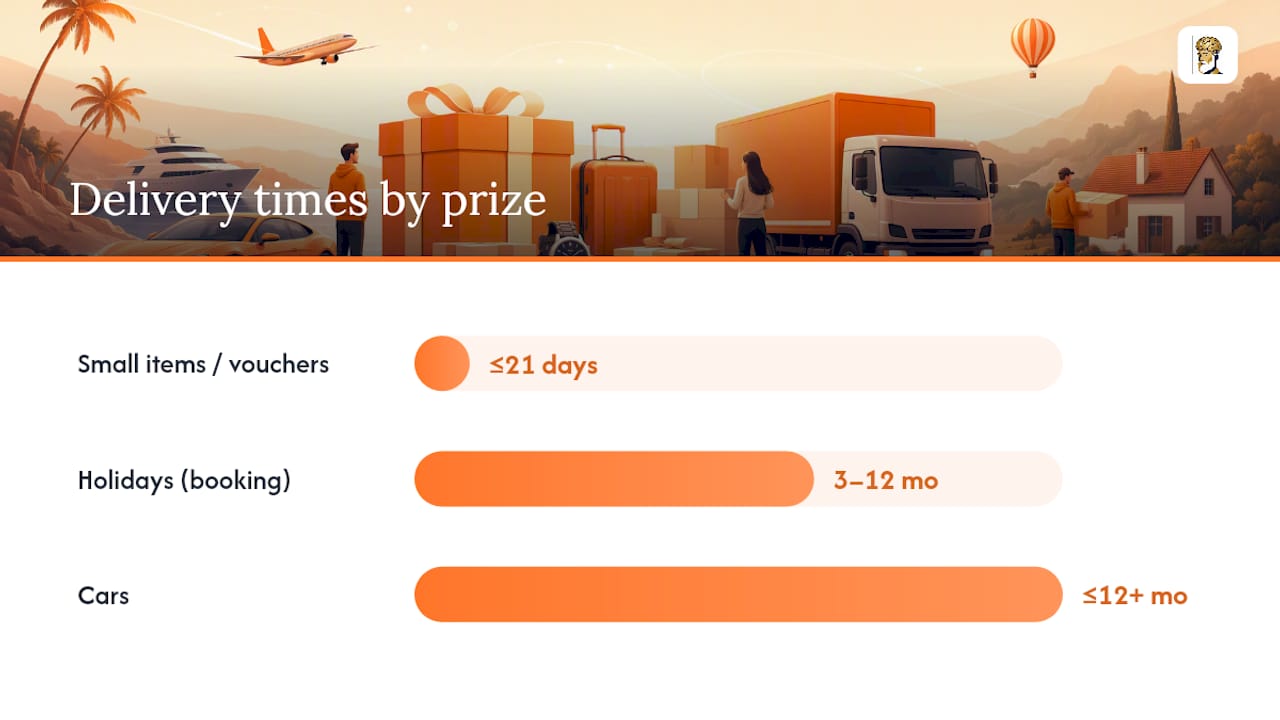
Small items and vouchers tend to move fastest. Most instant-win competitions fulfil physical prizes, excluding cars, within 21 calendar days of receiving the winner’s shipping details, assuming the item is in stock. That 21-day window is a useful benchmark across the industry, though it isn’t a legal requirement, just common practice among established operators.
Pro Tip: If a promoter’s T&Cs don’t state a delivery window at all, email and ask before you assume anything. A reputable operator will give you a straight answer.
Holiday prizes work on a different clock entirely. Winners are usually asked to nominate travel dates within a booking window, often three to twelve months, rather than receiving anything to “deliver” in the traditional sense. Flights, accommodation, and any restrictions on peak dates get confirmed once you’ve chosen when to travel.
Cars sit at the far end of the scale. Delivery or collection can take up to twelve months or longer depending on the make and model, particularly for imported or bespoke vehicles. Collection is often free, but promoter-arranged delivery to a UK address may carry a fee payable by the winner.
Supply shortages, registration paperwork, and courier capacity all commonly stretch these timescales beyond what the T&Cs first suggest. Treat any stated timeframe as a starting point, not a promise, and always check whether your winner confirmation email adds detail the general T&Cs don’t cover.
Collection versus delivery: who decides, and who pays
Promoters choose collection over delivery mainly for security. High-value goods, cars especially, carry real risk in transit, and insisting on collection from a verified location cuts that risk to near zero. Some operators offer delivery as an optional extra rather than a default, charging a fee to cover courier and insurance costs.
If collection isn’t realistic for you, most promoters have a process for handling that. Here’s the usual sequence:
- Check the T&Cs first for any clause on nominating someone else to collect on your behalf
- Contact the promoter directly to request an alternative, such as paid delivery or a rescheduled collection date
- Provide written authorisation if you’re nominating a proxy collector, often alongside their ID
- Confirm any address change in writing and note how long the promoter needs to process it
Address changes deserve particular attention. Some T&Cs set a strict deadline for updating delivery details after winning, and missing it can delay your prize by weeks. Legal guidance also notes that promoters generally cannot make winners pay simply to collect a prize if doing so would effectively charge for claiming it, though ordinary delivery charges for optional convenience are usually treated differently.
Verification, proof of identity and eligibility checks
Every legitimate promoter runs some form of identity check before releasing a prize, and skipping this step is the fastest way to see your prize delayed or withheld entirely.
Typical documentation requested includes:
- A passport or photocard driving licence to confirm age and identity
- Proof of address, such as a recent utility bill or bank statement
- A signed declaration confirming eligibility (age, residency, and sometimes employment status if the promoter excludes staff or family)
Promoter terms commonly require winners to show proof of identification at the point of delivery, and failing to produce it can result in disqualification. Age checks matter particularly for prizes tied to alcohol, gambling-adjacent competitions, or high-value goods where fraud risk is higher.
On data handling, GDPR requires promoters to collect only what’s necessary, store it securely, and delete it once the prize process concludes. Professional fulfilment providers typically build short retention periods and secure transmission into their standard workflow, so your ID documents shouldn’t sit on a promoter’s server indefinitely.
Pro Tip: Never send ID documents over unsecured email if you can avoid it. Ask whether the promoter has a portal or encrypted upload link, and query it if they don’t.
What to do if your prize is delayed, lost or refused
Most delivery problems resolve quickly once you know the right order of steps to take.
- Find your tracking number first. If dispatch was confirmed, tracking usually tells you more than a phone call will.
- Re-read the delivery clause in the T&Cs. Confirm what timeframe the promoter actually committed to before assuming they’ve broken a promise.
- Contact the promoter’s support team directly, quoting your entry reference and any evidence, screenshots of winning notifications, emails, confirmation numbers.
- Escalate in writing if you get no response within a reasonable period, and keep a dated record of every contact attempt.
- Involve Citizens Advice or Trading Standards if the promoter stops responding altogether, and consider the small claims process for a prize of clear monetary value that’s been withheld without justification.
Courier liability can also come into play. If a tracked item shows as delivered but never arrived, the courier’s own insurance or the promoter’s dispatch insurance may cover replacement, so ask specifically whether the item was insured in transit before assuming you have no recourse.
Legal basics UK winners should check in promoter T&Cs
UK prize draws sit under specific legal constraints, and understanding just one of them explains most of what you’ll read in a promoter’s terms.
To avoid being classed as an illegal lottery, promoters must provide a genuine free-entry route under the Gambling Act 2005, meaning entrants can’t be required to pay to enter, to discover if they’ve won, or to claim their prize. This is why free-entry competitions exist alongside paid-ticket ones, and why a promoter can’t suddenly charge you a “claim fee” once you’ve won.
Beyond that, prioritise checking:
- Delivery area limits, since some prizes are only fulfilled within Great Britain, not the wider UK or overseas
- Delivery fees, particularly for cars or bulky items where promoter-arranged delivery may cost extra
- Cash alternative terms, if offered, and whether the amount is fixed or negotiable
- Collection deadlines, since unclaimed prizes are sometimes forfeited after a set period
If your winner confirmation email contradicts the published T&Cs, the T&Cs usually take legal precedence, but ask the promoter to clarify in writing rather than assuming either document is wrong.
How professional prize fulfilment actually works
Larger competition operators rarely handle delivery in-house. Instead, they contract specialist fulfilment providers who manage the entire process from winner notification through to post-delivery support.
The typical workflow runs: the promoter notifies the winner, the fulfilment provider verifies identity and collects delivery details, the item is picked and packed from secure storage, then dispatched with tracking and delivery insurance. Most providers also handle any follow-up queries through a dedicated winner support line rather than routing everything back through the promoter’s general customer service.
Fulfilment agencies run secure storage, pick-and-pack, insured shipping and verification checks as one continuous process, which is precisely what reduces disputes between winners and promoters. Trackable shipping and a named support contact are the two things winners notice most.
For winners, this matters practically. If your winner communications include a genuine tracking number, a named support contact, and clear GDPR-compliant data requests, you’re almost certainly dealing with a professional fulfilment setup rather than an informal arrangement, and that generally means fewer delivery problems down the line.
What actually matters once you’ve won
Winning is the easy part. What separates a smooth prize collection from a frustrating one usually comes down to a handful of habits most winners don’t think about until something goes wrong.
Confirm your contact details the moment you’re notified, not days later. Ask for a tracking number as soon as dispatch is mentioned, and don’t assume “it’s on its way” means anything without one. Read the T&Cs delivery clause properly rather than skimming it, and keep a dated log of every email or call with the promoter, because that log becomes your evidence if a dispute arises.
On cash alternatives, accept one only if the amount genuinely reflects the prize’s value and you’d rather have the money than the hassle of collection. If a promoter offers a token cash sum instead of a car or holiday, you’re within your rights to ask whether delivery or collection is still available.
Reasonable promoters respond within days, not weeks, to a straightforward query. If yours doesn’t, that’s a signal worth noting before you enter their next competition.
— matt
Check operator delivery terms before you play
Every operator writes delivery, collection, and free-entry terms slightly differently, and the biggest advantage Rafflegenius gives winners is seeing those differences before you commit a single ticket, not after. Rafflegenius tracks live odds, ticket prices, and prize values across UK raffles, updating every ten minutes, and flags free-entry routes and operator notes so you’re comparing real terms rather than guessing from a T&Cs page buried in small print.

If you’re weighing up which competitions are worth entering, compare current UK raffles on Rafflegenius before you buy a ticket, and check the trusted operators list for a shortlist that’s already been reviewed for transparency. Ad-free browsing is available from £4 per month if you’d rather skip the clutter entirely while you compare odds and prize categories, from cars and cash to tech and holidays.
Sources
- How are the physical prizes sent to the winners? – BOTB
- Prize handling & fulfilment services | Grand Central
- Gambling Act 2005 — schedule notes
- Terms & Conditions — PrizeBox UK
FAQ
What are the legal requirements for prize draws in the UK?
UK prize draws must offer a genuine free-entry route under the Gambling Act 2005, so entrants can’t be charged to enter, find out if they’ve won, or claim their prize. Promoters must also publish clear terms covering eligibility, delivery, and any cash alternatives.
Which giveaway site is best for checking prize delivery terms?
The best approach is comparing operator terms directly rather than relying on one site’s claims. Rafflegenius tracks live odds and highlights operator delivery notes and free-entry routes across UK raffles, updating every ten minutes, so you can compare terms before entering.
What is the best raffle site in the UK?
There’s no single “best” site, since operators vary in prize categories, ticket pricing, and delivery practices. Rafflegenius doesn’t run raffles itself but compares live odds, prize values, and operator terms across the UK market so you can judge which operator suits your priorities.
Where can I find car giveaways in the UK?
Several UK prize competition operators run car giveaways, typically listed alongside cash, tech, and holiday prizes. Delivery or collection for vehicle prizes can take up to twelve months or longer depending on the model, and you can compare current car competitions across operators on Rafflegenius.
How long does it usually take to receive a prize after winning?
Most instant-win physical prizes, aside from cars, are fulfilled within 21 calendar days of the promoter receiving your shipping details. Digital prizes like vouchers or bank transfers usually arrive within minutes to five working days.
Recommended
18+ · Please gamble responsibly. Raffle Genius is a comparison service and does not run competitions.
Best odds, straight to your inbox
One email a week with the undersold UK competitions closing soon. No spam, unsubscribe any time. 18+