
27 August 2026

Avoid Licence Risk: Charity vs Profit Raffles, Gambling Act 2005
Charity raffles and profit raffles are not the same thing under UK law, and confusing them is the fastest way to fall foul of the Gambling Commission. Charity raffles are society lotteries, regulated under the Gambling Act 2005, and they usually require registration or a licence before a single ticket goes on sale. Commercial “profit” promotions, by contrast, generally sidestep the lottery regime altogether by running as prize competitions or genuine free draws. If you’re planning a UK fundraiser, the safest route is to follow Gambling Commission guidance directly or work with an already-registered or licensed operator.
TL;DR:
- Smaller charity raffles typically only require local authority registration, which takes several weeks, while larger or national lotteries need Gambling Commission licensing.
- Commercial prize competitions and free draws avoid lottery regulations by structuring entries as skill-based or genuinely free, provided entry routes are transparent and fair.
- Online raffles must restrict ticket sales to debit cards, verify age at purchase, and ensure secure handling of personal data to prevent crossing into remote-lottery territory.
- Profit raffles risk misclassification as unlicensed lotteries, face opacity in odds and prize transparency, and must adhere to strict advertising rules to avoid regulatory breaches.
- Supporter trust favors charity lotteries due to transparency requirements, but they involve more administrative effort, while profit raffles offer quicker setup with increased regulatory and trust risks.
Table of Contents
- What the law says: society lotteries, lotteries and the Gambling Act 2005
- Prize draws and free draws: how commercial organisers avoid the lottery regime
- When to register or license a charity raffle and how to do it
- Running a raffle online: payment, age checks and remote-lottery rules
- Outsourcing compliance: External Lottery Managers and operator choices
- Practical checklist: timeline, ticket pricing and recordkeeping
- Comparative overview of taxation implications for charity versus profit raffles
- Common pitfalls and compliance risks unique to profit raffles
- Benefits and drawbacks from the organizer’s perspective for both charity and profit raffles
- Specific restrictions on advertising and promotion differences between charity and profit raffles
- Publisher perspective: when a society lottery earns its complexity
- How Raffle Genius can help
- Sources
What the law says: society lotteries, lotteries and the Gambling Act 2005
A lottery, in the eyes of UK law, needs three ingredients: a payment to enter, a prize, and an outcome determined by chance rather than skill. Strip out any one of those three and the activity falls outside lottery law entirely, which is precisely why so many commercial promotions are engineered to remove the “payment” element. The Gambling Act 2005 sets out this test in detail and defines the categories that follow from it.
“Society lotteries” are the specific category charities and non-profit bodies use. They exist to raise money for a charitable, sporting, or other non-commercial purpose, and the proceeds must go towards that purpose rather than private profit. This is the legal line that separates a charity raffle from a profit-driven promotion dressed up to look like one.
Two bodies police this system:
- The Gambling Commission licenses larger society lotteries and sets national policy and guidance.
- Local authorities register smaller society lotteries and enforce compliance at that level.
Both draw their authority from the same statute, and both publish official guidance on fundraising, raffles and lotteries that organisers should treat as the primary reference point, not a secondary check after reading a blog post.
Prize draws and free draws: how commercial organisers avoid the lottery regime
Commercial brands running “win a car” or “win a holiday” promotions almost never register as lotteries. Instead, they structure the promotion as a prize competition or a free draw, both of which sit outside the Gambling Act 2005 when done properly.
A free draw needs a genuinely free way to enter, not a token gesture buried in the small print. According to Trafford Council’s guidance on prize competitions and free draws, the free route must be equally prominent and equally likely to win as the paid route. A prize competition takes a different path: it introduces a genuine skill element, such as a question with a level of difficulty that a “significant proportion” of entrants might get wrong.
Where commercial promotions get caught out:
- The free-entry route exists on paper but is hidden, slow, or requires a phone call nobody answers.
- The “skill” question is so easy it’s really a chance mechanism wearing a costume.
- Entrants are charged a premium-rate number or hidden fee to submit a free entry, which reintroduces the payment element.
Get any of these wrong and the promotion becomes an unlicensed lottery, whatever the marketing copy claims.
When to register or license a charity raffle and how to do it
Most small, local charity raffles generally require registration with the local authority where the society is based, not a full Gambling Commission licence. Registration suits smaller draws with modest ticket sales and a single geographic footprint. Larger lotteries, especially those run nationally or through External Lottery Managers, generally need a Gambling Commission operating licence instead.
Either route demands proper governance: a nominated promoter or officer responsible for compliance, clear terms and conditions covering the draw date and prize details, an accounting system that tracks proceeds against the good cause, and a documented draw procedure that can withstand scrutiny if challenged.
A practical sequence looks like this:
- Confirm your society’s charitable or non-commercial purpose in writing before applying.
- Check whether your projected ticket sales fit the small society lottery threshold or require a full licence.
- Find your registering authority using the Gov.
- Submit the registration or licence application with your governance documents attached.
- Set up the draw procedure, ticket records, and accounting system before tickets go on sale.
Registration typically takes several weeks, so build that lead time into your fundraising calendar rather than treating it as a formality you can rush the week before the draw.
Pro Tip: Running a one-off raffle at a fundraising event has its own exemption route under the Gambling Commission’s event lottery guidance — check whether you qualify before applying for a full licence you might not need.
Running a raffle online: payment, age checks and remote-lottery rules
Selling tickets online adds a layer of rules on top of standard registration. The Gambling Commission’s guidance for society lotteries and external lottery managers confirms that many charity lotteries must restrict online ticket purchases to debit cards only, cutting off credit card sales as a responsible gambling safeguard.
Beyond payments, organisers running raffles online need to build in:
- Age verification at the point of purchase, since entrants must be 18 or over.
- Clear terms and conditions covering refunds, closing dates, and how winners are drawn.
- Secure handling of payment and personal data throughout the transaction.
A raffle that sells tickets across multiple regions or relies heavily on remote sales channels can tip into “remote lottery” territory, which usually needs its own specific licence condition rather than a standard registration.
Outsourcing compliance: External Lottery Managers and operator choices
An External Lottery Manager, or ELM, runs the operational side of a lottery on a charity’s behalf: draw management, payment processing, ticket sales, and much of the day-to-day compliance burden. Many charities choose this route because it hands regulatory risk to a specialist rather than an in-house team learning as they go.
Before signing with an ELM, check the contract covers:
- The revenue split and how proceeds are reported back to your society.
- Audit rights, so you can verify figures independently.
- PCI and BACS compliance for payment handling.
- A clearly defined refund policy and data-handling clauses.
Pro Tip: Ask any prospective ELM for a sample compliance report before you sign. If they can’t produce one, that’s a red flag about how transparent the relationship will actually be once money starts moving.
Practical checklist: timeline, ticket pricing and recordkeeping
A well-run raffle follows the same shape whether it’s a £2 ticket or a £25 one: plan properly, price fairly, and keep records that survive scrutiny.
- Before launch: confirm the charitable purpose, finalise prizes, write clear T&Cs, and secure registration or licensing before advertising a single ticket.
- Pricing: calculate ticket price against total prize value and expected sales volume, and tell supporters plainly what share of each ticket goes to the cause versus costs and prizes.
- After the draw: run the draw exactly as your T&Cs describe, notify winners promptly, and retain sales and financial records for the period your regulator requires.
National charity raffles, such as the NSPCC’s summer raffle, illustrate the standard: published prize breakdowns, clear terms, and debit-card-only online sales. That level of transparency isn’t a nice extra. It’s what keeps supporters entering next year.
Comparative overview of taxation implications for charity versus profit raffles
Tax treatment is where the charity/profit divide becomes most concrete for organisers. A registered charity running a compliant society lottery generally sees the proceeds treated as part of its charitable income, which can benefit from the tax reliefs available to registered charities, provided the funds are genuinely applied to the charitable purpose stated in the registration.
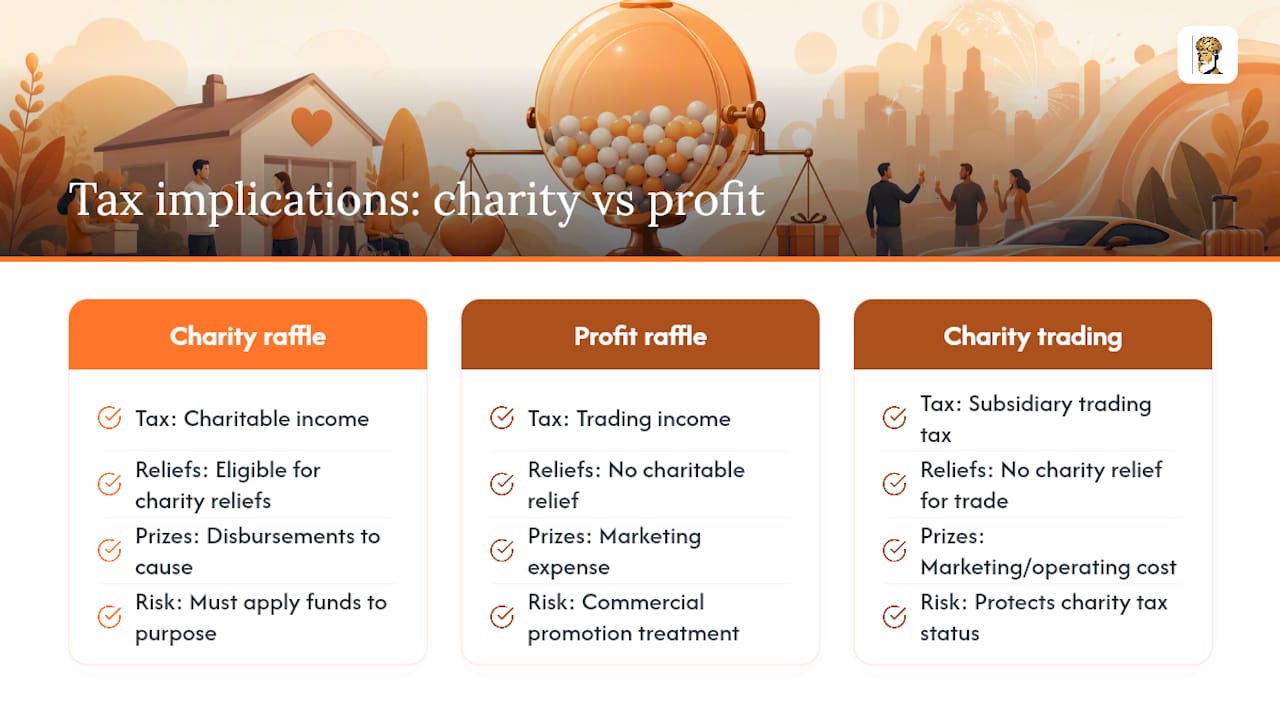
Commercial raffle or prize competition operators sit in a different position entirely. Revenue from ticket sales in a genuine profit-making promotion is trading income, taxed as normal business profit, with no charitable relief attached. Prizes given away as part of a free draw are typically a marketing cost to the business rather than a charitable disbursement.
There’s a middle category worth flagging: profit-making raffle ideas run by a charity’s trading subsidiary, rather than the charity itself, follow the tax rules for that subsidiary’s trading activity, not the charity’s own reliefs. This structure is common where a charity wants to run a higher-value commercial promotion without risking its charitable tax status on activity that looks more like trading than fundraising.
Getting this wrong has real consequences. HMRC and the Gambling Commission both take an interest when a “charity raffle” label is used to dress up what is, in substance, a commercial promotion benefiting private individuals rather than the stated cause. If you’re unsure which category your event falls into, that’s a conversation for an accountant familiar with charity finance, not a guess based on what a similar-looking raffle did last year.
Common pitfalls and compliance risks unique to profit raffles
Profit-making raffles carry a specific set of risks that charity lotteries mostly avoid, precisely because they operate without the registration and reporting structure charities are used to.
The biggest trap is misclassification: running what is functionally a lottery while calling it a “prize competition” without a genuine skill element or a workable free-entry route. Trading Standards and the Gambling Commission both treat this as operating an unlicensed lottery, which carries criminal liability, not just a fine.
A second pitfall is opacity around odds and prize allocation. Commercial operators aren’t required to publish the same level of transparency a registered society lottery must, which means ticket buyers often have no reliable way to check how many tickets have sold or how good their actual odds are. This is exactly the gap that has pushed some players towards independent tracking tools rather than trusting a promotion’s own marketing claims.

A third risk sits in advertising claims themselves. Overstating prize values, understating the odds, or implying a charitable benefit that doesn’t exist all breach Advertising Standards Authority rules, separately from any Gambling Commission issue. Profit raffles that blur “for a good cause” messaging without an actual registered charity behind them attract complaints fast, and regulators have shown they follow up on them.
Benefits and drawbacks from the organizer’s perspective for both charity and profit raffles
Charity raffles offer a real advantage: supporter trust. Because society lotteries operate under registration or licence, backed by published T&Cs and accounting obligations, donors tend to give more readily than to an unregulated promotion. The drawback is administrative weight. Registration, recordkeeping, and reporting take time and expertise that a small volunteer-run society may not have in-house, which is exactly why many turn to an External Lottery Manager despite the added cost.
Profit raffles offer speed and flexibility that charity lotteries can’t match. A commercial operator can launch a prize competition in days rather than weeks, since there’s no registration wait, and can adjust prizes or pricing on the fly. The drawback is the trust deficit: without a registered charitable purpose or Gambling Commission oversight, commercial promotions have to work harder to convince buyers the odds are fair and the prize genuinely exists, and one high-profile complaint can damage a brand’s promotion for good.
Neither model is inherently better. It depends on what you’re trying to achieve, how much administrative capacity you have, and how much of your income relies on repeat, trusting supporters versus one-off, price-sensitive entrants.
Specific restrictions on advertising and promotion differences between charity and profit raffles
Charity raffles face restrictions tied directly to their registered or licensed status. Advertising must not mislead supporters about how proceeds are used, must accurately reflect the registered purpose, and, for larger licensed lotteries, must include specific information such as the promoter’s identity and how to obtain a refund. Gambling Commission rules also require that any advertising aimed at under-18s be avoided entirely, mirroring the age restriction on entry itself.
Profit raffles and prize competitions face a different pressure point: Advertising Standards Authority rules on prize accuracy and free-entry prominence. If a promotion advertises a free-entry route, that route must be given equal visibility to the paid route in the same advert, not tucked away in a footnote. Overstating the value of a prize, or implying odds better than what’s actually on offer, breaches advertising codes regardless of whether the promotion counts as a lottery under gambling law.
Both categories share one obligation regardless of structure: age-restricted advertising. Whether it’s a society lottery or a commercial prize draw, promotions with a payment element must not target audiences under 18, and platforms hosting these adverts carry their own compliance responsibility for where and how they place them.
Publisher perspective: when a society lottery earns its complexity
A society lottery earns its administrative overhead when you’re building sustained, repeat income, not chasing a single event. For a one-off campaign, a prize draw is often the pragmatic choice. What matters most to us at Rafflegenius, watching this market closely, is that clear odds and fee disclosure consistently correlate with supporter trust. Tracking how operators actually perform over time, rather than taking a single promotion’s claims at face value, is the simplest way for organisers and players alike to spot an undersold competition before it closes.
— matt
How Raffle Genius can help
If you’re comparing operators before listing a raffle, or you’re a supporter trying to work out whether a promotion’s odds stack up, Rafflegenius gives you a live view most single-operator sites won’t. Rafflegenius tracks live odds, ticket prices, and closing times across UK raffles and prize competitions, refreshing every ten minutes, so you’re not relying on a static “odds explained” page that hasn’t been updated since launch.
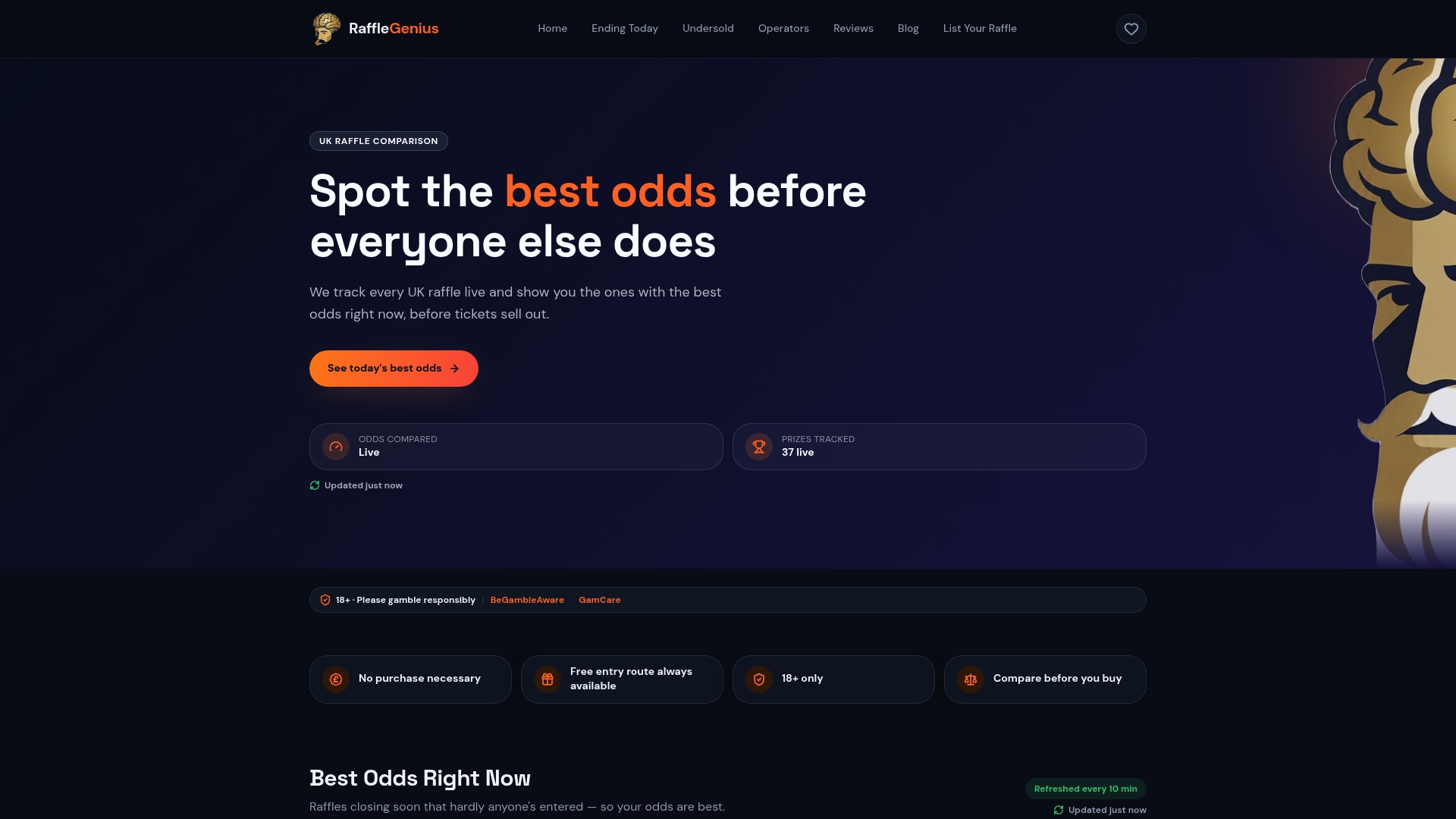
For organisers researching the market before choosing a route, checking operators we track gives a sense of how transparent a given promotion is compared with others in the same category, including where competitions look genuinely undersold relative to prize value. Whether you’re weighing up a society lottery against a commercial prize draw, or simply want to enter with better information than most players have, start by browsing what’s currently listed on Rafflegenius and see how the odds compare before you commit.
Sources
- Fundraising, raffles and lotteries — Gambling Commission
- Legislation
- Prize competitions and free draws — Trafford Council guidance
Recommended
18+ · Please gamble responsibly. Raffle Genius is a comparison service and does not run competitions.
Best odds, straight to your inbox
One email a week with the undersold UK competitions closing soon. No spam, unsubscribe any time. 18+