
4 October 2026

Spot bot entries in UK raffles with 10 minute live odds
Choose raffles that offer the best chance per pound: compare odds per £1, ticket price and prize value, and check the operator’s terms before you buy. Favour draws that publish tickets remaining or a maximum ticket cap, since these figures let you calculate a genuine chance of winning. Always check the terms and conditions for a free-entry route and any significant conditions before you part with money.
TL;DR:
- Raffles with capped tickets and published remaining ticket counts offer better odds per pound than uncapped draws, especially when sales are lagging.
- Always verify that the free-entry route is as convenient and affordable as paid options, and check for clear, significant conditions like minimum ticket thresholds.
- Calculating the odds per £1 spent provides a quick comparison, and draws with lower ticket sales relative to their cap tend to be more favorable.
- Automated bot entries can artificially inflate ticket sales and dilute genuine chances, with detection relying on speed, IP, and purchase patterns.
- Using live comparison tools helps identify the best-value draws but cannot guarantee fairness or that an operator will honor its terms.
Table of Contents
- How to compare live odds quickly
- What to check in terms and conditions and why those items matter
- How to calculate value: worked examples of expected value and cost-per-chance
- How a live tracker like Raffle Genius helps in practice
- Definition and detection of bot entries in raffles
- Common methods and motivations behind bot entries
- Impact of bot entries on legitimate participants
- Legal and ethical considerations surrounding bot entries
- Strategies and technologies used to prevent or mitigate bot entries
- Why evidence-based tracking beats impulse entry from ads
- Try Raffle Genius: live odds without the guesswork
- FAQ
- Sources
How to compare live odds quickly
The fastest way to sort raffle entries is to convert everything into a single figure: odds per £1 spent. A ticket that costs £5 with 1 in 2,000 odds offers a weaker chance per pound than a £2 ticket with 1 in 1,500 odds, even though the first looks more generous on paper. Dividing the odds by the ticket price gives you a number you can line up across operators in seconds.
Four data points matter most when you are scanning a listing page:
- Tickets sold and tickets remaining: these tell you how close a draw is to its cap and how much the odds might shift before close.
- Maximum ticket number: a published cap means the odds cannot get worse than stated, whereas an uncapped draw can dilute your chance as more tickets sell.
- Previous-draw data: operators who publish past results and winner numbers give you a way to check that draws actually close and pay out.
- Instant-win or multi-prize mechanics: these change your effective odds, since a single ticket might qualify for several smaller prizes alongside the headline one.
A listing page worth your time will show tickets sold, a clear closing date and a visible free-entry link without you needing to dig through several pages to find them. Draws that hide this information, or bury it below a long scroll of marketing copy, are usually the ones worth skipping. Our undersold competitions page groups draws where ticket sales lag behind the cap, which tends to produce the sharpest odds per pound.
Pro Tip: When two draws look similar on price, the one with fewer tickets sold relative to its cap is almost always the better bet.
What to check in terms and conditions and why those items matter
Odds and price get you most of the way to a decision, but the terms and conditions decide whether that decision is a fair one. A handful of items recur across operators and are worth checking every time:
- Free-entry route: by Gambling Commission guidance, a prize competition keeps its exemption from gambling licensing only when the free route is no more expensive and no less convenient than paying to enter. A free-entry link buried behind a postal-only process, for instance, falls short of that standard.
- Significant conditions: the ASA warns that high-value prize promotions often omit significant conditions such as minimum ticket thresholds, cash alternatives, or whether the main prize will be awarded regardless of how many tickets sell. These details must be stated clearly, not tucked into a footnote.
- Winner selection mechanism: look for a description of how the draw is conducted and whether it relies on an independently verifiable random process rather than a vague promise to “pick a winner”.
- Timing and delivery: check when winners are notified and when the prize is actually supplied, since delays here are a common source of complaints.
The pages we link under trusted operators flag which of these items each operator discloses clearly, which saves you reading every set of terms in full.
How to calculate value: worked examples of expected value and cost-per-chance
Expected value, or EV, is simply the prize value multiplied by your chance of winning, compared against what you paid. A positive EV does not guarantee a win, but it tells you which entry gives you more for your money on average.
Say Draw A cost £2 a ticket, has 5,000 tickets and a prize worth £8,000. Say Draw B costs £5 a ticket, has 3,000 tickets and a prize worth £12,000.
- Draw A: chance per ticket is 1 in 5,000, so EV = £8,000 ÷ 5,000 = £1.60 against a £2 stake.
- Draw B: chance per ticket is 1 in 3,000, so EV = £12,000 ÷ 3,000 = £4.00 against a £5 stake.
- Expressed as a ratio of EV to stake, Draw A returns 80% of its ticket price and Draw B returns 80% too, so on this measure they are evenly matched once you adjust for price.
Research from GOV.UK found that, across a sample of operators, prize values typically equate to roughly 47–49% of total ticket sales, which gives you a rough benchmark for what a reasonably generous draw looks like. A draw sitting well below that range is returning less value per ticket than the sector average.
When the final ticket total is not yet known, use the maximum cap as your assumption rather than current sales, since that is the worst-case number and keeps your EV estimate conservative. Bear in mind that EV cannot capture everything: it ignores the enjoyment of playing, any premium you place on a collectable prize, and the extra value of instant-win mechanics layered on top of the main draw.

How a live tracker like Raffle Genius helps in practice
Working through odds, terms and EV by hand for every draw you are considering takes time, which is the gap a live comparison tool is built to close. Our platform tracks live odds, ticket price, prize value and operator notes across the UK raffle market, refreshing the figures every 10 minutes so the numbers you see reflect current ticket sales rather than a snapshot from days ago.
A practical way to use it:
- Set filters for the prize category you want, whether that is cars, cash, tech or something else.
- Sort the results by odds-per-£ to surface the sharpest value first.
- Open the listing and check the terms and conditions items covered above before you click through.
- Enter only once you have confirmed the free-entry route and significant conditions are clearly stated.
Frequent updates matter most for undersold draws, where odds can shift noticeably within a single day as tickets sell. A tracker can show you where the numbers stand right now, but it cannot guarantee a draw closes fairly or that an operator honours its terms, so the checks in the earlier sections remain yours to make.
Pro Tip: Bookmark a shortlist of three or four draws with strong odds-per-£ rather than chasing a single “best” one, since odds shift as tickets sell.
Definition and detection of bot entries in raffles
A bot entry is a ticket purchase or form submission generated by automated software rather than a genuine individual, typically designed to buy multiple entries faster than a person could type them manually. In raffles and prize competitions, this usually shows up as scripted account creation, automated form-filling, or repeated rapid purchases from the same payment method or device fingerprint within a short window.
Operators detect this activity through a mix of technical and behavioural signals: unusually fast entry speeds that no human typing could match, repeated entries from the same IP address or device, failed CAPTCHA challenges, and purchase patterns that cluster around the exact moment a draw opens. Some platforms also flag accounts with no browsing history before purchase, since a genuine entrant typically views the prize page before buying a ticket.
Detection is rarely perfect. A household sharing one internet connection, or a person using a shared work device, can occasionally trigger the same flags as a bot, which is why most operators combine several signals rather than relying on a single trigger. For a player comparing draws, the practical takeaway is that a listing showing a sudden, unexplained spike in tickets sold is worth treating with a little more caution than one with a steady, organic sales pattern.
Common methods and motivations behind bot entries
The motivation behind most bot activity in raffles is straightforward: improving the odds of winning by buying far more tickets than a manual process would allow, often across multiple accounts to spread the activity and avoid single-account limits. Some operators have also reported scripts built specifically to target high-value, low-ticket-count draws in the moments after they launch, when the odds per ticket are at their best.
Common methods include automated scripts that fill in entry forms faster than a person can type, tools that rotate between multiple email addresses or payment details to bypass per-account entry limits, and browser automation that refreshes a page repeatedly to catch a draw the instant it opens. A smaller category of activity involves reselling bulk-purchased tickets, where the motivation is profit from resale rather than winning the prize directly.
None of this is specific to raffles. The same automation techniques turn up wherever a limited-availability purchase creates an incentive to buy faster or in greater volume than a normal customer would, from concert tickets to limited product drops. Raffles are simply one more market where a favourable odds-to-price ratio makes the effort worthwhile for whoever is running the script.
Impact of bot entries on legitimate participants
For a genuine entrant, the practical effect of bot activity is a worse chance of winning than the advertised odds suggest. If a draw caps at 10,000 tickets and a portion of those are bought by scripts rather than individuals, every honest entrant’s real chance of winning is diluted compared with what they assumed when they bought their ticket.
There is also a trust cost. A draw that sells out unusually quickly, or shows a sudden jump in tickets sold immediately after launch, can discourage legitimate players from entering future draws by the same operator, even when the operator itself is not at fault. Over time, this erodes confidence in the wider market, which is part of why transparency around ticket sales and draw mechanics matters so much to operator credibility.
The Gambling Commission has also flagged concern around illegal, individual-led lotteries and raffles circulating on social media, which sit entirely outside licensed oversight and carry a different, harder-to-quantify risk for anyone who enters them. Sticking to operators who publish clear ticket data and verifiable draw processes is the most reliable way to limit exposure to both automated entry abuse and outright illegitimate draws.
Legal and ethical considerations surrounding bot entries
Using automated software to buy raffle tickets sits in a legal grey area that depends heavily on the operator’s own terms of service. Most operators explicitly prohibit automated entry in their terms and conditions, which means a bot-driven entry can be disqualified or voided even if no law is broken, since the breach is of a private contract rather than a statute.
Separately, operators that fail to manage this activity properly risk falling foul of broader consumer protection expectations. The voluntary code of good practice for prize-draw operators encourages operators to provide clear information on draw mechanisms and, where possible, maximum ticket numbers or prior draw data, so entrants can judge their genuine likelihood of winning. A draw that allows unchecked bot activity undermines exactly the kind of transparency this guidance is meant to protect.
The ethical issue is simpler than the legal one: bot entries take a disproportionate share of a limited pool of chances away from people who entered manually and in good faith. Whatever the legal position in a given operator’s terms, this is the core reason the practice draws criticism from players and regulators alike.
Strategies and technologies used to prevent or mitigate bot entries
Operators use a layered approach to keep automated entries out of their draws, since no single method catches everything. CAPTCHA and similar human-verification steps remain the most common first line of defence, designed to slow down or block scripted form submissions. Rate limiting, which caps how many entries a single IP address or account can submit within a given period, is another standard tool.
Behavioural analysis adds a further layer: monitoring for entry speeds, mouse movement patterns, or purchase timings that are implausible for a human user. Account verification steps, such as confirming an email address or payment method before an entry counts, raise the cost of running multiple accounts and discourage casual bot use. Some operators also set a hard per-person ticket limit on individual draws, which blunts the advantage even a successful bot run would offer.

None of these measures is foolproof, and the strongest operators tend to combine several of them rather than relying on one. From a player’s perspective, the presence of these checks at the point of entry, alongside clear published ticket data, is a reasonable proxy for an operator that takes fairness seriously. Our guide to assessing raffle legitimacy covers the practical signals worth checking before you buy.
Why evidence-based tracking beats impulse entry from ads
The raffle adverts that catch your eye on social media rarely show you the full picture. A striking prize image draws attention, while the significant conditions, the minimum ticket threshold or the cash-alternative clause, sit several taps away in text nobody is encouraged to read.
Comparing odds, price and terms before you buy takes a few minutes, and that habit consistently beats clicking through on whichever advert looks most tempting that day. It will not turn a bad draw into a good one, but it reliably steers you away from the worst value and towards the entries that are worth your money.
My honest view is that the players who do best over time are not the ones chasing the flashiest prize, but the ones who check the published mechanics and the free-entry route before every single purchase.
— matt
Try Raffle Genius: live odds without the guesswork
A live odds comparison platform tracks live odds, ticket prices and prize values across the UK raffle market with frequent updates, so you can know which draws currently offer the sharpest chance per pound. Listings on the comparison platform include operators that appear to meet transparency signals, which helps users get a shortlist of the best-value draws without reading dozens of terms and conditions pages themselves.
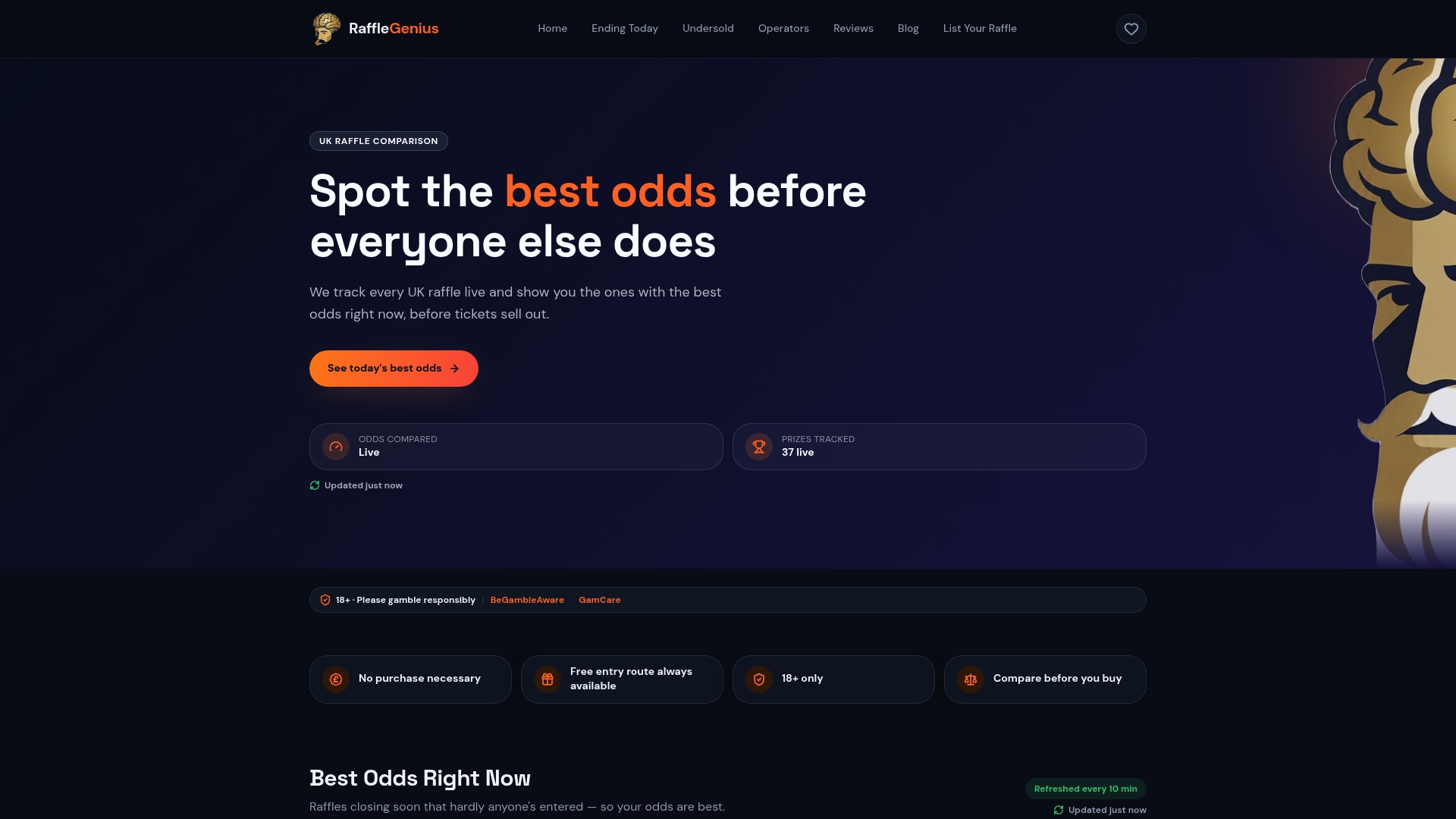
- Browse our live odds comparison to see current best-value draws across cars, cash, tech and more.
- Go ad-free for £4 per month if you would rather compare odds without distraction.
- If you run a raffle or prize competition, see our listing page for how to get featured.
Start with our live comparison page, filter for the prize category you care about, and sort by odds-per-£ to see where your money goes furthest today.
FAQ
What counts as a bot entry in an online raffle?
A bot entry is a ticket purchase generated by automated software rather than a person, usually aimed at buying far more tickets than manual entry would allow. Operators detect this through signals like unusually fast entry speeds, repeated purchases from one device or IP address, and failed verification checks.
Are bot entries illegal in UK raffles?
Running automated software against a raffle usually breaches the operator’s own terms of service rather than breaking a specific law, so the main consequence is disqualification or a voided entry. Legitimate operators who follow the voluntary code of good practice for prize-draw operators are expected to give entrants a fair, bot-free chance of winning.
How do I calculate my real odds of winning a raffle?
Divide the number of tickets you hold by the maximum number of tickets the draw can sell, using the published cap rather than current sales if the draw has not closed. Comparing this figure against ticket price across several draws, expressed as odds per £1, is the quickest way to judge which entry offers better value.
What should I check before entering a high-value prize raffle?
Check that the free-entry route is no more expensive or less convenient than paying, as required by Gambling Commission guidance, and look for any significant conditions such as minimum ticket thresholds or cash alternatives. The ASA’s guidance on high-value prize promotions confirms these conditions must be stated clearly before you buy.
Does Raffle Genius guarantee I will win a raffle?
No tracker can guarantee a win, since the outcome of any raffle depends on chance. Our comparison tool shows you live odds, ticket prices and prize values updated every 10 minutes, so you can choose the better-value entry, but the draw itself remains down to luck.
Sources
Recommended
18+ · Please gamble responsibly. Raffle Genius is a comparison service and does not run competitions.
Best odds, straight to your inbox
One email a week with the undersold UK competitions closing soon. No spam, unsubscribe any time. 18+